
Why write bad Latin?
Anyone who is capable of reading the Latin on this blog will be able to make the same observation of its quality: it is not very good Latin. Apart from a few outright errors, the Latinitas is so low, that reading it is largely a waste of time for those learning Latin. Readers will therefore be relieved to hear that I am not writing in Latin for the sake of producing material for Latin students to read.
Instead, the purpose of the previous Latin post, as with the similar short journal entries I have been writing privately for a couple of weeks, is to have a way of roughly assessing how the attempted revival of my Latin skills is going. Since taking advantage of the most recent Legentibus Black Friday deal, I’ve read slightly less than 70,000 words of Latin on the app. This is obviously not an enormous amount of Latin, in the scale of language learning. For me, however, that number is an enormous success–I don’t think I’ve read that much Latin in a similar time frame since undergrad. This has been just barely enough material for me to notice, one day in January, that I really had become a little more comfortable reading Latin.
That’s one of the hard things about language learning: nothing lasting happens fast. The real progress–the kind that doesn’t evaporate after a week or two off–can’t be tracked very well over the short term. I like the ways that the Legentibus setup reminds me of how much I’ve read, and of how far I’ve come. That’s been somewhat useful as motivation. I refuse, however, to set up any goals or track any kind of streak in the app. That sort of thing tends to depress me, by shoving my inevitable failure in my face. It’s also fairly artificial. I would much rather track the actual fact of my learning, than whether or not I showed up to learn precisely when I promised a computer program that I would.
Unfortunately, assessing language learning is really pretty tricky. I’ve been persuaded by the notion that assessing meaningful production is the least worthless way of trying to keep track of language learning. My rule of thumb with communicative SLA strategies is always, would I do this activity in English? And in the case of my silly little notes about Legentibus, the answer is actually yes. The PhD did finally teach me the value of reading notes. I wouldn’t mind at all being able to look back on a record of what I read, when I read it, and what I thought about it. If I can write that record in Latin–even if the Latin itself is pretty poor–then that is not a meaningless activity to perform in the language. And I’d like to think that progress in acquiring Latin may be a little less nebulous in the act of writing than it is in reading.
Involving some kind of production in my Latin revival may also be useful in acquisition. I don’t really understand the technical usage of the word ‘noticing’ among SLA researchers (who don’t all seem to agree that the phenomenon described is particularly real or important in acquisition, for what that’s worth). It does seem to be the case, however, that the act of writing forces me to ask questions about communicating in Latin that reading often doesn’t. It also forces me to review sentence constructions that I haven’t seen in a while, since the grammar remains pretty sheltered (almost no use of the subjunctive, for example) in the easy material on Legentibus.
But why post bad Latin?
Why not bury it in a dark cave, where it belongs? Why publish it?
I’ve been astonished to see just how many Zoomers' resilience in handling assignments is just as bad or even worse than my own was. The number of them who just don’t seem psychologically equipped to handle the stresses thereof appears to be enormous. Today is not the day to get into the strengths or weaknesses in The Anxious Generation-style descriptions of the phenomenon. Today, I simply acknowledge what all language teachers know: that the kids these days–bless them–have quite a high chance of going into a mental tailspin or simply cheating their way through assessments (thanks so much for your help with the latter, ChatGPT). Not all of the causes for that are under our control, but some of the solutions may be. We need to be thinking very seriously about both the purpose and practice of our assessments. The costs of pointless or ill-conceived attempts at evaluating acquisition are simply too high to ignore.
I admit that the other side of this knife is that I am atrocious at keeping up with students' busywork. I’m also pretty bad at keeping up with the important stuff. It’s vital for me to know the difference between the two. If I can be sure that I’m giving feedback to students in a way that really helps them, it’ll be easier for me to get it done. If I know that I’m only grading their tests because The Man expects me to grade their tests…I’d rather find a better way to spend my finite time and rather deficient attention.
It’s possible that the particular comments I have to make about the available readings on Legentibus (or on LLPSI) may be of interest to Latin teachers or learners. But even if those comments are basically somewhat insipid, I still think it’s interesting to put the theory of ‘routine, meaningful production is the least-worst way to evaluate language acquisition’ to a public test. This sort of little pedagogical experiment is (obviously) the sort of thing that interests me, but it seemed possible that it might interest other teachers who are trying to figure out how to make assessments more useful and more meaningful for their students. Maybe I’m not the only one who’s curious to see what my writing will look like after the next 70,000 words on Legentibus.
Furthermore, although I am not possessed of a particularly strong desire to teach Latin again, it’s entirely possible that I will find myself doing so. Should such an opportunity arise, I would much prefer to do the job with large quantities of spoken Latin. It’s a little embarrassing to be putting large quantities of bad Latin onto the internet, but I’m sure it will come in handy if I ever find myself with the need to speak the language.
And as a casual perusal of this site will reveal, I’m also taking the opportunity to dump poor Ancient Greek reading notes on the internet–although we sadly have no τοῖς ἀναγιγνώσκουσιν equivalent. The Ancient Greek notes are for a similar purpose, except that I care much more about developing a decent Greek style someday than a Latin one: I have (you’ll be shocked to learn) strong feelings about the dearth of AG reading material that’s accessible to real beginners, and one of my hobbies is trying to amend that lack. If you spot something offensive in either my Latin or (especially) my Greek, there’s no need to be shy about pointing it out.
Legentibus Beginner Course, level 8
Diē Veneris quattuor fābulās Latīne in Legentibus applicātiōne lēgī. Prīma fābula erat ‘Eques et Magus’, ē Gesta Rōmānōrum apta ā Daniel Pettersson. Horrifer erat fābula atque mē tenuit. Repetitiō vocābulōrum in illā fābulā auxiliō erat discipulīs. In fābulā ‘dē culmō, carbōne, phaseolō’ autem plūra novōrum mihi vocābulōrum ūsa sunt. Nōn molesta erant dē Colloquium Persōnārum ‘Colloquium Vīcēsimum Tertium’ atque ‘Capitulum Vīcēsimum Quārtum - Puer Aegrōtus’ dē LLPSI. Molestum vērō erat post ‘Puer Aegrōtus’ Pēnsum A. Tabulam verbōrum scrībere nihil iūcunditātis neque multum ūsūs habet.
It’s as expected that Alpha schools have simply invented a new way to fail students, but I still find it interesting to see precisely how Alpha schools are failing to teach: www.404media.co/students-…
Learned today that GE Lessing (modern discoverer of Archimedes' Cattle Problem) serendipitously relates to underlying questions about faith, proof, and miracles in my thesis. On the one hand, great! more to read! OTOH, oh dear, more to read….
ἀνεγνώσθη...
σήμερον ἀνέγνων τοῦ ΛΟΓΟΥ τὸ ὄγδοον κεφάλαιον, τοῦτʼ ἐστιν «ἡ Εὐρώπη». «ἡ Εὐρώπη» ἐστὶ χρήσιμον «πινακικεφάλαιον», ὡς ὁ Πατρολογιστὴς λέγει, ἀλλὰ ὀλίγα ἐν τῷ κεφαλαίῳ δυσχερῆ εἰσι τοῖς ἀναγιγνώσκουσι τοῖς οὐκ Ἰβηρικοῖς. οἱ μαηθταὶ οἱ Ἰβηρικοὶ δηλονότι ἀναγνωρίζουσι τὴν Ἔβυσον, ἔγωγε μέντοι τοῦτο τὸ ὄνομα εἶδον οὐδέποτε πάντων τῶν ἐμῶν ἔτων τοῦ Ἑλληνιστὶ ἀναγιγνώσκεῖν. ἡ δὲ νῆσος «Ἄνδρος» καὶ οὐκ ἀνἐνγώρισα, ἀλλὰ ἡ μὲν Ἄνδρος ἐν τῷ πίνακι τῷ τοῦ ἐπιγιγνομένου κεφαλαίου φαίνεται, ἡ δὲ Ἔβυσος οὐ φαίνεται ἐν οὐδενὶ πίνακι τοῦ οὐδενὸς κεφαλαίου, ὡς ἐμοὶ φαίνεται. πολλὰ δὲ τῶν Ἑλληνικῶν ὀνομάτων καὶ Ῥωμαϊκῇ γράφονται, ταῦτʼ εἰσιν, Rhēnus, Dānuvius, Tiber, Rōma, Pompeiī, καὶ Herculaneum. ἀλλὰ τὸ «Ibiza» ἢ ὅμοιόν τι ὄνομα Ῥωμαϊκῇ οὐ φαίνεται. οὗτοι δὲ οὖν οἱ πίνακες οὐ χρησιμώτατοι πλὴν τῶν ἀναγιγνόντων Ἰβηρικῶν.
σήμερον καὶ ἀνέγνων τὴν τοῦ Παύλου ἐπιστολὴν πρὸς Φιλήμονα. πλείονα ἔχω λέξαι περὶ ταύτης τῆς ἐπιστολῆς ἢ περὶ τοῦ ὀγδόου κεφαλαίου τοῦ ΛΟΓΟΥ, πολλά περὶ τὴν κοινωνίᾱν καὶ τὸν οἶκον τὸν τοῦ θεοῦ, ἀλλὰ ταῦτα κατέχω ἕως δυνήσομαι ἀμεινόνως κοινωνῆσαι τὰς γνώμᾱς μου Ἑλληνιστί.
χαίρετε, ὦ πάντες! So excited to finally have my own website. Can’t wait to start contributing to the wild world of microblogging book reviews in Latin and Ancient Greek!
Captain Elliott, of Persuasion
I have begun listening to Persuasion, the way that you might tear into whole-grain bread as soon as it has left the oven. A warm slice of bread is never quite going to count as health food, but it is not so very bad for you, either--and it is awfully nice. Re-reading Jane Austen is really not at all what I am meant to be doing with my life, but life at Upper Cross has proved comforting so far.
I wonder how much my impression of Anne Elliott this time around has been shaped by the current theme in my reading. I spent most of the journey back from the States re-reading parts of the Temeraire series by Naomi Novik. Last week I listened to sufficient samples of Patrick Tull and Simon Vance to put in a request for the latter's recording of Master and Commander (though I respect the conventional opinion that Tull's accents are more lively and more authentic). So captaincy and ships were very much at the back of my mind as I listened to Anne's management of Musgroves of all ages and stages. And indeed, there is a very particular kind of leadership in the way Anne handles the crew at Upper Cross. The bloody discipline of the Navy--very much present in what I recall of C.S. Forester's books, presumably a feature of O'Brian's which my imperfect memory of them has elided, and implicitly queried by Novik's characters--is of course an impossibility in Jane Austen's countryside. But the domestic version of good Naval order, or its absence, is near the fore of Austen's descriptions of a household's residents and their characters. And when other parties are slack, it is Anne who is relied upon: to smooth tempers, to stop her nieces and nephews from running wild, to hint at the correct or sensible action for her sister to take, to play umpire or diplomat between her sister and brother-in-law.
At least, Anne keeps the household shipshape when she is allowed to. She has little effect at Kellynch Hall, where her father and sister Elizabeth use her without even appreciating her good sense, as the Musgroves do. Here perhaps is a contrast with the captains of His Majesty's Navy and His Majesty's (fictitious) Aerial Corps: the captain of a household, who in Austen's world is a woman, gains her authority from diplomacy rather than orders. Where Anne is respected, however imperfectly, she uses her powers to keep things shipshape; where she is ignored, she is reduced to playing Cassandra. Does Captain Wentworth know anything like the struggles of a domestic captain? Does he understand the parallel between his role and Anne's? There has been no hint of it by Chapter Ten--and I suspect that the comparison may never really come into focus. But I am finding the contrast between the management of a ship and a household, however eisegetical, an interesting theme in this particular voyage through Persuasion.
Book Review: Dava Sobel's Galileo's Daughter
The title is misleading: this is not a review of Galileo’s Daughter. More precisely, it is a review of Alan Lightman’s review of Galileo’s Daughter. I have written up some thoughts about Lightman’s review in order to fulfill the remaining requirement for the Reader badge, as outlined in Volume One of the Rebel Badge Book. This is the first badge I’ve completed–may there be many more! And may one of them be the Writer badge, when I–Deo volente–finish the rough draft of my PhD dissertation this summer.
Alan Lightman’s review of Galileo’s Daughter is in some ways excellent. He eloquently summarizes the historical highlights of Galileo’s life, capturing the personality of the scientist well. That said, I worry he has missed the heart of the book. Lightman writes,
'The daughter's letters reveal little about the father's thoughts, yet they add texture to his world. Where we learn much more about the scientist is in the letters he wrote and received from friends, students, churchmen and other scientists.... Although ''Galileo's Daughter'' focuses on the daughter, its real center of gravity rests with the father and the gripping battle that enveloped him.'
With this appraisal, which comes in the first third of a review that stretches to nearly fifteen hundred words, Lightman dismisses what makes Galileo’s Daughter stand out from the many biographies of Galileo that already exist.
I do not think that I read Maria Celeste’s letters as texture–or if I did, perhaps I have a higher opinion of texture than Lightman does. The emphasis on Maria Celeste is interesting firstly because, at least in my opinion, Sobel does such a remarkable job of drawing out the character of the nun. In the letters, as in Sobel’s commentary on them, we see generosity and concern for others as a driving motivation for the young woman. In the details which Lightman calls ‘texture’, we see sacrifice, asceticism, piety, suffering, and the struggle of daily life. Maria Celeste’s life was difficult. I think one of the few weaknesses of the book was Sobel’s implicit lack of sympathy for Maria Celeste’s sister, Suor Arcangela. Reading between the lines, the chronically ill Arcangela was not cut out for the challenge of life under the Rule of St Clare–a challenge which was imposed upon her, rather than chosen. Did Arcangela resent the father who had hidden her away in a world of hunger, exhaustion, and illness? Sobel never asks. I could not help but reflect, though, that Arcangela might have had some justification for not desiring emotional closeness with the father who consigned her to a life of privation.
In light of Suor Arcangela’s notable silence towards her father, then, the fact that Maria Celeste was able to care so deeply for him is all the more remarkable. She seems to have brought out the best in Galileo the man, in addition to adoring Galileo the legend. Sobel’s note at one point that Maria Celeste bid fair to become the convent’s abbess is a melancholy one. What the ‘texture’ of her letters reveals is that in Maria Celeste the convent, as well as the father, lost someone of great importance too soon.
And it is the religious aspect that I think is secondarily so important about this biography, as opposed to others. In Maria Celeste’s letters we see authentic, persistent, and generous piety. The excerpted correspondence with churchmen, which Lightman suggests is more illuminating, is one which might well lead the reader to anger and frustration with the Roman Catholic Church. At least, it certainly did so for me. The texture of the letters exchanged with cardinals and ambassadors and popes is a texture of power and of nepotism. Between the cardinals and the Medici there is little to choose. Titles and estates are inherited or fought for, in the church just as in secular matters. What Sobel highlights more clearly, through her use of primary sources, than do many write-ups of Galileo, is the extent to which the scientist’s problems with the church were about the authority to interpret Scripture. The problem with the Copernican view was not that it contradicted Scripture per se but that it contradicted the official interpretation of Scripture. And as reading about this conflict reignited old anger in me, it was restorative to have so much ‘texture’ as counterpoint. Because if the Italian church of Galileo’s time had not had its Poor Clares along with its Barberinis, I would have wanted to see it burned to the ground, just as the Protestants did.
In Lightman’s view, then, it seems that reading the book without Maria Celeste’s letters would largely deprive the reader of local flavor. I think however that it is her love, her generosity, and her piety–echoed in Galileo’s affection for her and patronage of the convent–which redeems the story. The view of the Roman Catholic church would otherwise be too brutal, too arrogant, and too frustrating to deal with. As it is, Suor Maria Celeste helps me to understand why, even at the end of his life, Galileo would have been able to remain committed to the church of Rome.
Μοῖρα: The Session(s) Zero
Finally, here's the introduction to the Fate Core rules, lightly adapted and containing some beginner-friendly Ancient Greek!
The philosophy of the game emphasizes collaboration between players and the game master (GM), so even in English it's standard to start with a session zero. In this session zero, the players and GM discuss the setting for the game, what sort of thematic issues they're interested in playing out, who their characters are, and how their characters are connected to one another (which is sometimes called the Phase Trio). I can't imagine getting through half of that in a single 50-minute class period, so I've divided the session zero into a few fundamental questions.
First, what sort of story do we want to play (ποῖον μῦθον βούλεσθε)?
After introducing the new vocabulary through picture or movie talks, I would pose the following questions in Greek, supported by lots and lots of illustrating slides:
ποῖα πρόσωπα βούλεσθε; (what sort of characters do you want?)
- ἆρα πάντα τὰ πρόσωπα ἄνθρωποι (ἢ ἡμίθεοι, κένταυροι, νύμφαι, καὶ τὰ λοιπά…) (are they all human, or demigods, centaurs, nymphs, etc?)
- ἆρα τὰ πρόσωπα κρείσσονα τῶν ἀνθρώπων; (are the characters stronger than human beings?)
- ἆρα τὰ πρόσωπα Ἑλληνικὰ ἢ ξενικά; (are the characters Greek or foreigners?)
- ἆρα τὰ πρόσωπα βασιλεῖς ἢ δοῦλοι; (are the characters kings or slaves?)
ποίους θεοὺς βούλεσθε; (what sort of gods do you want?)
- ἆρα οἱ θεοί εἰσιν ἀληθεῖς; (are the gods real [in the story]?)
- ἆρα οἱ θεοί εἰσιν ἐγγὺς τῶν ἀνθρώπων, ἢ πόρρω; (are the gods near or far from human beings?)
- ἆρα οἱ θεοί εἰσιν Ἑλληνικοὶ ἢ ξενικοί; (are the gods Greek or foreign?)
My only rule for the setting is that it has to be one in which it makes sense for their characters to be speaking ancient Greek. If students want to play as demigod heroes inspired by Homer (or Rick Riordan), that's fine. If they want to play as non-superpowered mythical heroes--also fine. They could be native to mainland Greece, or they can be foreigners who've learned Greek. I presented the idea of social class in its extremes--kings or slaves--mainly to get students thinking and talking about what kind of lives they are interested in playing out.
I'd try and use a lot of Greek during this conversation, but I really do need to know what their expectations/interests are regarding the supernatural in the story. I would not expect students to respond (or indeed, discuss amongst themselves) in Greek.
New vocabulary based on my list, as it stands:
-
βούλομαι [Herm.]
-
ποῖος [Moira/TPR]
-
ὁ μῦθος [Kat.]
-
τὸ πρόσωπον [LGPSI 3]
-
κρείσσων [Moira]
-
βασιλεύς [Herm.]
-
ξενικός [Moira]
-
θεός [Herm., Kat.]
-
ἀληθής [LGPSI 5, Kat.]
-
ἐγγύς [LGPSI 6]
-
πόρρω [LGPSI 6, Kat.]
Second, I need to know when and where students want the game to be set (πότε καὶ ποῦ γίγνεται ὁ μῦθος;)
Again, the only real rule (in my book, anyway) is that it has to be a setting in which people spoke ancient Greek. I would be surprised if students have a good understanding of how widely Greek was spoken, so this seems like a good point to give them a very quick (English) crash course in the geographical and chronological range of the language. The purpose of this session is to choose a time and place in which our story will occur, so descriptions of different eras are mainly going to be framed in terms of suggestions of what kind of storylines would be a natural fit.
πότε γίγνεται ὁ ἡμέτερος μῦθος; ἐν τινί αἰῶνι γίγνεται ὁ ἡμέτερος μῦθος; (when does our story happen; in what age/era?)
ποῦ γίγνεται ὁ ἡμέτερος μῦθος; (where does our story happen, in Greece or far from/outside of Greece?)
- ἐν Ἑλλάδι ἢ πόρρω/ἔξω Ἑλλάδος;
ἐν ποῖοις τόποις γίγνεται ὁ μῦθος; (in what sort of places does our story happen?)
- …ἐν μακροῖς τόποις ἢ μῑκροῖς; (large or small)
- …ἐν πόλει ἢ τοῖς ἀγροῖς; (city or countryside)
- …ἐν πόλεσι πολλαὶς ἢ μιᾷ πόλει; (lots of cities or one city)
- …ἐν νήσοις ἢ ὕλαις ἢ ὄρη ἢ σπηλαίοις; (islands, forests, mountains, caves?)
Again, lots and lots of pictures, lots of examples of where different well-known Greek narratives occur, lots of examples of well-known historical episodes. The geographical settings will be somewhat restricted by the vocabulary list; still, it's good to know what students are interested in, and therefore where the campaign(s) might spend the most time.
It would of course be less work to just tell players when and where the story is set, but I think that students are far more likely to get engaged if, e.g., they've expressed some collective interest in the Hellenistic era and then they tune in next week for an adventure set in Alexandria or Rhodes. Or, if they're all about 300 and they want to have a story that involves the Persian wars. If what gets them really excited about learning Greek is the early years of the Byzantine empire, then I will find a way to turn Procopius into a Fate campaign.
New vocabulary needed:
-
πότε…; [Kat.]
-
γίγνομαι [Herm., Kat.]
-
ἡμέτερος [Kat.]
-
ἐν (if not earlier)
-
αἰῶν [Moira]
-
ἔξω (?) [LGPSI 5]
-
ὁ τόπος [LGPSI 1, Kat.]
-
ὁ ἀγρός [LGPSI 5]
-
ἡ ὕ-λη [Moira]
-
τὸ ὄρος [Herm.]
Third is a character generation (char gen) session (τίς εἶ σύ, καὶ τίνες ἐστὲ ὑμεῖς;)
Fate doesn't do the same complicated character sheets as D&D, for example; instead, it distills the essence of each player character (PC) into five Aspects that players get to choose--well, choose by negotiating with the GM. Each Aspect should be short (~3-5 words) and communicate something important about what that character is, does, or has; ideally, an Aspect is something that might be good/helpful in some situations and bad/a hindrance in others. I think the best Greek work to communicate the idea conveyed by Aspect in the Fate game is στοιχεῖον (but let me know, as usual, if you think there's a better way of expressing the essential elements of a character). I've combined Fate's Phase Trio mechanic with the Aspects, because I think that's the best way to ensure that the characters really are connected in ways that are useful to me as GM. More coordinated input from students on the story theoretically means less prep work for me!
τὸ πρῶτον στοιχεῖον
- I'm making the first element of the character into what Fate calls the 'high concept' Aspect, the thing that most succinctly expresses the core of who that character is. Hercules' high concept Aspect, for example, might be 'mighty son of Zeus'. Odysseus' could be 'clever protege of Athena', or perhaps 'wily king of Ithaca'--whichever you think is more central to his identity. Atalanta could be 'speedy huntress raised by bears'. Is Medea's identity better captured by 'magic-wielding princess of Colchis', or 'Helios' witchy granddaughter'? Discuss! Students should have been thinking about who their characters would be since the last class, when a time & place were decided.
τὸ δεύτερον στοιχεῖον
- Fate refers to the second Aspect as a character's 'trouble'; it has some (though not complete) overlap with ἁμαρτίᾱ. It should be the Aspect of your character that nearly always gets you into, well, trouble. Is Hercules' trouble that Hera hates him, or is it that he has a short temper? Is Medea's trouble that she likes Jason? A trouble could be a character flaw, a weakness, an enemy/rival…you name it. Every character gets one.
τὸ τρίτον στοιχεῖον: τόλμημα τι νεόν σον
- Or in English, what's a recent adventure your character has been on? What was their last incident/escapade? Hopefully players figure out something more about their characters' personality as they decide this Aspect. Given how condensed campaigns will have to be to fit into the classroom, a GM might want to draw on this Aspect in some characters when laying out the plot.
τὸ τέταρτον στοιχεῖον: πῶς σὐ οἶσθα ἄλλον τι πρόσωπον;
- Or in English, how do you know one of the other characters? Could be a relative, enemy, ξένος, rival, coworker, student of the same teacher, former neighbour, whatever. You could assign which characters have to have a connection, or you can let students choose. Again, this Aspect should clarify who characters are and give GMs something to work with in their storytelling.
τὸ πέμπτον στοιχεῖον: πῶς σὺ οἶσθα καὶ ἄλλον πρόσωπον;
- Yep, just repeat step 4: how does your character know someone else in the group? Same rules apply as above.
I reckon that negotiating the five στοιχεῖα for each student/character, providing lots of examples from movies/TV/books for them to think about what drives characters in fiction, would take longer than one class period. Consequently, I'd just start in the process one day, and the next day I'd finish up and then discuss how the Fate rules incorporate Aspects into the mechanics of the game, i.e., by Invoking or Compelling them (which I would probably merge in the classroom). The short version (and you should really go read or watch an example of a longer version) is that I, the narrator/teacher/GM, can Invoke/Compel an Aspect of someone's character by making it a part of the story, usually in a way that makes their situation more difficult or complicated. If the player accepts the Invoke, they receive a Fate token (ψῆφος μοίρᾱς) from me, and the story carries on with that complication. If the player is unwilling to accept that consequence of the Aspect, they can reject the offer; they receive no Fate token, and the story carries on without that complication. For example, Inigo Montoya in The Princess Bride carries the Aspect of 'dedicated to becoming the greatest swordsman'. After climbing the Cliffs of Insanity, Vizzini tells Inigo to kill the Man in Black. At this point, Fate invokes Inigo's Aspect of 'dedicated to becoming the greatest swordsman', and he (disadvantageously) assists the Man in Black by throwing him a rope--because he needs to test his skill with the blade against the stranger.
An Aspect of Harry Potter's might be 'abused orphan hates bullies': the Dursleys were horrible to Harry, so he refuses to stand by while someone else is bullying them. When Draco Malfoy steals Neville Longbottom's Remembrall, he Invokes Harry's hatred of bullies--and Harry has to do something stupid and rule-breaking in order to rescue Neville's possession.
As stated above, the GM can Invoke/Compel an Aspect of someone's character. (Would I phrase this in Greek as ἀναγκάζω/ἐπικλῶ τὴν μοῖράν σου, παρέχω στοιχεῖόν τι τῆς μοίρᾱς σου, or something else? Still undecided--but whatever it is, the offered plot twist would always be followed by ἆρα βούλῃ δέχεσθαι;) For the price of a Fate token, other players can however also suggest an Invoke/Compel of another player's Aspect to the GM. If the GM approves of the proposed plot twist, they will offer it, with a Fate token, to the player whose Aspect is being Invoked. The affected player can accept or decline, but either way, the player who suggests the Invocation does not get their Fate token back.
Additionally, a player can Invoke one of their own Aspects (opportunity to distinguish the use of the active and middle voices, huzzah! ἐπικλοῦμαι!) in a way that is narratively advantageous; if the GM accepts the proposal, then the cost to the player is again one Fate token. Someone playing Hercules in a combat situation might, for example, Invoke 'mighty son of Zeus' in order to attempt some epic feat of strength; in the mechanics of the game, the player would normally add +2 to a relevant roll of the dice.
Yes, there are dice rolled in Fate--but I'll cover that another day. The conversion of Fate tokens into story developments described above is referred to as the 'Fate economy'. As you can see, turning down lots of disadvantageous Invokes/Compels restricts your ability to Invoke your character Aspects for your benefit later on, so think twice before rejecting someone else's narrative suggestion.
New vocabulary required:
-
ὑ-μεῖς [LGPSI 5, Kat.]
-
ἡμεῖς [Herm., Kat.]
-
τὸ στοιχεῖον [Moira]
-
τὸ τόλμημα [Moira]
-
οἶδα, οἶσθα, οἶδε [LGPSI 4, Kat.]
-
ἀναγκάζω/παρέχω (???) [Moira]
-
ἐπικλέω [Moira]
-
δέχομαι [Moira]
Apart from the rules for when and how to roll the dice, that's all the rules you need to play Fate. Tune in next time to learn how to Attack, Defend, Overcome, or Create an Advantage! While you wait (impatiently, no doubt) for my summary of the rest of the Fate mechanics, check out this teacher's blog about playing D&D in the Latin classroom.
As usual, chime in if you have thoughts or (heaven forfend) spot a misplaced accent in my Greek.
Technical Language and Hellenistic ἐξήγησις
In the last week, I have binged nearly 50 episodes of Tea with BVP, and something about the way that BVP himself uses the words 'exercise', 'activity', and 'task' set off some thoughts; a few of those thoughts began crystallizing when I reread my manifesto-like post on teaching historical languages. I included a footnote at the end of my twelve points, specifying that I was using the word 'acquire' (and indeed 'learn') the way that Krashen et al. do, to form a mental representation of a language, i.e. implicit knowledge of the language, rather than to gain explicit knowledge about the language. I reckon I could rephrase that footnote a bit more clearly. Still, what I got across--I hope--was that I was using the words 'acquire' and 'learn' in their technical sense, not the way that they usually are.
And that is what BVP does when it comes to 'exercise', 'activity', and 'task': he restricts the usage of those terms, beyond the normal English usage. The distinction between 'exercise' and 'activity' is not randomly created, because it draws on connotations and associations of the two words; that said, there are many contexts in which the two would function synonymously, or in which either would be an 'accurate' choice of word. In BVP's usage, however, the semantic range of 'exercise' and 'activity' does not overlap, not at all, because an 'activity' is a use of the language that involves communication, whereas an 'exercise' is a use of the language that does not involve communication. Nor do 'activity' and 'task' overlap in BVP's usage. A 'task' is a use of the language that involves communication to some purpose apart from the usage or acquisition of the language.
While intuition and connotations make it fairly easy to remember the distinctions BVP makes with these three words, they are not obvious ones. These three specific definitions are not accessible to English speakers, even native English speakers, unless they come into some kind of contact with second language acquisition researchers or foreign language teachers.
Even then, most contact with those who use these three ordinary words in the technical sense is unlikely to result in more English speakers acquiring these technical definitions, because these are all perfectly normal words. I doubt that any of the hosts of Tea with BVP entirely restricts their usage of these words to the above definitions. There's no way that they've all stopped using the many other definitions of the word 'exercise'; there's no way they don't talk about 'activity' unless they mean 'communicative use of the target language'; there's no way that they've given up the regular meanings of the word 'task'. Which means that even becoming drinking buddies with BVP isn't enough to acquire his technical definitions of any of these words. You'd have to come into contact with him (or anyone else who uses these words in their technical sense) within a relevant context, in order to acquire their technical meanings for yourself. In other words, we might tentatively define 'technical language' as 'the use of language with restricted definitions, within a restricted context'.
What does any of this have to do with my dissertation? Well, I've been thinking about the Greek word ἐξήγησις lately. I've been wondering whether ἐξήγησις counts as a genre of ancient Greek writing. In that sense, one might ask whether ἐξήγησις is a 'technical' word, or has a 'technical definition'. My impression--for which I should eventually come up with some concrete, presentable evidence--is that ἐξήγησις does have a restricted meaning. Sure, we gloss it as 'explanation', but when the word ἐξήγησις is used of an explanation, it comes with some pretty specific conventions and expectations.
That's just a hunch, that ἐξήγησις has a restricted meaning from the obvious one. It will take time to research and argue properly. It's pretty easy to answer the question of whether that postulated restricted definition is linked to a restricted context: yes. If we plug it into Logeion, we see that ἐξηγέομαι is a perfectly nice, normal Greek word--the 1,911th most common in the corpus--used with a variety of related meanings across a wide range of eras, places, and genres (the top listed authors are Galen, Epictetus, Herodotus, Andocides, and Aeschylus). ἐξήγησις, on the other hand? Only the 4, 578th most common word in the corpus, and with a list of top authors far more concentrated in time and genre: Polybius, Galen, Diogenes Laertius, Pausanias, and Flavius Josephus. And indeed, following from that restricted context is an extremely short list of glosses in the LSJ--'statement, narrative', or 'explanation, interpretation'.
There's more work to do another time, and more to be said about why I care that ἐξήγησις acts like a technical word (the short version is that I'm a little obsessed with Hipparchus). For now, though, I feel comfortable suggesting that there's a there there, when it comes to ἐξήγησις as a genre with conventions and expectations worth exploring further.
Ancient Greek 101 Vocabulary--Now in a Logical Sequence!
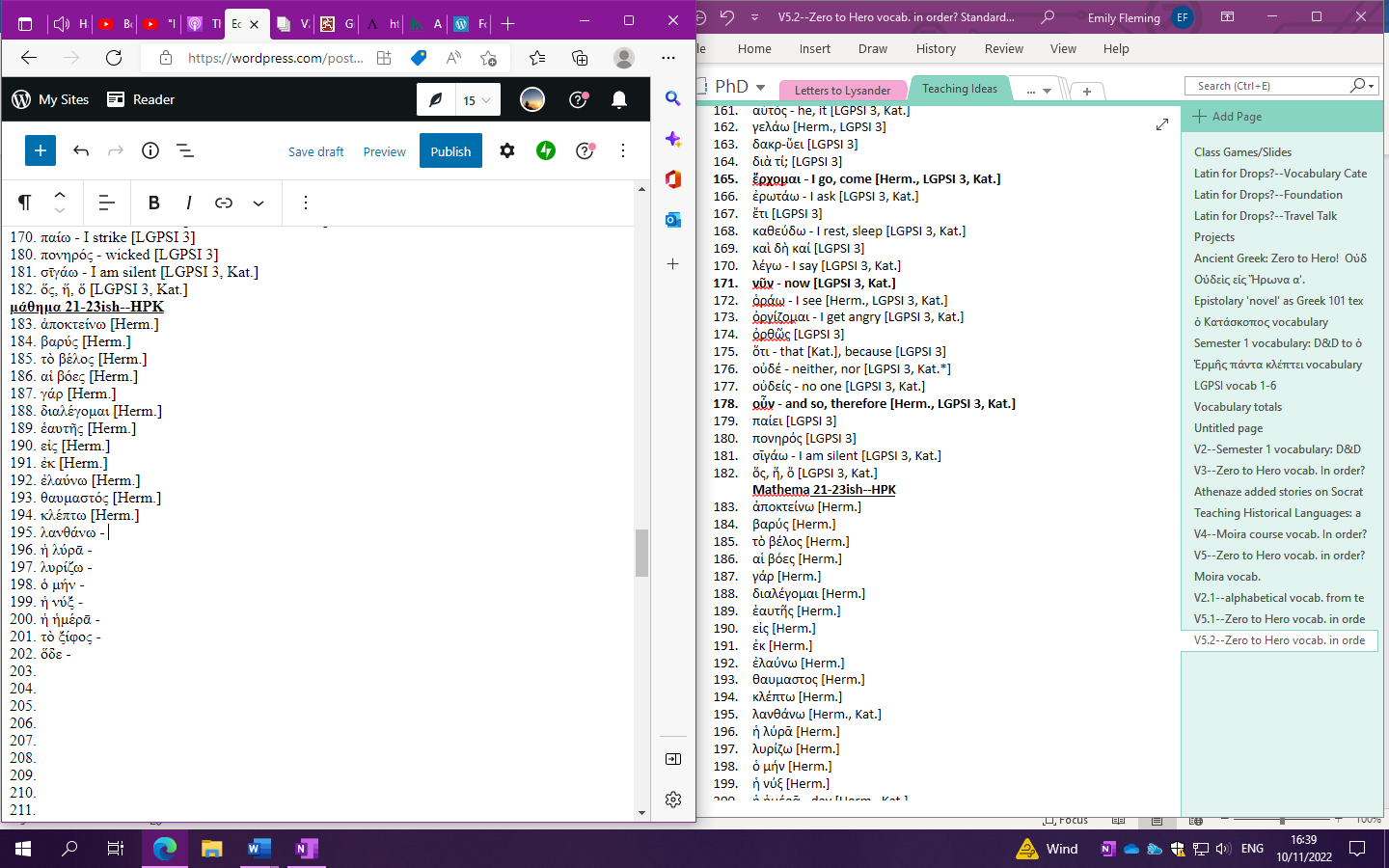
My thesis is stressing me out a bit, so it may actually be some time before I take the time to make my Μοῖρα rules look presentable. This week, however, I've chosen to de-stress by sequencing the remainder of my Greek 101 vocabulary list. I think it would be nice to introduce, on average, 7-8 words per class, reserving about two weeks free of any vocabulary-specific goals. One could distribute those vocabulary 'zero days' however one wished, without planning them out--a sick day here, a review day there, a party at the end of the class. I know I'd be a much better teacher if I gave myself permission to slow down when it was obvious students needed it, without feeling guilt or pressure for not hitting certain benchmarks. That's the main reason I haven't broken these μαθήματα down into weeks: I don't want to get stuck trying to fit into an inflexible schedule.
Once you remove some of the low-frequency words (now italicized) from Ἑρμῆς Πάντα Κλεπτει and take into account the fact that the vocabulary for the first day is atypical (names, greetings, roll call, and the alphabet = 27 Greek words, more or less), things average out close to how I'd like them to. Still, it might be more realistic for me to try and trim a few words off the list of words I expect students to acquire, and to accept that I'll be consistently glossing a handful of these.
As I continue working on some stories, I'm sure I'll tweak the order of this list; the bold text indicates words I'm already sure I'll want earlier in the semester. It turns out that it's hard to tell a story without conjunctions or adverbs! I haven't yet used ἀρέσκει + dative in any of my drafts, but it seems like a good idea to introduce all of the 'super seven' verbs early in the semester. And am I really going to wait till the last month of class to ask a bunch of college students if they're tired?
How I plan to use this list
As explained elsewhere, I want to be able to teach an Ancient Greek course in which practically all of the time a student might spend on grammar exercises, vocabulary flashcards, or verb paradigms is swapped out for reading texts that they can understand 95-98% of, without too much reliance on glosses. My math suggests that, in a standard one-semester course, such a goal would ideally be attained by reading 40,000-50,000 words of Greek that are composed as much as possible from a vocabulary in the 300-400 word range. Additionally, these 300-400 words should be ones likely to prove useful in their later reading.
I'll therefore be relying on some version of this list while I'm writing short stories and Mad Libs-like sketches for Μοῖρα sessions. Check back from time to time to see whether I make any progress on this!
How you could use this list
However you like, obviously. But if you think that a reading-intensive Greek course with limited vocabulary sounds like something you'd use, consider writing additional Greek texts that would fit roughly into a sequence of Lingua Graeca Per Se Illustrata 1-3, Ἑρμῆς Πάντα Κλέπτει, LGPSI 4-6, and ὁ Κατάσκοπος. If roleplaying games in class don't sound like something you'd ever do in class, feel free to ignore the words bracketed [Moira]. Similarly, if you're never going to use Total Physical Response in the classroom, you can skip right past the words bracketed [TPR]; they're not going to appear in any of the three texts mentioned by other people.
Of course, you might be trying to teach Ancient Greek communicatively in quite a different context. If I were teaching at a seminary, for example, ideally I'd come up with a different list. I'd use tools like this one or this one to match the vocabulary of, say, the gospel of John against existing Koine readers (Mark Jeong's reader comes to mind, though so far I've only read reviews & the preview of it) to create a different 300-400 word list. If you do engage in such a project, please let me know--I'd be keen to follow along.
If you spot an error or omission, if you find this list useful, or if you have suggestions for improvements--again, please comment!
μάθημα α᾿.
1. χαῖρε/χαίρετε, χαίρω [LGPSI 3, Herm., Kat.]
2. τὸ ὄνομα [Herm., Kat.]
3. μοι [Herm.]
4. ἐστίν [LGPSI 1]
5. τί...; [Herm.]
6. σοι/ὑμῖν [Herm.]
7. ναί [LGPSI 3]
8. καί [LGPSI 1, Herm., Kat.]
9. ἆρα…; [LGPSI 1]
10. οὐχί/οὐκ/ού [LGPSI 1]
11. πάρεστιν [LGPSI 3, Herm., Kat.]
12. ἄπεστιν [Kat.]
13. ἤ [LGPSI 1]
14. πῶς ἔχω/ἔχεις/ἔχει;
15. καλῶς ἔχω/ἔχεις/ἔχει.
16. κακῶς ἔχω/ἔχεις/ἔχει.
17. ὦ… [LGPSI 3]
18. γράφω [Kat.]
19. τοῦτο [LGPSI 5]
20. τὸ γράμμα [LGPSI 1]
21. Ἑλληνικά [LGPSI 1]
22. ᾄδω [LGPSI 3, Herm.]
23. πάντες [Herm.]
24. εὖγε!
25. αἱ λέξεις [LGPSI 1]
26. νέαι [LGPSI 6]
27. ἔρρωσο/ἔρρωσθε!
μάθημα β᾿.
28. τίς/τίνες;
29. ἀνίσταμαι, ἀνάστηθι…[Moira/TPR]
30. καθίζομαι…[Moira/TPR]
31. βάδιζω, βάδιζε, βαδίζετε…[Herm., LGPSI 5]
32. πρός [Herm., LGPSI 5, Kat.]
33. τὴν θύρᾱν, τῆς θύρᾱς [LGPSI 5]
34. ἀπό [LGPSI 5, Kat.]
35. τρέχω…[Moira/TPR]
μάθημα γ᾿.
36. ἀνοίγω [LGPSI 4]
37. κλείω [Moira/TPR]
38. τὸ βιβλίον [Moira/TPR]
39. τύπτω [LGPSI 3]
40. ἡ/ὁ διδάσκαλος [Moira/TPR]
41. ἡ/ὁ μαθητής, αἱ/οἱ μαθηταί [Moira/TPR]
μάθημα δ᾿.
42. τίθημι [LGPSI 4]
43. ἡ δραχμή, τὴν δραχμήν [Kat.]
44. ἐπί [LGPSI 4]
45. ἡ τραπέζη [LGPSI 4]
46. ἐν [LGPSI 1]--also εἰς [Herm.], or is it too confusing to introduce both on same day?
47. δίδωμι [Herm., Kat.]
μάθημα ε᾿.
48. ὁ (γεωγραφικὸς) πίναξ/πινάκιον [TPR]
49. ποῦ [LGPSI 1]
50. ἐνθάδε [LGPSI 3]
51. δέ [LGPSI 1]
52. ποταμός [LGPSI 1]
53. νῆσος [LGPSI 1]
54. μέν [LGPSI 1]
55. μεγάλη [LGPSI 1]
56. μῑκρός [LGPSI 1]
57. μακρός [only for Moira/TPR...unless I missed it somewhere in one of the texts]
58. πόλις [LGPSI 1]
μάθημα Ϛ'.--LGPSI 1a
59. ἀλλά [LGPSI 1]
60. πολλαί [LGPSI 1]
61. ὀλίγοι [LGPSI 1]
62. τὸ πέλαγος [LGPSI 1]
63. ἡ ἀρχή [LGPSI 1]
64. ἐπαρχίᾱ [LGPSI 1]
μάθημα ζ᾿.
65. εἷς/μία/ἕν [LGPSI 1]
66. δύο [LGPSI 1]
67. ἀριθμός [LGPSI 1]
68. τρεῖς/τρία [LGPSI 1]
69. τέσσαρες/τέσσαρα [LGPSI 2]
70. πέντε [only Moira?]
71. ἕξ [only Moira?]
72. μείζων (ἤ) [LGPSI 6]
73. ἀριθμῶμεν [LGPSI 4]
74. πόσα/πόσοι; [LGPSI 2, Kat.]
μάθημα η᾿--LGPSI 1b.
75. χί-λια [LGPSI 1]
76. πρῶτον [LGPSI 1]
77. δεύτερον [LGPSI 1]
78. τρίτον [LGPSI 1]
79. ἑπτά [LGPSI 1]
80. ὀκτώ [Kat.]
81. ἔννεα [Moira]
82. δέκα [Kat.]
83. ἕνδεκα [Moira]
84. δώδεκα [Moira]
85. συλλαβή [LGPSI 1]
μάθημα θ'.
86. ὁ ἀνήρ [LGPSI 2]
87. ἄνθρωποι [LGPSI 6]
88. ἡ γυνή [LGPSI 2]
89. ὁ παῖς/παιδίον [LGPSI 2]
90. ἡ κόρη [LGPSI 2]
91. ὁ πατήρ [LGPSI 2]
92. ἡ μήτηρ [LGPSI 2]
93. ὁ υἱός [LGPSI 2]
94. ἡ θυγάτηρ [LGPSI 2]
95. ὁ ἀδελφός [Herm., LGPSI 5]
μάθημα ι'--LGPSI 2
96. δοῦλος/δούλη [LGPSI 2]
97. δεσπότης/δέσποινα [LGPSI 2]
98. ἡ οἰκίᾱ [LGPSI 2]
99. κύ-ριος [LGPSI 2]
100. οἰκεῖ [LGPSI 2]
101. οἴκαδε [Herm.]
102. οἴκοθεν [Herm.]
μάθημα ια'.
103. ἐμοῦ/μου [LGPSI 2]
104. σου/σοῦ [LGPSI 2
105. ἑκατόν (100) [LGPSI 2]
106. πεντήκοντα (50) [LGPSI 2]
107. εἴκοσι(ν) [Moira]
108. παίζωμεν! [LGPSI 5]
109. ἡ Τύχη [Moira]
110. βάλλω [LGPSI 5, Kat.]
111. ὁ κύβος [Moira]
112. νῑκάω [Herm., Kat.]
113. πολύ [LGPSI 3]
114. ἴσος [Moira]
μάθημα ιβ'. (what kind of game do you want to play?)
115. βούλομαι [Herm.]
116. ποῖος [Moira/TPR]
117. ὁ μῦθος [Kat.]
118. τὸ πρόσωπον [LGPSI 3]
119. κρείσσων [Moira]
120. βασιλεύς [Herm.]
121. ξενικός [Moira]
122. θεός [Herm., Kat.]
123. ἀληθής [LGPSI 5, Kat.]
124. ἐγγύς [LGPSI 6]
125. πόρρω [LGPSI 6, Kat.]
μάθημα ιγ'. (when and where should our game be set?)
126. πότε…; [Kat.]
127. γίγνομαι [Herm., Kat.]
128. ἡμέτερος [Kat.]
129. ἐν (if not earlier)
130. αἰῶν [Moira]
131. ἔξω (?) [LGPSI 5]
132. ὁ τόπος [LGPSI 1, Kat.]
133. ὁ ἀγρός [LGPSI 5]
134. ἡ ὕ-λη [Moira]
135. τὸ ὄρος [Herm.]
μάθημα ιδ'. (character generation and Invoke/Compel rules--will likely take two class periods)
136. ὑ-μεῖς [LGPSI 5, Kat.]
137. ἡμεῖς [Herm., Kat.]
138. τὸ στοιχεῖον [Moira]
139. τὸ τόλμημα [Moira]
140. οἶδα, οἶσθα, οἶδε [LGPSI 4, Kat.]
141. ἀναγκάζω or παρέχω [Moira]
142. ἐπικλέω [Moira]
143. δέχομαι [Moira]
μάθημα ιε'. (the Fate rules)
144. ποιέω [Herm., Kat.]
145. εἰ [Kat.]
146. προσβάλλω [Moira]
147. ἀμύ-νω [Moira]
148. ὑπερβάλλω [Moira]
149. ὠφελέομαι [Moira]
μάθημα ιϚ'.
150. δύναμαι [Herm., Kat.]
151. ἡ πῡραμίς [Moira]
152. ἡ κλῖμαξ [Moira]
153. ἡ πρᾶξις [Moira]
154. ὁ λόγος [Moira]
155. ἁμαρτάνω [Moira]
156. μετὰ [Herm., LGPSI 5, Kat.]
157. ἡ ἀριστείᾱ [Moira]
μάθημα 18-20ish--LGPSI 3
158. ἀγαθός [LGPSI 3]
159. ἀκούω - I hear [LGPSI 3, Kat.]
160. ἀποκρί-νεται [LGPSI 3]
161. αὐτός - he, it [LGPSI 3, Kat.]
162. γελάω [Herm., LGPSI 3]
163. δακρ-ὔει [LGPSI 3]
164. διὰ τί; [LGPSI 3]
165. ἔρχομαι - I go, come [Herm., LGPSI 3, Kat.]
166. ἐρωτάω - I ask [LGPSI 3, Kat.]
167. ἔτι [LGPSI 3]
168. καθεύδω - I rest, sleep [LGPSI 3, Kat.]
169. καὶ δὴ καί [LGPSI 3]
170. λέγω - I say [LGPSI 3, Kat.]
171. νῦν - now [LGPSI 3, Kat.]
172. ὁράω - I see [Herm., LGPSI 3, Kat.]
173. ὀργίζομαι - I get angry [LGPSI 3, Kat.]
174. ὀρθῶς [LGPSI 3]
175. ὅτι - that [Kat.], because [LGPSI 3]
176. οὐδέ - neither, nor [LGPSI 3, Kat.]
177. οὐδείς - no one [LGPSI 3, Kat.]
178. οὖν - and so, therefore [LGPSI 3, Herm., Kat.]
170. παίω - I strike [LGPSI 3]
180. πονηρός - wicked [LGPSI 3]
181. σῑγάω - I am silent [LGPSI 3, Kat.]
182. ὅς, ἥ, ὅ [LGPSI 3, Kat.]
μάθημα 21-23ish--HPK
183. ἀποκτείνω [Herm.]
184. βαρύς [Herm.]
185. τὸ βέλος [Herm.]
186. αἱ βόες [Herm.]
187. γάρ [Herm.]
188. διαλέγομαι [Herm.]
189. ἑαυτῆς [Herm.]
190. εἰς [Herm.]
191. ἐκ [Herm.]
192. ἐλαύνω [Herm.]
193. θαυμαστός [Herm.]
194. κλέπτω [Herm.]
195. λανθάνω [Herm.]
196. ἡ λύρᾱ [Herm.]
197. λυρίζω [Herm.]
198. ὁ μήν [Herm.]
199. ἡ νύξ [Herm.]
200. ἡ ἡμέρᾱ [Herm.]
201. τὸ ξίφος [Herm.]
202. ὅδε [Herm.]
203. οὔτε...οὔτε [Herm.]
204. τὸ παιδίον [Herm.]
205. πέρδομαι [Herm.]
206. πταίρω [Herm.]
207. ἡ πυράγρᾱ [Herm.]
208. ἡ ῥάβδος [Herm.]
209. τὸ σπήλαιον [Herm.]
210. τὸ τόξον [Herm.]
211. ἡ τρίαινα [Herm.]
212. ἡ χελώνη [Herm.]
213. τὸ χρῆμα [Herm.]
μάθημα 24-25ish--LGPSI 4
214. ἀμφορεύς - jar [LGPSI 4]
215. ἀποχωρέω [LGPSI 4]
216. ἀσπάζομαι [LGPSI 4]
217. βλέπω [LGPSI 4]
218. ἔνειμι - I am in [LGPSI 4, Kat.]
219. ἔπειτα [LGPSI 4]
220. κατηγορέω (accuse, denounce, speak against) [LGPSI 4]
221. κελεύω [LGPSI 4]
222. κενός [LGPSI 4]
223. μόνος - alone, only [LGPSI 4, Kat.]
224. οἶνος [LGPSI 4]
225. οἰνών (wine cellar) [LGPSI 4]
226. οὐδαμῶς - not at all [LGPSI 4, Kat.]
227. πάλιν - again, back [LGPSI 4, Kat.]
228. πλήρης [LGPSI 4]
229. ὁ σάκκος [LGPSI 4]
μάθημα 26-32ish--LGPSI 5
230. ἄγγελος - messenger [LGPSI 5, Kat.]
231. αἰσχρός [LGPSI 5]
232. ἅμα [LGPSI 5]
233. ἄνευ - without [LGPSI 5, Kat.]
234. ἀπέρχομαι - I go away [LGPSI 5, Kat.]
235. ἄστυ [LGPSI 5]
236. αὐλή [LGPSI 5]
237. οἱ γονεῖς (the parents) [LGPSI 5]
238. δεῦρο [LGPSI 5]
239. δήλως [LGPSI 5]
240. ἐκεῖνος - that [LGPSI 5, Kat.]
241. ἐπανέρχομαι [LGPSI 5]
242. ἑτέρᾱ [LGPSI 5]
243. ζητέω [LGPSI 5]
244. ἵππος - horse [LGPSI 5, Kat.]
245. καλός - good, fine, pretty [LGPSI 5, Kat.]
246. κῆπος (garden, orchard, plantation) [LGPSI 5]
247. κόπτω [LGPSI 5]
248. λαλέω [LGPSI 5]
249. ματαίως (in vain) [LGPSI 5]
250. ἡ ὁδός [LGPSI 5]
251. οἰκήματα [LGPSI 5]
252. οἴμοι [LGPSI 5]
253. ὀφθαλμὸν [LGPSI 5]
254. ὀχέομαι (rides) [LGPSI 5]
255. περί - around, about [LGPSI 5, Kat.]
256. περίστῡλον [LGPSI 5]
257. πολλάκις - many times, often [LGPSI 5, Kat.]
258. πορεύομαι [LGPSI 5]
259. προσέρχομαι [LGPSI 5]
260. σύν - with [LGPSI 5, Kat.]
261. σφαῖρα [LGPSI 5]
262. ὐπέρ +acc. [LGPSI 5]
263. φίλος - friend [LGPSI 5, Kat.]
μάθημα 33-34ish--LGPSI 6
264. ἄγω - I carry, lead [LGPSI 6, Kat.]
265. ἀρχαία [LGPSI 6]
266. ἡ θαλάσσης [LGPSI 6]
267. κεῖμαι [LGPSI 6]
268. μεταξύ (between) [LGPSI 6]
269. οὕτω(ς) - like this, like that [LGPSI 6, Kat.]
270. ποῖ [LGPSI 6]
271. πόθεν [LGPSI 6]
272. πρό - before, in front of [LGPSI 6, Kat.]
273. πύλαι [LGPSI 6]
274. τείχη [LGPSI 6]
275. φέρω - I carry, bring [LGPSI 6, Kat.]
276. ὡς - as, like, that, in [LGPSI 6, Kat.]
277. ὥσπερ [LGPSI 6]
μάθημα 35-42ish--Kat.
278. ἀγγέλλω - I announce, report [Kat.]
279. ἀγορά - market [Kat.]
280. ἀεί - always [Kat.]
281. ἀλλήλων - each other [Kat.]
282. ἄν - grammatical particle [Kat.]
283. ἀναγιγνώσκω - I read [Kat.]
284. ἀποθνῄσκω - I die [Kat.]
285. ἀπόλλυμι - I destroy [Kat.]
286. ἀρέσκω - I please [Kat.]
287. ἄρχω - I begin, rule [Kat.]
288. αὔριον - tomorrow [Kat.]
289. γιγνώσκω - I learn, recognize [Kat.]
290. δειπνέω - I have a meal [Kat.]
291. δεσμωτήριον - prison [Kat.]
292. δέω - I lack [Kat.]
293. δή - intensifier [Kat.]
294. διά - because of, through [Kat.]
295. διέρχομαι - I go through [Kat.]
296. διότι - because [Kat.]
297. διώκω - I chase [Kat.]
298. ἐάν - if [Kat.]
299. ἐάω - I allow [Kat.]
300. εἰκών - statue [Kat.]
301. ἐκκλησία - gathering, meeting [Kat.]
302. ἔμπορος - merchant [Kat.]
303. ἐννοέω - I consider [Kat.]
304. ἐξέρχομαι - I go out, come out [Kat.]
305. ἐπεί - when, since [Kat.]
306. ἐπιστολή - letter [Kat.]
307. ἔργον - work [Kat.]
308. ἔτος - year [Kat.]
309. εὖ - well [Kat.]
310. εὐθύς - immediately, suddenly [Kat.]
311. εὑρίσκω - I find [Kat.]
312. ἡγεμών - leader [Kat.]
313. ἤδη - already [Kat.]
314. ἥμισυς - half [Kat.]
315. θάνατος - death [Kat.]
316. ἵνα - in order to, so that [Kat.]
317. ἴσως - maybe [Kat.]
318. ἰχθύς - fish [Kat.]
319. καλέω - I call [Kat.]
320. κάλλιστος - best, prettiest [Kat.]
321. κάμνω - I am tired [Kat.]
322. καταβάλλω - I knock down [Kat.]
323. καταλαμβάνω - I seize, arrest [Kat.]
324. κατασκοπέω - I spy [Kat.]
325. κατάσκοπος - spy [Kat.]
326. κίνδυνος - danger [Kat.]
327. κλέπτης - thief [Kat.]
328. κόραξ - crow [Kat.]
329. κωμῳδία - comedy (type of play) [Kat.]
330. λιμήν - harbor [Kat.]
331. λούω - I wash [Kat.]
332. μάχη - battle [Kat.]
333. μάχομαι - I fight [Kat.]
334. μένω - I wait, remain [Kat.]
335. μῑσέω - I hate [Kat.]
336. μύρμηξ - ant [Kat.]
337. ἡ ναῦς - ship [Kat.]
338. νεκρός - corpse [Kat.]
339. νομίζω - I think [Kat.]
340. ξύλινος - wooden [Kat.]
341. οἶκος - house [Kat.]
342. οἰκτίρω - I pity [Kat.]
343. ὅπου - where [Kat.]
344. ὅστις - whoever, whatever [Kat.]
345. οὐδέποτε - never [Kat.]
346. παύω - I stop [Kat.]
347. πειράω - I try [Kat.]
348. ποιητής - poet [Kat.]
349. πόλεμος - war [Kat.]
350. ποτε - at some point [Kat.]
351. προφήτης - prophet [Kat.]
352. πτώχος - beggar [Kat.]
353. πωλέω - I sell [Kat.]
354. σῖτος - food [Kat.]
355. στρατιώτης - soldier [Kat.]
356. ταχέως - quickly [Kat.]
357. τοιοῦτος - this [Kat.]
358. τότε - then [Kat.]
359. φεύγω - I flee, escape [Kat.]
360. φημί - I say [Kat.]
361. φιλέω - I love [Kat.]
362. φοβέομαι - I fear [Kat.]
363. φύλαξ - guard [Kat.]
364. φυλάττω - I guard [Kat.]
365. χαλεπός - difficult [Kat.]
366. χρήσιμος - useful [Kat.]
367. ὠνέομαι - I buy [Kat.]
CI Curriculum for Ancient Greek: Zero to Hero!
Yes, I realize that 'Zero to Hero' is beyond the acceptable level of cheesiness in naming conventions for university courses. As this curriculum project is very much still in development, however, for now I am going to refer to it by whatever cheesy name I feel like. While 'Zero to Hero' is not exactly a sophisticated title, it communicates some key features of the way I aspire to teach Ancient Greek. First, by assuming that some students are starting from absolute scratch, with no previous Latin (or indeed, any other second language), and with no knowledge of the terminology of formal grammar. Second, by spending many hours of class time playing Μοῖρα, a D&D-like tabletop roleplaying game.
Well, I say 'D&D-like' because Dungeons and Dragons is the only TTRPG with which I expect the average person to be familiar. Μοῖρα is a slight simplification of the Fate Core system; if you know anything about Fate, you know that it's actually radically different from any edition of D&D. The main advantages for me of the Fate system are that it is more narratively driven and involves less number-crunching. Using less math might widen the appeal for the average university student; it certainly makes the rules a lot easier for me to translate and explain. More important to me is the storytelling focus, which gives me a relatively straightforward formula for a gamified version of TPRS. I love the idea of using TPRS in the classroom, but the scope for subject matter feels overwhelmingly broad (how am I supposed to come up with that many ideas for vocabulary-sheltered stories?) and high pressure. If the stories fail to engage students--if they're too repetitive, or not funny enough, or funny for twelve-year-olds but not for twenty-year-olds--then I've put in all that work for very little return.
And so I gravitate towards gamified storytelling. The structure of games is inherently somewhat repetitive, as a feature rather than a bug: the point of a game is to innovate within the rules, in order to create something satisfying or to entertain yourself (and your friends). I feel much more comfortable with my ability to create an interesting new environment (settings, NPCs, potential missions) for an existing game, than with my ability to create an interesting new story on my own. Part of the draw of the Fate system is meant to be the players' power to control aspects of the narration--which coincidentally means that the responsibility of telling a good story isn't all on the teacher or GM. Players in a Fate game have much more control over what happens in a session than do students in a Storyasking lesson. If students want to tell the kind of silly story that TPRS is known for, then they can absolutely get invested in the game to make that happen. If a room full of undergraduates wished to produce a different kind of story, whether serious or melodramatic, then they too could negotiate their preferred tone and dynamic in the exact same way.
In theory--famous last words!--it wouldn't be necessary for students to produce much speech in the target language. I reckon I'll have to hold myself consciously to reasonable expectations for student output, i.e., one to two words in the L2 towards the beginning of the semester, and perhaps as much as four or five words at a time after sixteen weeks. But I wouldn't be surprised if there's a hint of burnt rubber in the air, the first few times I take Μοῖρα out for a spin.
Sound interesting yet? I certainly hope so! I don't imagine that students can learn Ancient Greek purely from playing an RPG; rather, I think that playing RPGs would be a relatively easy and effective way to provide engaging input during class. I don't expect students to learn to speak anything beyond short phrases in Greek, nor do I particularly care what their spoken Greek sounds like. At the end of the day, the only one of the four language skills (listening, speaking, reading, writing) that we really need to engage with historical languages is reading. Speaking in Greek to a class is useful because allows me to provide input (necessary for acquisition) and students to negotiate meaning with me and with each other (certainly helpful for acquisition).
The only thing I particularly care about students doing outside of class meetings is reading. (Or listening to the same input, in the case of dyslexia or other significant learning differences.) At the time I'm writing this, October 2022, there are extraordinarily few Greek texts I'm aware of with sufficiently sheltered vocabulary for students to read (rather than decode) in their first semester. Over the past few months, I've compiled a list of about 350 Greek words from two CI-style novellas with heavily sheltered vocabulary and minimally sheltered grammar (Ἑρμῆς Πάντα Κλέπτει and ὁ Κατάσκοπος), as well as from the first six chapters of Seumas Macdonald's Ørberg-inspired Lingua Graeca Per Se Illustrata. I haven't checked recently how perfectly said list overlaps with Dickinson College Commentaries' Core 500 words, but it's certainly close--rather closer, I would guess, than the first 350 vocabulary items in any existing Greek textbook. In addition to this list (alphabetized, at the end of this blog post), I've come up with the couple of dozen words I think absolutely necessary to explain and play Μοῖρα, again preferring whatever vocabulary is high-frequency in the extant Greek corpus. Altogether, those three texts (plus the handful of supporting texts which have been written so far for LGPSI) will give your student access to a little less than 13,000 words of Ancient Greek written input for the first semester.
That sounds great. Some unscientific back-of-the-napkin estimation suggests that Athenaze I contains perhaps half that amount of Greek text, utilizing nearly four times as many different words (there are roughly 1300 in the Greek-English index at the back of the book). If we genuinely want our students to acquire by reading, and to learn to read well, 13,000 words of Greek text based on a 350-word vocabulary is moving in the right direction. Go us!
On the other hand...the rule of thumb for undergraduate courses is that you should expect to do roughly two hours' work outside of class for every contact hour, right? I think I'd spend the first two weeks teaching more dynamic vocabulary before handing them the first chapter of LGPSI, so we can divide those 13,000 words over the remaining fourteen weeks of a typical semester...and suddenly our 13,000 words don't look like nearly enough. There's no way that 900 words a week is enough input for university students to read, and no way they could spend six hours every week reading and re-reading those same 900 words without dying of boredom. (At least, I would have died of boredom.) Which means, we need an awful lot more Greek text for students to read, sticking pretty much to our core vocabulary list.
How many words do we need? There's not a ton of easily accessible data out there on the link between total words read and language acquisition--if you know of some, please comment! But a glance at Lance Piantaggini's blog suggests that high school students in their first year of a CI Latin program can comfortably read something like 45,000 words over the course of a school year. That, I think, is what we should be aiming for in the first semester of an undergraduate course that meets three times per week. If we expect students to acquire a language twice as fast in a university setting, then they deserve twice as much practice (and by practice, I mean input) as secondary students get. And that input should be as engaging and informative as we can make it.
This is obviously much too large a project for me to tackle alone, but I've made a small start. I've begun drafting a graded reader to fill in the gaps between Ἑρμῆς Πάντα Κλέπτει, ὁ Κατάσκοπος, and the first six chapters of LGPSI. (Why only the first six, you may ask? Purely because I'm not sure how well students could acquire more vocabulary.) Ordering the vocabulary and breaking it up roughly by class session is not a quick or easy task; I'd be thrilled to be done with that part of the project by Christmas. I do, however, have a draft of the vocabulary ordered for roughly the first six weeks, complete with incomplete lesson plans on PowerPoint. At some point I'll get around to posting those first fifteen slideshows, to illustrate how I imagine I might try to get students into the first session of Μοῖρα. Said presentations are of course riddled with errors and incomplete--I have not yet gone to the trouble of making the slides I would use for Picture Talks, for example.
You might notice that I have failed to standardize the presentation of the following list: only some of the nouns have articles listed, not all of the verbs are 1st person singular, macrons combined with other diacritics are represented by a hyphen following the vowel, etc. I've also left on the handful of low-frequency words that show up in Ἑρμῆς Πάντα Κλέπτει, even though I don't plan on requiring students to recall the words for, say, 'trident' or 'tongs'. Obviously I don't plan on targeting those words in the reader I'm writing; still, it seems preferable to know which words students would have seen before.
I reckon that's more than enough for one blog post; I'll share my PowerPoints introducing Μοῖρα another day. If you feel any of the work that I'm doing on Ancient Greek curriculum is useful, interesting, misguided, whatever--please get in touch! I would be particularly thrilled to collaborate with others on writing relevant Greek texts--my syntax and morphology are (I think) correct most of the time, if not error-free, but I'm well aware of how clunky my Greek is.
- ἀγαθός [LGPSI 3]
- ἄγᾱν -much, too much [Herm.]
- ἄγγελος - messenger [LGPSI 5, Kat.]
- ἀγγέλλω - I announce, report [Kat.]
- ἀγορά - market [Kat.]
- ἐκ τῶν ἀγρῶν [LGPSI 5]
- ἄγω - I carry, lead [LGPSI 6, Kat.]
- ᾄδω [Herm., LGPSI 3]
- ὁ ἀδελφός [Herm., LGPSI 5]
- ἀεί - always [Kat.]
- αἰσχρός [LGPSI 5]
- ἀκούω - I hear [LGPSI 3, Kat.]
- ἀληθής - true [LGPSI 5, Kat.]
- ἀληθῶς - truly [Kat.]
- ἀλλά - but [Herm., LGPSI 1, Kat.]
- ἀλλήλων - each other [Kat.]
- ἄλλος - other [Kat.]
- ἅμα [LGPSI 5]
- ἀμφορεύς (jar) [LGPSI 4]
- ἄν - grammatical particle [Kat.]
- ἀναγιγνώσκω - I read [Kat.]
- ἀναλαμβάνω [Herm.]
- ἄνευ - without [LGPSI 5, Kat.]
- ἀνήρ [LGPSI 2]
- ἄνθρωπος - person [LGPSI 6, Kat.]
- ἀνοίγω [LGPSI 4]
- ἄπειμι - I am away [Kat.]
- ἀπέρχομαι - I go away [LGPSI 5, Kat.]
- ἀπό - (away) from [LGPSI 5, Kat.]
- ἀποδίδωμι [Herm.]
- ἀποθνῄσκω - I die [Kat.]
- ἀποκρ’ῑνεται [LGPSI 3]
- ἀποκτείνω - I kill [Herm., Kat.]
- ἀπόλλυμι - I destroy [Kat.]
- ἀποχωρέω [LGPSI 4]
- ἆρα - marks a yes/no question [Herm., LGPSI 1, Kat.]
- ἀρέσκω - I please [Kat.]
- ἀριθμεῖ (verb) [LGPSI 4]
- ὁ ἀριθμός [LGPSI 1]
- ἀρχαία [LGPSI 6]
- ἡ ἀρχή [LGPSI 1]
- ἄρχω - I begin, rule [Kat.]
- ἀσπάζου [LGPSI 4]
- ἄστυ [LGPSI 5]
- αὐλή [LGPSI 5]
- αὔριον - tomorrow [Kat.]
- αὐτός - he, it [LGPSI 3, Kat.]
- βαδίζω [Herm., LGPSI 5]
- βάλλω - I throw [LGPSI 5, Kat.]
- βαρύς [Herm.]
- ὁ βασιλεύς [Herm.]
- τὸ βέλος [Herm.]
- βλέπει [LGPSI 4]
- αἱ / οἱ βόες [Herm.]
- βούλομαι - I want [Herm., LGPSI 5, Kat.]
- γάρ - because [Herm., LGPSI 4, Kat.]
- γελάω [Herm., LGPSI 3]
- γίγνομαι - I become, happen [Herm., Kat.]
- γιγνώσκω - I learn, recognize [Kat.]
- οἱ γονεῖς (the parents) [LGPSI 5]
- τὸ γράμμα [LGPSI 1]
- γράφω - I write [Kat.]
- γυνή [LGPSI 2]
- δακρ-ὔει [LGPSI 3]
- δέ - and [Herm., LGPSI 1, Kat.]
- δειπνέω - I have a meal [Kat.]
- δέκα - ten [Kat.]
- δεσμωτήριον - prison [Kat.]
- δεσπότης/δέσποινα [LGPSI 2]
- δεῦρο [LGPSI 5]
- δεύτερον [LGPSI 1]
- δέω - I lack [Kat.]
- δή - intensifier [Kat.]
- δήλως [LGPSI 5]
- διά - because of, through [Kat.]
- διὰ τί; [LGPSI 3]
- διαλέγομαι [Herm.]
- δίδωμι - I give [Herm., Kat.]
- διέρχομαι - I go through [Kat.]
- διότι - because [Kat.]
- διώκω - I chase [Kat.]
- δοῦλος/δούλη [LGPSI 2]
- δραχμή - drachma [Kat.]
- δύναμαι - I can [Herm., Kat.]
- δύο - two [Herm., LGPSI 1, Kat.]
- ἐάν - if [Kat.]
- ἑαυτοῦ - his/her/its own [Herm., Kat.]
- ἐάω - I allow [Kat.]
- ἐγγύς [LGPSI 6]
- ἐγώ - I [Herm., LGPSI 3, Kat.]
- εἰ - if [Kat.]
- εἰκών - statue [Kat.]
- εἰμί - I am [Herm., LGPSI 1, Kat.]
- εἰς - into, to, at [Herm., LGPSI 4, Kat.]
- εἷς - one [LGPSI 1, Kat.]
- εἰσέρχομαι - I enter, go in, come to [Kat.]
- ἐκ - out of / ἐξ - out of [Herm., LGPSI 4, Kat.]
- ἑκατόν (100) [LGPSI 2]
- ἐκεῖνος - that [LGPSI 5, Kat.]
- ἐκκλησία - gathering, meeting [Kat.]
- ἐλαύνω [Herm.]
- ἐμός - my [Herm., LGPSI 2, Kat.]
- ἔμπορος - merchant [Kat.]
- ἐν - in [Herm., LGPSI, Kat.]
- ἔνειμι - I am in [LGPSI 4, Kat.]
- ἐνθάδε [LGPSI 3]
- ἐννέα [Kat.]
- ἐννοέω - I consider [Kat.]
- ἐξέρχομαι - I go out, come out [Kat.]
- ἔξω +gen. [LGPSI 5]
- ἐπανέρχονται [LGPSI 5]
- ἐπαρχίᾱ (government of a district, provincia) [LGPSI 1]
- ἐπεί - when, since [Kat.]
- ἔπειτα [LGPSI 4]
- ἐπί [LGPSI 4]
- ἐπιστολή - letter [Kat.]
- ἑπτά [LGPSI 1]
- ἔργον - work [Kat.]
- ἔρχομαι - I go, come [Herm., LGPSI 3, Kat.]
- ἐρωτάω - I ask [LGPSI 3, Kat.]
- ἑτέρᾱ [LGPSI 5]
- ἔτι [LGPSI 3]
- ἔτος - year [Kat.]
- εὖ - well [Kat.]
- εὐθύς - immediately, suddenly [Kat.]
- εὑρίσκω - I find [Kat.]
- ἔχω - I have [Herm., LGPSI 4, Kat.]
- ζητεῖ [LGPSI 5]
- ἤ - or [LGPSI 1, Kat.]
- ἡγεμών - leader [Kat.]
- ἤδη - already [Kat.]
- ἡμεῖς - we [Herm., Kat.]
- ἡ ἡμέρᾱ - day [Herm., Kat.]
- ἡμέτερος - our [Kat.]
- ἥμισυς - half [Kat.]
- ἡ θαλάσσης [LGPSI 6]
- θάνατος - death [Kat.]
- θαυμαστος [Herm.]
- θεός - god, goddess [Herm., Kat.]
- θερμός [Herm.]
- θυγάτηρ [LGPSI 2]
- θύρᾱ [LGPSI 5]
- ἵνα - in order to, so that [Kat.]
- ἵππος - horse [LGPSI 5, Kat.]
- ἴσως - maybe [Kat.]
- ἰχθύς - fish [Kat.]
- καθεύδω - I rest, sleep [LGPSI 3, Kat.]
- καί - and [Herm., LGPSI 1, Kat.]
- καὶ δὴ καί [LGPSI 3]
- κακῶς [adj. LGPSI 5]
- καλέω - I call [Kat.]
- κάλλιστος - best, prettiest [Kat.]
- καλός - good, fine, pretty [LGPSI 5, Kat.]
- κάμνω - I am tired [Kat.]
- καταβάλλω - I knock down [Kat.]
- καταλαμβάνω - I seize, arrest [Kat.]
- κατασκοπέω - I spy [Kat.]
- κατάσκοπος - spy [Kat.]
- κατηγορεῖ (accuse, denounce, speak against) [LGPSI 4]
- κελεύει [LGPSI 4]
- κεῖνται [LGPSI 6]
- κενός [LGPSI 4]
- ὁ κεραυνός [Herm.]
- ὁ κεστός [Herm.]
- κῆπος (garden, orchard, plantation) [LGPSI 5]
- κίνδυνος - danger [Kat.]
- κλέπτης - thief [Kat.]
- κλέπτω [Herm.]
- κόπτει [LGPSI 5]
- κόραξ - crow [Kat.]
- ἡ κόρη [LGPSI 2]
- τὸ κτήμα [Herm.]
- κ’ῡριος [LGPSI 2]
- κωμῳδία - comedy (type of play) [Kat.]
- λαλοῦσιν [LGPSI 5]
- λαμβάνω - I take [Herm., LGPSI 4, Kat.]
- λανθάνω - I escape the notice of [Herm., Kat.]
- λέγω - I say [LGPSI 3, Kat.]
- λέξις [LGPSI 1]
- λιμήν - harbor [Kat.]
- λούω - I wash [Kat.]
- ἡ λύρᾱ [Herm.]
- λυρίζω [Herm.]
- ματαίως (in vain) [LGPSI 5]
- μάχη - battle [Kat.]
- μάχομαι - I fight [Kat.]
- μεγάλη - big, great / μέγας - big, great [LGSPI 1, Kat.]
- μείζων (ἤ) [LGPSI 6]
- μέν - marks contrast [Herm., LGPSI 1, Kat.]
- μένω - I wait, remain [Kat.]
- μετά - after, with [Herm., LGPSI 5, Kat.]
- μεταξύ (between) [LGPSI 6]
- μή - not, in order that not [LGPSI 1, Kat.]
- ὁ μήν [Herm.]
- ἡ μήτηρ [Herm., LGPSI 2]
- μῑκρός [LGPSI 1]
- μῑσέω - I hate [Kat.]
- μόνος - alone, only [LGPSI 4, Kat.]
- μῦθος - story [Kat.]
- μύρμηξ - ant [Kat.]
- ναί [LGPSI 3]
- ἡ ναῦς - ship [Kat.]
- νέα [LGPSI 6]
- νεκρός - corpse [Kat.]
- νῆσος [LGPSI 1]
- νῑκάω - I win, defeat [Herm., Kat.]
- νομίζω - I think [Kat.]
- νῦν - now [LGPSI 3, Kat.]
- ἡ νύξ - night [Herm., Kat.]
- τὸ ξίφος [Herm.]
- ξύλινος - wooden [Kat.]
- ἡ ὁδός [LGPSI 5]
- οἶδα - I know [LGPSI 4, Kat.]
- oἴκαδε [Herm.]
- οἰκέω - I live (in) [Herm., LGPSI 2, Kat.]
- οἰκήματα [LGPSI 5]
- ἡ οἰκίᾱ [LGPSI 2]
- oἴκοθεν [Herm.]
- οἶκος - house [Kat.]
- οἰκτίρω - I pity [Kat.]
- οἴμοι [LGPSI 5]
- οἶνος [LGPSI 4]
- οἰνών (wine cellar) [LGPSI 4]
- ὀκτώ - eight [Kat.]
- ὀλίγος - little, few [LGPSI 1, Kat.]
- ὄνομα - name [Herm., Kat.]
- ὅπου - where [Kat.]
- ὁράω - I see [Herm., LGPSI 3, Kat.]
- ὀργίζομαι - I get angry [LGPSI 3, Kat.]
- ὀρθῶς [LGPSI 3]
- τὸ ὄρος [Herm.]
- ὅστις - whoever, whatever [Kat.]
- ὅτι - that [Kat.], because [LGPSI 3]
- οὐ - not / οὐκ - not / οὐχ - not [Herm., LGPSI 1, Kat.]
- οὐδαμῶς - not at all [LGPSI 4, Kat.]
- οὐδέ - neither, nor [LGPSI 3, Kat.*]
- οὐδείς - no one [LGPSI 3, Kat.]
- οὐδέποτε - never [Kat.]
- οὖν - and so, therefore [Herm., LGPSI 3, Kat.]
- οὔτε...οὔτε [Herm., LGPSI 4]
- οὕτω(ς) - like this, like that [LGPSI 6, Kat.]
- ὀφθαλμὸν [LGPSI 5]
- ὀχεῖται (rides) [LGPSI 5]
- ἡ παιγνιά-; τὸ παίγνιον; [Herm.]
- τὸ παιδίον [Herm.]
- παίει [LGPSI 3]
- παίζει [LGPSI 5]
- παῖς [LGPSI 2]
- παλαίω [Herm.]
- πάλιν - again, back [LGPSI 4, Kat.]
- πάρειμι - I am present [Herm., LGPSI 3, Kat.]
- πᾶς - all, every / πᾶσα - all, every / πᾶν - all, every [Herm., Kat.]
- ὁ πατήρ [Herm., LGPSI 2]
- παύω - I stop [Kat.]
- πειράω - I try [Kat.]
- τὸ πέλαγος [LGPSI 1]
- πέντε [LGPSI 1]
- πεντήκοντα (50) [LGPSI 2]
- πέρδομαι - fart [Herm.]
- περί - around, about [LGPSI 5, Kat.]
- περίστῡλον [LGPSI 5]
- πλήρης [LGPSI 4]
- ποῖ [LGPSI 6]
- ποιέω - I make, do [Herm., Kat.]
- ποιητής - poet [Kat.]
- πόθεν [LGPSI 6]
- πόλεμος - war [Kat.]
- πόλις - city [LGPSI 1, Kat.]
- πολλάκις - many times, often [LGPSI 5, Kat.]
- πολλή - much, many / πολύ - much, many, (adv. [LGPSI 3]) very / πολύς - much many [LGPSI 1, Kat.]
- πονηρός [LGPSI 3]
- πορεύεται [LGPSI 5]
- πόρρω - further [LGPSI 6, Kat.]
- πόσος - how much, many? [LGPSI 2, Kat.]
- ποταμός [LGPSI 1]
- ποτε - at some point [Kat.]
- πότε - when? [Kat.]
- ποῦ [LGPSI 1]
- πρό - before, in front of [LGPSI 6, Kat.]
- πρός - towards, to [Herm., LGPSI 5, Kat.]
- προσέλθε [LGPSI 5]
- προσχωροῦσι(ν) [LGPSI 6]
- πρόσωπα (faces, masks, characters, etc.) [LGPSI 3]
- προφήτης - prophet [Kat.]
- πρῶτος - first [LGPSI 1, Kat.]
- πταίρω - sneeze [Herm.]
- πτώχος - beggar [Kat.]
- πύλαι [LGPSI 6]
- ἡ πυράγρᾱ - tongs [Herm.]
- πωλέω - I sell [Kat.]
- πῶς - how? [Kat.]
- ἡ ῥάβδος [Herm.]
- ὁ σάκκος [LGPSI 4]
- σῑγάω - I am silent [LGPSI 3, Kat.]
- σῖτος - food [Kat.]
- τὸ σκῆπτρον [Herm.]
- σός - your (s.) [LGPSI 2, Kat.]
- τὸ σπήλαιον [Herm.]
- στρατιώτης - soldier [Kat.]
- σύ - you (s.) [Herm., LGPSI 3, Kat.]
- συλλαβή [LGPSI 1]
- σύν - with [LGPSI 5, Kat.]
- σφαῖρα [LGPSI 5]
- ταχέως - quickly [Kat.]
- τε - and [Herm.*, LGPSI 5, Kat.]
- τείχη [LGPSI 6]
- τέσσαρες/τέσσαρα [LGPSI 2]
- τήμερον - today [Herm., LGSPI 5*(sigma), Kat.]
- τίθημι [LGPSI 4]
- τις - someone, something [Herm., LGPSI 5, Kat.]
- τίς - who? what? [LGPSI 2, Kat.]
- τοιοῦτος - this [Kat.]
- τὸ τόξον [Herm.]
- τόπος - place [LGPSI 1, Kat.]
- τότε - then [Kat.]
- ἡ τραπέζη [LGPSI 4]
- τρεῖς/τρία [LGPSI 1]
- ἡ τρίαινα - trident [Herm.]
- τρίτον [LGPSI 1]
- τύπτω [λγπσι 3]
- ὁ υἱός [Herm., LGPSI 2]
- ὑμεῖς - you (pl.) [LGPSI 5, Kat.]
- ὐπέρ +ακκ. [LGPSI 5]
- φέρω - I carry, bring [LGPSI 6, Kat.]
- φεύγω - I flee, escape [Kat.]
- φημι - I say [Kat.]
- φιλέω - I love [Kat.]
- φίλος - friend [LGPSI 5, Kat.]
- φοβέομαι - I fear [Kat.]
- φύλαξ - guard [Kat.]
- φυλάττω - I guard [Kat.]
- χαίρω - I am happy, (imp.) hello [Herm., LGPSI 3, Kat.]
- χαλεπός - difficult [Kat.]
- ἡ χελώνη [Herm.]
- χί-λια (1,000) [LGPSI 1]
- χρῆμα - thing, (pl.) money, possessions [Herm., Kat.]
- χρήσιμος - useful [Kat.]
- ὦ - marks an address to someone [Herm., Kat.]
- ὠνέομαι - I buy [Kat.]
- ὡς - as, like, that, in [LGPSI 6, Kat.]
- ὥσπερ [LGPSI 6]
- ὁ, ἡ, τό [Herm., Kat.]
- ὅς, ἥ, ὅ [LGPSI 3, Kat.]
- ὅδε, ἥδε, τόδε [Herm., Kat.]
- οὗτος, αὗτη, τοῦτο [Herm., LGPSI 5, Kat.]
And here's the additional vocabulary I (currently) think necessary to explain and play Μοῖρα as a class:
- ὁ κύβος
- ποῖος
- κρείσσων
- ξενικός
- αἰῶν
- τὸ στοιχεῖον
- τὸ τόλμημα
- ἀναγκάζω or παρέχω
- ἐπικλέω
- δέχομαι
- προσβάλλω
- ἀμύ-νω
- ὑπερβάλλω
- ὠφελέομαι
- ἡ πῡραμίς
- ἡ κλῖμαξ
- ἡ πρᾶξις
- ὁ λόγος
- ἁμαρτάνω
- ἴσος
- ἡ ἀριστείᾱ
Some Thoughts on Teaching Historical Languages
As I've been working on an Ancient Greek curriculum project, I've come up with the following list of principles I'm trying to follow. Some of them are a little contentious; I'll try and return to this post some time to add footnotes that indicate where my ideas come from. Questions? Comments? Concerns? If so, please comment!
- The primary goal of teaching historical languages is almost always to enable students to read authentic texts in the historical language.
- Given the difficulty of acquiring* sufficient vocabulary to read goal texts in the target language, vocabulary acquisition should be strongly guided by the frequency of words in either the language as a whole--even, if possible, the frequency of words in the earliest authentic texts intended to be read.
- Whether the study of those historical languages [as perhaps the most time-consuming aspect of studying the classics] is truly accessible to a vast majority of students, is likely to be a major factor in whether classics as a discipline flourishes during an age of change in higher education. This is true both from an ideological perspective, because accessibility is increasingly recognized as an issue of justice rather than talent; and from a pragmatic one, because a department that is effectively open to only a small percentage of students is unlikely to maintain its funding.
- Research in second language acquisition and education suggests that the number of new words a student can acquire during one contact hour is, on average, 7 +/- 2. In one semester meeting three times a week for sixteen weeks, therefore, we should not expect students to acquire much more than 350 words. Given in addition the large number of inflections associated with most words in Greek and Latin, I do not think that it is realistic to expect that the average student is capable of retaining much more vocabulary than this.
- Because classics programs are universally structured around the expectation that students will proceed from zero knowledge of the target language to reading complex authentic texts within two years or less--an expectation which would likely not be considered realistic in modern language departments--it is vital for our language curricula to be as efficient as possible.
- Most time in and out of class should therefore be dedicated to the language-learning activities which have been shown to increase acquisition of the target language; conversely, we should not require students to dedicate significant time or effort to activities which have yet to be shown to increase acquisition of the target language.
- As a corollary, teachers should not be required to dedicate significant time and effort to activities which have yet to be shown to increase acquisition of the target language.
- Specifically at early stages of learning a language--which is to say, the first and perhaps the second semester--there is no indication in current research that the correction of students' production of the target language furthers their acquisition of the language. Teachers should therefore not be required to spend significant amounts of time or effort correcting students' production of the target language during the first semester or two, and students should not be expected to spend significant amounts of time or effort either making or reviewing those corrections.
- There is--perhaps surprisingly--no conclusive research indicating that the explicit teaching of grammar affects students' acquisition of the target language one way or another. Consequently, explicit teaching of grammar should occupy a minority of students' and teachers' time.
- Research does conclusively underscore the importance of comprehensible input in students' acquisition of the target language. Consequently, input in the target language, whether written or spoken, should occupy the majority of the students' time and effort in and out of class. Note that the implicit teaching of grammar is a core aspect of quality comprehensible input.
- Because students are human beings--and because their level of genuine interest may affect the language acquisition process--that comprehensible input should be engaging--whether interesting, entertaining, or both--whenever practicable. Engaging content has the additional benefit of fostering interaction and camaraderie among classmates and between students and teachers. Such community is beneficial both for students as individuals and for departments as a whole.
- Because historical languages--no less than any other language--provide a window into a foreign history and culture, and because students require some historical and cultural background in order to engage with ancient texts, that comprehensible input should provide, insofar as it is practicable, engagement with the world and the lives of those who spoke and wrote the target language.
*A note on vocabulary: I use the terminology of 'acquisition' rather than 'learning' consistently throughout, in order to imply that our goal is what Krashen et al. refer to as 'acquiring a language' rather than 'learning [about] a language'. I recognize that theirs is, at least originally, a peculiar distinction between the two words, and that the phrases 'learning a language' and 'acquiring a language' are entirely synonymous in most contexts.
'Objectivity and Impartiality: Epistemic Virtues in the Humanities', Lorraine Daston (2015)
A lifetime of unfinished projects has taught me one good thing: how to start enthusiastically. Four days after arriving in St Andrews for my master's degree, I sat down in the library with Classical Scholarship: A Biographical Encyclopedia and began making my way through its five hundred and thirty-four pages.* (This process was hindered by authors Briggs and Calder's alphabetical arrangement of their fifty subjects and my determination to read through the biographies in more or less chronological order; needless to say, the plans of Briggs and Calder were foiled by my compulsive tendencies.) An account of the lives and passions of fifty classicists was exactly what I needed to orient myself in the discipline, and the understanding I gained of the history of classics has proved highly useful since; I am thankful for the coincidence that I found that book on that day.
I wasn't looking for a history of how some of those very classicists shaped contemporary views of objectivity when I searched the Durham library website this morning for "Ancient Greek textual criticism", but I have once again found exactly what I was looking for by not looking for it. Daston and Galison's Objectivity was cited frequently in some of the early chapters of Values of Precision, enough that I thought I might want to get around to reading it someday; after running across Daston's chapter in the unenticingly named The Making of the Humanities, Volume III today, I am eager to track down a copy. More importantly, I am newly affirmed in the importance of my new discipline, which appears to be something called 'history of science'.
In St Andrews, my nearly-new discipline was Classics--Ancient Greek literature, specifically. I'd squeezed a classical lit major out of my final three semesters at UNC-Chapel Hill (not at all recommended, but pleasant times were nevertheless had). Classical Scholarship had helped me see what kind of research could be done in Classics and what kind of training you needed to do it. Similarly, Lorraine Gaston's chapter of The Making of the Humanities is exactly the kind of thing I want to read, and exactly the kind of thing I think--even after millennia of historical research--needs writing. I am surprised to find myself technically occupying the Ancient History side of the Durham department, rather than the Classics side; it is nice to be reassured that I am possibly in the right spot after all. That would mean that I need to learn how to become a historian, however, which sounds like a lot of work at the moment.
Key concepts that I need to keep tracing from Daston 2015:
- Objectivity--or as Daston frames it in this chapter, objectivity versus impartiality. Does impartiality overlap exactly with the concept of 'disinterestedness', so important in the eighteenth century and vanishing in the next? Daston doesn't say; perhaps she and Galison discuss this in the longer book.
- 'Epistemic virtues'--these came up fairly often in Berrey's Hellenistic Science at Court, which I found fascinating; they seem highly relevant to my project. Need to read more about the history of this term and its significant uses.
- Thucydides I.22--I knew that {akribeia}** came up in Thucydides, I think (thanks TLG!), but I hadn't thought about that fact in quite a while. I'm still trying to figure out where exactly Ancient Greek historical writing fits into my dissertation outline--a section on 'rhetorical uses of accuracy & precision' keeps not quite fitting in where I want it to--but maybe there's a closer link than I had realized between Greek historiography and Alexandrian textual criticism (the latter of which is what I had intended to read up on this morning). Maybe {akribeia} in writing history & Homer is what I need; maybe this is finally the connection that will turn my pages and pages of notes into a coherent whole...
- 'Big Science', to use Daston's term--absolutely fascinating the way she traced the origins of highly collaborative and highly methodical research projects in, say, nuclear physics to 19th century historiographical projects like Mommsen's Corpus Inscriptionum Latinarum. I've been reading up on 20th century science megaprojects (the Manhattan Project, the Apollo missions, et al.) for an idea that I had last week for a novel. I absolutely have not started to write the novel (well, except for a few paragraphs), and of course my dissertation takes priority, so it doesn't even matter if I see connections between the novel and what I'm reading for my PhD--but the synergy is exhilarating. I may start a new Scrivener file, just so I can take notes for the novel as well....
- Networks--fascinating also the way she stresses the importance of apprenticeship-like research seminar groups in establishing historical methodologies. This features connects both with a number of chapters in Values of Precision, which emphasized how standards are negotiated by networks (cf. especially M. Norton Wise's 'traveling numbers' concept), and with the image of a mathematical network described in Netz's 2002 chapter (and elsewhere in Netz's writing, I think). I'm sure this broader topic has connections with Steven Johnstone's A History of Trust in Ancient Greece, but at the moment I can't think what they are.
- Daston's conclusion--a fascinatingly negative take on objectivity as a whole--not just in its potential for facilitating distortion of history, or the posing of wrong-headed questions, but for its social effects. I don't know exactly the extent to which I agree with that negativity, but I love so much being forced to reevaluate. What a marvelous idea, this 'history of science'. How relevant. How important. How interesting. Someone should write a novel about a science historian time-traveling to 1940....
The soundtrack for today's work has been 1940's instrumentals: if I can't let myself work on the fiction project, I can at least listen to the characters' music and pretend that I'm working in a coffee shop, rather than my sister's childhood bedroom.
*Thank goodness my 879,453-word journal has a search function. I finished Classical Scholarship four days later, in case you were wondering. In case you weren't--well, all I'll say is that future generations were grateful for Samuel Pepys.
**I systematically use braces {} to denote a word which has been transliterated. You should, too, because a) it reduces ambiguity; b) nobody is using braces for anything else; c) braces are a standard feature of keyboards, whereas italicizing can be a pain; d) it reduces the ugliness of transliterated words like {'istorih}; and e) I wouldn't have to keep writing this footnote.
Clearing the Shelves, Part II: January's Fiction
I felt justified in listing writing under “Skills” on my recently refurbished résumé. After all, I exercise my ability to put words on a page most mornings by churning out seven hundred and fifty words of uncensored thought, as prescribed by Julia Cameron in The Artist’s Way and facilitated by www.750words.com; I’ve written a few short stories and drafted a few (admittedly terrible) novels; occasionally I even write about what I read and post it on the Internet. I recently realized, however, that there exists a dire discrepancy between the time I spend writing and the time I spend editing. On this blog, for example, the total published posts are outnumbered by the rough drafts which will never see the light. (This is the third post to be labeled “Clearing the Shelves, Part II”, so perhaps sequential titling isn’t a good strategy for me.) As effective as my “morning pages” have been in combating writer’s block, I sometimes feel a little chagrin at the stylistic sloppiness such a habit has left unchecked.
In misfortune there is opportunity, no? After the beginning of the knee pain that followed two weeks of slightly overenthusiastic running (I’ll start with interval training next time, I promise), I began reading as though that was my best ticket out of life-transition-induced depression. Consequently, I got through about at least foot of books in January. In trying to keep this post to a manageable length, I’ve gotten even more practice in editing than I expected: first this review was of all of the books I finished in January, then of just the fiction, and then of all the fiction that didn’t raise deep questions about the nature and functions of fantasy as a genre. While it may take me some days to post it all, I’ve gotten even more editing practice than I expected. (Success. Sort of.) These five fiction books all came from my crate of unread books; all but one ended up in the canvas tote bag bound for Mr. K’s Used Books.
- Last Song before Night, Ilana C. Meyer
- Carpe Jugulum, Terry Pratchett
- The Truth, Terry Pratchett
- The Spy Who Came In from the Cold, John le Carré
- The Promise, Chaim Potok
Ilana C. Meyer was too recent a writer for me to be able to predict the quality of her writing from her reputation; Terry Pratchett, on the other hand, is legendary as the Wodehouse of modern fantasy. I’m glad I finally got around to reading the two Pratchett novels a friend passed on to me a few summers ago, although working through my feelings about the vampire pastiche Carpe Jugulum proved surprisingly involved and long-winded; I’ll post those reflections on good and evil in fantasy as soon as I figure out just what I think about Granny Weatherwax.* I have less to say about The Truth, but perhaps the strongest recommendation I can give is that it’s the only one of the books I read in January that I plan to keep.
That’s not just because I enjoyed Pratchett’s endless news- and word-related puns on William de Worde, founder of Discworld’s first newspaper; nor is it just because I liked the humorous, Raymond Chandler-esque, magical gritty city better than Carpe Jugulum’s mountainous Kingdom of Lancre. Pratchett’s characterization in this book, of both heroes and villains, is excellent, nowhere more so than with William. At first he seems like a pretty generic version of Aimless Young Male Protagonist, Just Starting His Hero’s Journey. The Truth certainly is William’s hero’s journey, and he certainly grows up over the course of the novel. But the way Pratchett gradually reveals (mostly through the thoughts and dialogue of William’s friends) that William’s inexperience with the world extends beyond knowledge of how to run a newspaper, into both ignorance of injustice and insensitivity in handling it–all of this is very well executed. By the end of the novel, William has grown in courage and competence but still doesn’t know who he is. The reader does, and that’s part of what makes William an interesting character. I replaced The Truth on the shelf so that I can enjoy all the newspaper quips again sometime, and so that I can sit down and study just how Pratchett illustrates different characters so well.
I turned from Terry Pratchett to John le Carré with some trepidation. The first le Carré book I read was Tinker, Tailor, Soldier, Spy, a laborious read which involved at least three false starts and a great deal of confusion. The Spy Who Came In from the Cold is, despite also being a story about Cold War espionage, quite a different book. Where Tinker, Tailor felt like an impossible maze of characters, identified more often by physical characteristics than by name, the narration in Spy Who Came In sticks closely to just two characters. The game those characters are playing is also more straightforward than Smiley’s dilemma in Tinker, Tailor; consequently, the reader can spend less time unraveling the plot and more time paying attention to Alec and Liz. Le Carré’s writing is lean and understated rather than flowery, and highly effective in capturing the grim atmosphere of East Germany and in giving the reader an occasionally ironic distance from his characters' opinions. (In his memoire, he credits the clarity of his style to a supervisor from his early days as a spy–not a profession that came up when my high school English teacher extolled the practical applications of good writing.) It’s not a happy or romanticized story of the Cold War, but it is a gripping one. A quick read and an unforgettable conclusion; highly recommended.
Although Chaim Potok’s The Promise was written within a few years of Spy Who Came In, it is a world away from the thrills of espionage. The Promise is primarily a story about being Jewish in twentieth-century America, and much of its tension involves textual criticism and interpretation of ancient religious writings. As a Christian who has lately been spending some quality time with the Greek New Testament, I thoroughly enjoyed the book’s scholars getting into heated debates about the validity of textual emendations to the Torah. What makes The Promise an interesting book even for those indifferent to stemmatics and manuscript traditions, however, is the way that Potok interweaves an apparently abstract, impersonal question (“how ought we to wrestle with the difficult aspects of our sacred texts?") with the book’s very personal family dramas. As in The Chosen, an earlier book with the same protagonists, Potok is rather more enamored of Freud than later psychologists are (or than I am, for that matter); the reliance on Freud is occasionally irritating, given that one of the subplots involves a psychologically troubled teenager. Nevertheless it’s a fascinating story of sons and scholars that comes together in the last few chapters in an emotionally satisfying conclusion. To paraphrase one of the characters in The Promise: you can “hear the Song of Songs”, the author’s love of the Torah, in the way he writes. Whatever your religion, it’s a beautiful and somewhat unusual theme to encounter in a novel.
*Hypothesis: If a story is not to be a tragedy, then the fate of its characters who embrace evil must be either defeat or redemption. All the stories I can think of in which the villains/monsters don’t meet one of these fates (or potentially some weird combination thereof?) are tragedies–if you can come up with an exception to this rule, please share it in the comments! Otherwise I’m going to forge ahead with the somewhat bizarre argument that Carpe Jugulum is actually a tragedy in disguise….
Beach Reading
Prior to this summer, I can’t remember spending a week at the beach in July. I arrived on the South Carolina coast during the second week of July expecting sweltering misery and sunburns. I was disappointed on both counts: I had a wonderful time lounging on the beach and returned melanoma-free. I brought a small library of things I’d been meaning to read, however, and I finished four books with my feet in the sand.
The most fun book from my giveaway pile was definitely P.G. Wodehouse’s The Brinksmanship of Galahad Threepwood. I enjoy Wodehouse very much (and the Blandings books in particular), but I still plan to let this one find a new home at Mr. K’s or the next Skyland library book sale. Wodehouse novels generally contain the same elements as a Shakespearean comedy: mistaken identity, mayhem, mixing of classes, and at least two or three weddings at the conclusion. Brinksmanship was entertaining, well-written, and immaculately choreographed in plot (Wodehouse supposedly wrote detailed plot outlines for all his novels before writing the first word.) There are some familiar faces here, with slight variations and new names: a few feckless young men who quite innocently end up on the wrong side of the law, a competent and unassumingly pretty young woman, a writer forced to pay rent by banging out pulp fiction or children’s books, and an Responsible Agent of Order (in this case Beach and a policeman ally rather than the Efficient Baxter). Gally was a new character to me, and a pleasant variation on the theme of Bertie Wooster; in the end, however, most of the members of this book’s cast were a little less charming and a little more frustrating that those of, say, Leave it to Psmith. Recommended if you find yourself holding this book and needing a good laugh–but not recommended as heartily as what I consider the perfect Blandings book, Something Fresh.
The shortest book I read at the beach was easily Zitkála-Šá’s American Indian Stories, less than a hundred pages long. What fascinated me about this collection of loosely connected essays, anecdotes, and stories was its melding of styles. The author’s prose tends towards the Edwardian: long sentences, ornate diction, poetic descriptions of natural beauty. The stories, however, are something else. The author starts off by describing her childhood and transition to a Quaker boarding school in Indiana, then some of her career as a teacher and writer. This impressionistic autobiography comprises maybe two thirds of the book. The rest of it is what you might call fiction, both traditional stories and original ones, but is presented with no announced transitions and no familiar signposts that the author is leaving the story of her life and turning to someone else’s. Occasionally I would realize, a page or two into a new section, that the narrator was no longer Zitkála-Šá but the nameless protagonist of a new story. I can’t say I have a deep familiarity with Sioux storytelling conventions after finishing this book, but I enjoyed its different perspectives on narrative, history, and tradition. I won’t be holding on to it for a re-read, but I recommend it for anyone who wants to learn more about Native American stories and experiences.
There’s an old inside joke in my family: What is the capital of Yugoslavia? That’s it. That’s the whole joke. It’s not much funnier when you know the backstory, which relies on one party being repeatedly annoyed by other parties in the same way for eleven or twelve years. I picked up The Fall of Yugoslavia: The Third Balkan War as a sort of trump card for one of the annoyers; unfortunately, they didn’t want it at the time and I couldn’t get rid of it without reading it. (Have I mentioned that I have trouble letting go of knowledge?) I finally got through all two hundred and ninety-eight pages of Serbian names I can’t pronounce and political intrigue and endless acronyms for paramilitary organizations, and I’m glad I did. The Balkan conflicts of the 90’s are a little too old for me to remember, a little too recent for history books, and a little too localized for the rest of the world to understand, or to care much anymore. Journalist Misha Glenny’s narrative is fascinating: he starts the story with the debate over whether Knin properly belonged to the new people of Croatia or Serbia, and continues through the dissolution of Yugoslavia and the various attempts by external and internal parties to stop the bloodshed in the region. In addition to tracing the ethnic conflict back to its various historical roots–Serbian prominence under communism, atrocities committed by Croatians during World War II, the conversion of Bosnians to Islam under the Ottoman Empire, and more–Glenny points out the two major failings of the international response to the Balkan wars.
First, interest–Glenny highlights Slovenia’s entirely peaceful secession from Yugoslavia as the trigger of the conflict, not because of any ethnic tension there, but because it forced the other republics to dissolve their political ties sooner, and with less forethought and negotiation than they required. Also, Germany had a historic economic interest in Croatia, and German diplomats therefore pushed other countries to recognize Croatian independence. Which seems like a good idea, but there was still active conflict in Croatia at the time between the army and its large Serbian minority, who were concerned about the discrimination they were beginning to face under the new regime. . .and Macedonia wanted independence too and was politically stable, but Greece has long been concerned about Macedonia as a political and cultural threat, and Greece had pull with Germany, so Germany more or less badgered what would soon become the EU into recognizing Croatia and Slovenia but not Macedonia. . .but of course Macedonia has a small Albanian minority with some opinions of their own, and so on and so on.
The second major issue–ignorance. I accepted Glenny’s arguments because he knows the region extremely well, speaks the languages, won various journalism awards, and had substantial friends and connections in various parts of Yugoslavia, not to mention some excellent contacts in the US State Department. Twenty-five years ago, I might have read about the latest slaughter of innocent Bosnians and been outraged. Yet atrocities were committed often and everywhere throughout Croatia, Serbia, and Bosnia-Herzegovina; after reading about atrocity after retributive atrocity committed by various paramilitary groups, you start to realize that no people were unaffected by destruction, and that not many people were innocent. Some of them were just much savvier in manipulating the visiting camera crews.
The Fall of Yugoslavia was rather depressing but well written, insightful, and shows the futility and tragedy of trying to establish ethnically “pure” states in the Balkans or anywhere else. I still planned on letting it find a new home, but I spent enough time talking about Croatia during World War II that at least two more Flemings will have finished it within a couple of months. Recommended for anyone interested in the Balkans, geography, political science, or twentieth-century history.
I started reading Schaeffer’s The God Who Is There in high school but only made it halfway. When I pulled it off my shelf this summer and turned to my bookmark, I was utterly lost. So I started back at the beginning and pulled out a notebook for thinking, copying, and generally slowing myself down. My reading style is usually fast and careless, but I have never been particularly successful in speed-reading philosophy.
And that’s what The God Who Is There is: Christian philosophy. Meant as a discourse on apologetics in the postmodern era, the book delves into big questions of art and culture, epistemology, ontology, semantics, faith, and existentialism. Schaeffer launches early in the book into Hegelian dialectic, of which I remember the textbook summary and little else. Schaeffer isn’t very keen on Hegel’s thesis/antithesis/synthesis model: to him, it interferes with man’s ability to establish truth and non-truth, Aristotle-style. The further I read, the less sure I was that I really understood Hegel’s philosophy. (Do innovative ideas, wrong or right, perhaps take more than a sentence to summarize?) I think I’ll need to read some Hegelian philosophy to understand why Schaeffer was so opposed to dialectical thinking.
Once I got through that part of the book, however, I could only appreciate Schaeffer’s insight. Fifty years ago, he wrote about the perceived chasm–the “line of despair,” in his words–between the things we can know can know (e.g. that the earth is round, or that public parking here in downtown Charlotte is overpriced) and the “philosophic other” we can believe in (that God exists, or that someone loves you). Schaeffer’s primary argument is that, while our knowledge of the universe is limited and some things are easier to recognize than others, the leap of faith in God is “over a brook rather than into a chasm”: He is sufficiently (though not exhaustively) evident in our world and in our lives. Schaeffer traces the development of that chasm as it traveled from philosophy to art to music to general culture, and finally theology.
That main thesis took me some serious time and mental energy to work through; my grandmother cheered me up by telling me that she used to read Schaeffer with encyclopedias and dictionaries open on the table. The latter part of the book was easier to read and full of insights. I was especially interested when he got started on words and their meanings. He cites a number of instances of writers and artists (Dali, for instance) using the connotations of Christian symbols (a cross, a church, an image of Jesus) in their art, without intending meaningful correlation to what they represent. Schaeffer is right: religious symbols are part of the wider culture, whether or not you believe in them, and are therefore free game in a way for any artist, regardless of their beliefs. I can like, accept, or be interested in Dali’s art as art or his art for what it communicates–but I shouldn’t stop thinking about what art or music means just because Jesus is in it. The same goes for art produced by confessing Christians, too.
In a book about creativity I’ve been working through (The Artist’s Way, by Julia Cameron), the author encourages the reader to keep an open mind–not necessarily so that they will change their beliefs, but so that they will examine them. I greatly appreciate the ways that Schaeffer encouraged me to examine my beliefs in The God Who Is There, and recommend the book for anyone else who wants to think through their answers to life’s big questions.
Editor’s note: an earlier version of this post incorrectly identified Lithuania as part of Yugoslavia. Thanks to my grandfather for pointing it out–don’t write posts late at night, folks.
Clearing the Shelves, Part I
I introduced this blog with a post on last year’s books, and–until I find a topic of interest that forces me to explain the title of my blog–I suppose I might as well keep the monthly reading going. If you see something on the list and either like it or decide to read it, let me know!
- This Is Awkward: How Life's Uncomfortable Moments Open the Door to Intimacy and Connection, Sammy Rhodes
- Searching for Bobby Fischer, Fred Waitzkin
- In a Sunburned Country, Bill Bryson
- Jinx, Sage Blackwood (re-read)
- Jinx's Magic, Sage Blackwood (re-read)
- Jinx's Fire, Sage Blackwood (re-read)
- Chance Fortune Out of Time, Shane Berryhill (re-read)
- The Unicorn Hunt, Dorothy Dunnett
- National Velvet, Enid Bagnold
- Civilization and Its Discontents, Sigmund Freud
I could list dozens more examples (with even more exclamation points!), but you should understand that the enthusiasm is sincere: I really like books, and I really will read pretty much anything. Unfortunately, my good intentions don’t always last long after my return from the library book sale, and I end up with shelves full of books I haven’t read yet, and will likely never need to read. Major categories of unread books I own include books about foreign languages, books in foreign languages (Harry Potter and the Sorcerer’s Stone in five languages, for example), classic literature I’ve been a little lazy about, and general nonfiction.
One of my missions upon returning home from college was to start clearing out some of these books–at least the ones that I didn’t really need. As titles such as Pandemonium and Parade: Japanese Monsters and the Culture of Yōkai and Crime Science: Methods of Forensic Detection migrated from the shelf to the discard pile and back to the shelf, I was forced to think about why it is hard for me to get rid of books I haven’t read. Why do I collect so many books in the first place?
One of the reasons homeschooling was such a pleasure for me is that I deeply love both knowledge and stories. There’s no such thing as useless information! was my creed for a few years. Someday I might find myself writing a murder mystery, and need to know more about crime science. I might visit Japan and want to know more about Japanese folklore. Giving away Introductory Analysis: The Theory of Calculus feels like giving up on my dreams of learning more about math. I find it hard to give up knowledge, and owning a book is a marvelous vehicle for gaining more knowledge. I also still nourish the dream of expanding and revising ideas for stories, to which end nearly all stories are useful. I can hardly become a better writer without reading, right?
I should be able to accept that I can just check these books out from the public library when they’re more relevant to my life. That worked, for a few books. I don’t know Spanish and I’m working on German and Greek right now: El mago de Oz can go. With books like The Fall of Yugoslavia, though, I know I’ll never seek it out (unless of course I am moving to a former Yugoslav republic–unlikely to occur). My best chance at reading most of these books is now, and some part of me will be disappointed if I don’t read them.
The compromise I reached was therefore that I would get rid of these books I didn’t love, but I would read them first. I haven’t read that many of the books earmarked for the Mr. K’s pile, however, because it can be hard to make myself read something I don’t care much about instead of something I do. That being said, I started cracking down on these semi-wanted books last month, and I have knocked out four. Only a few dozen to go. . . .
Now that the introduction’s out of the way, on to the books!
I picked up In a Sunburned Country a few years ago because I didn’t know anything much about Australia. I know a little more, thanks to Bill Bryson’s tour. Bryson’s gift as an author is anecdotes. Little stories about the people he met at Uluru, about the punishing adventures of explorers in the Outback, about the nice Australian lady he corresponded with for decades, about stopping by various big things along the roadside because there’s nothing but rabbits for two hundred miles. (It would be fascinating to see the Big Prawn…also hard to imagine one wouldn’t be a bit disappointed.) I was more interested in, say, Bryson’s visit to a radio school than his account of getting drunk in a middle-of-nowhere pub and setting up a timeshare in Thailand. His accounts of the flora and fauna are delightful: did you know that Australia is home to twenty-foot worms? Or that kangaroos are sort of pests? The history of European settlement was interesting, but often not as much fun. I knew going into the book that white Australia’s treatment of its Aboriginal people was shameful, but it was still horrifying to read stories of native people occasionally being hunted more or less for sport a few centuries ago. I suppose most countries have ugliness in their past, however nice and sensible the people generally are. Recommended if, like me, you’ll probably never see Australia but wish you could. Still passing the book on to a new home.
Searching for Bobby Fischer was a lot of fun as a former chess club member, even though I couldn’t tell you the King’s Indian Gambit if my life depended on it. Since Fred Waitzkin was a journalist, I expected the writing to be clear and effective, and it was. What I didn’t realize is that being a journalist afforded him certain interesting experiences when he took his young son, Josh, to watch a tournament in Russia. The movie of the same name focuses on Josh, naturally, and streamlines Waitzkin’s account of national championships, victory and defeat, tangents on famous chess players. There’s a lot more about Fischer himself in the book, as well as other chess greats. I knew some of them (Susan Polgar is only more famous now than she was in the late eighties), but there were lots of wonderful stories about other prodigies on the rise, the characters in Washington Square Park, and the casualties of Russian politics in the chess world. Recommended for anyone curious about the strange world of chess. Still not keeping it.
I nearly gave up on National Velvet. Horse books aren’t really my thing, and I have no special nostalgia for the Elizabeth Taylor film. What kept me going was a) the book’s shortness; b) the insight into working-class England of the 1930’s; and c) the strange interactions of the Brown family. The main plot is a sort of wish fulfillment for both readers and characters (look what happens when you pray, “Oh God, give me horses!"), but the family interactions are surprisingly unromanticized. Both Velvet and her mother are singled out as unattractive, and not in a YA, “I feel like I’m so ordinary but this hunk can’t take his eyes off me” way. Just ordinary plainness, with extraordinary passion underneath. Donald, the baby brother, is another fascinating minor character: is he a psychopath, or just a weird kid? It doesn’t really matter, but the story is a little richer (and weirder) because of his beautiful face and fascination with death. The pacing is a little weird, and the writing style is not one I would ever desire to emulate, but I don’t regret finishing the story, which has its moments of fun. Not really recommended except for horse lovers and people with nothing much to do. Not keeping it.
I was going to give away Civilization and Its Discontents without opening it–I know I read at least parts of it for a Comparative Literature course–but I couldn’t remember what it was about. Also a short read. Freud lays out across eight chapters the what and why of modern man’s general, chronic unhappiness. He theorizes (at least, I think he does) that it comes down to our guilt (largely sublimated) at experiencing desires perfectly able to be satisfied in an amoral primitive world but incongruous with civilization’s continued existence. I don’t fully buy into all of his theory; also, if he set forth a remedy for this guilt, I missed it. So are we supposed to just tell ourselves not to feel guilty for wanting to have four different women as wives? Not exactly a life-changing book to have read, but interesting for the way it lays out problems. It is true that we accept compromises to our desires, knowingly or not, in choosing to follow laws and show up for work on time and live like other people do. I’ve been thinking through my particular discontent with civilization more often in the past couple of months, as I was until recently planning a thru-hike of the Appalachian Trail. I think, though, that I’ll look elsewhere than Freud for my solutions. Recommended only if you like philosophy and have about two hours to kill on a Wednesday night. Not keeping it; sorry, UNC.
This Is Awkward does not belong to me in the first place, and I therefore do not have to decide whether to keep it. I think I would, if I had that choice. It’s a highly relevant take on awkwardness and other life problems, written by an RUF pastor whom I was privileged to hear speak at Fall Conference during college. Be warned: Rhodes is truly honest about the awkward aspects of his life, from insecurity about writing a book to struggles with depression, from his parents' divorce to his own problems with physical intimacy. His honesty and his humor are what make This Is Awkward a worthwhile read. It’s encouraging, to read it and realize that God’s grace extends even to bad Christians, even to those of us who keep screwing up in the same ways again and again. It’s also a great call for authenticity: stories like his, which require some true humility in the telling, are the ones that make an impact, and allow other people to be real, too. Something for us all to try. Recommended.
As I mentioned last post, I’m a chronic re-reader, and no, that hasn’t changed in the last few weeks. I picked up my Kindle while sort-of cleaning my bedroom, and went through a few of the books I own only in a virtual form. No need to worry about shelf space with these–huzzah! Sage Blackwood’s Jinx trilogy, which I think I owe to an Amazon sale and an aunt’s recommendation, is quirky: there are some serious fantasy stereotypes (orphan with mysterious powers, trio of adventurous children, various quests through a magical forest), but there’s also some original charm. Blackwood succeeds in not only in building some quirks into her Brothers Grimm-type forest, the Urwald, but also in connecting it with a distant university and a totally different type of magic. Interesting thematic questions arise, especially in the second and third books: how do you persuade individuals to band together? What should you do when there’s serious disagreement over natural resources? When should access to knowledge be limited? The depth of characterization varies, but I appreciated that the title character has some unusual limitations. Sure, he has great power, like every other middle-grade fantasy protagonist, but he comes to realize that he’s actually not a born leader. Not on his own, anyway–he has to rely on other people’s gifts as well as his own. Isn’t that true to life? Recommended for other secret lovers of middle-grade fantasy.
When I first read Chance Fortune Out of Time, I was a little disappointed. It’s an interesting setup: Chance Fortune, together with various friends and enemies, is cast through time and space trying to fix something that went badly awry while the Outlaws were busy in the Shadow Zone (see Chance Fortune #2). Certain characters are forced to get along, or at least work together, and this should create some great tension. Somehow, though, the tension doesn’t run very deep for either of the two groups wandering through the space-time continuum. Chance and his companion work through their history real quick, it seems, and all we really get out of it are some not-so-subtle allusions to other superheroes. I guess Berryhill must be a DC fan, and a fan of Doctor Who, judging by some more references, and he clearly enjoys tales of the Old West, which is all great–I just wish he would go back to telling his own stories. The first two Chance Fortune and the Outlaws books are just as packed with allusions to the world of comics and pulp fiction (well, really any fiction in the case of Chance Fortune and the Shadow Zone) but they work because the characters and story have real heart. This book doesn’t match the emotional depth of its predecessors. On the other hand, there are two great twists, which I will not spoil (more out of principle than because I expect readers of this blog to flock to the CF series). Well played, Berryhill: the Boogeyman’s backstory was awesome. The real reason to read (or re-read) this book is the ending: totally out of left field for me, but in a way that resonates with what these books are about. “God makes us strong so that we may protect the weak.” Recommended for those who have enjoyed the previous Chance Fortune books.
And that just leaves Dorothy Dunnett, whose books I felt compelled to return to after being accepted to a master’s program the University of St Andrews in Scotland. I would feel utterly unprepared to spend a year in Scotland without a decent understanding of the court of James III, so back to the machinations of Nicholas van der Poele I go.
Last Year's Books
For the first time in my life, I’ve kept a reasonably complete list of the books I’ve read. This has been a goal for years–it’s quite common to open an old, partly-filled notebook and find a page or two listing some of the books I read over the course of a day, or a week, or a month. (See, for example, my primary high school notebook: Tarzan of the Apes, finished 2/10/10; The Return of Tarzan, finished 2/10/10; and An Education for Our Time, finished 7/19/10.) From May 2017 to March 2018, however, I managed to keep this list going in the back of my planner.* I can’t imagine a better introduction to this blog than a long list of books.
- The Pigeon Tunnel: Stories from My Life, John Le Carre
- Odd and the Frost Giants, Neil Gaiman
- Crispin: The Cross of Lead, Avi
- On the Trail: the History of American Hiking, Silas Chamberlain
- Outliers, Malcolm Gladwell
- Sense and Sensibility, Jane Austen (re-read)
- Queens' Play, Dorothy Dunnett (re-read)
- The Disorderly Knights, Dorothy Dunnett
- Crispin: At the Edge of the World, Avi
- Pawn in Frankincense, Dorothy Dunnett
- The Ringed Castle, Dorothy Dunnett
- Checkmate, Dorothy Dunnett
- Crispin: The End of Time, Avi
- Excellent Women, Barbara Pym
- The Old Man and the Sea, Ernest Hemingway
- My Side of the Mountain, Jean Craighead George (re-read)
- Music Education in the Christian Home, Mary Ann Froehlich
- The Chronicles of Downton Abbey, Jessica Fellows & Matthew Sturgis
- The Power of Babel, John McWhorter
- Till We Have Faces, C. S. Lewis (re-read)
- The Screwtape Letters, C. S. Lewis (re-read)
- The Great Divorce, C. S. Lewis (re-read)
- Out of the Silent Planet, C. S. Lewis (re-read)
- The First Days of School, Harry K. & Rosemary T. Wong
- Margin: Restoring Emotional, Physical, Financial, and Time Reserves to Overloaded Lives, Richard A. Swenson
- Perelandra, C. S. Lewis (re-read)
- That Hideous Strength, C. S. Lewis (re-read)
- Hidden Figures, Margot Lee Shetterly
- One Thousand Gifts, Ann Voskamp
- Extravagant Grace, Barbara Duguid
- The Tolkien Reader, J. R. R. Tolkien
- The Thief, Megan Whalen Turner (re-read)
- The Queen of Attolia, Megan Whalen Turner (re-read)
- The King of Attolia, Megan Whalen Turner (re-read)
- A Conspiracy of Kings, Megan Whalen Turner (re-read)
- Thick as Thieves, Megan Whalen Turner
- Niccolo Rising, Dorothy Dunnett
- Spring of the Ram, Dorothy Dunnett
- Race of Scorpions, Dorothy Dunnett
- Scales of Gold, Dorothy Dunnett
- Lies Women Believe: And the Truth That Sets Them Free, Nancy Leigh DeMoss
- A Wrinkle in Time, Madeleine L'Engle (re-read)
- A Wind in the Door, Madeleine L'Engle (re-read)
- Iron Man: The Gauntlet, Eoin Colfer
- Many Waters, Madeleine L'Engle
- Holes, Louis Sacchar (re-read)
- The View from Saturday, E. L. Konigsberg (re-read)
- A Swiftly Tilting Planet, E.L. Konigsberg
First, who is Dorothy Dunnett, the most featured author on the list? Dunnett was a Scottish painter and author, mostly of historical fiction set during the Renaissance and Reformation (though the Reformation doesn’t play much of a role in the books). Her books are probably the most dense fiction I’ve read: dense with imagery, detail, names, untranslated period poetry, chess metaphors, and plot. So much plotting in those books. The first series, the Lymond Chronicles, provided marvelous distraction during a period of time when I was desperate for an escape; I highly recommend the first book, The Game of Kings, to anyone who enjoys historical fiction. The main character of the second series, House of Niccolo, is harder for me to like…and likability matters in a series much longer and denser than A Song of Ice and Fire.
Second, even a casual peruser can see that I am a chronic re-reader. Sometimes age brings out new aspects of a book. Sense and Sensibility is different from when I left it at nineteen: I have more sympathy for Edward Ferrars this time, and Elinor’s trials are even more painful. Same story with Lewis’s Space Trilogy and Till We Have Faces. As a teenager I didn’t understand everything happening with Jane and Mark or with Orual, and I knew it. I’d planned on coming back to these stories for a long time, and the journey back was beautiful. The Tree, the river, and the mask speak to me more clearly than they did in seventh grade, and I’m glad to have returned to Lewis’s greatest work.
Sometimes I re-read to remember. Upon finding out that the fifth book in Megan Whalen Turner’s Queen’s Thief series had been released under my radar, I began pulling her books off the shelves right away and dropping heavy hints about Christmas gift ideas to my mother. I read the series freshman year of college, during my inaugural Book Binge week (an unhelpful coping mechanism for the stress of the last week before exams), and a refresher seemed in order. The Thief remains an excellent book for children, well-written enough for an adult to enjoy, and superbly put together in its surprise ending. As the characters mature in the later books, Turner maintains the depth of her world and its characters. (Highly recommended series for teenagers…and anyone else, really.)
If I’m honest, though, the main reason I read and re-read is for comfort, just as I did before my freshman year exams. Life is stressful and discouraging, and a good story reminds us of what is good and what is true and what is beautiful. Whether that tale is the familiar, well-crafted story of Holes during the long third quarter or the fresh joy of “Farmer Giles of Ham” during an exhausting night at Heathrow, a good story is a source of hope in the dark.
*I have some consistency issues (as should already be clear from this first post) and therefore have resorted to using an undated planner wherein I fill in the months I’m using it and feel no guilt about missing say, February, October, and November. My planning year is therefore somewhat offset from the norm. Also, I’m pretty sure I didn’t finish any books in the entire month of April this year. Mono is hard.
The Bus Don't Go to Hogwarts* (Day 6)
This morning Professor Armitage summoned us for an extra half class session. Normally we will have no class on Fridays, but the professor wished to cram in some discussion of Julius Caesar (and hand out our tickets) before seeing the play. Afterwards I and one of my flatmates, Kari, began a journey across time and space:
[caption id=“attachment_134” align=“alignnone” width=“224”] Home of many amazing books I was not allowed to photograph–which left more time for appreciating them.[/caption]
O.K., not much of a literal journey. However, the rare books gallery (containing a Gutenberg Bible, the Magna Carta, and manuscripts of everything from Beowulf to Persuasion) was wonderful. After an hour or so in the British Library, we walked five minutes down the road to King’s Cross Station, in search of a particular platform. Once we had located Platform 9 3/4, we queued up for half an hour to take a couple of pictures with a trolley stuck partly in a wall. If ever you are lucky enough to find yourself in London, move “pictures at Platform 9 3/4” fairly far down on your list, unless you’re planning to frame the picture and hang it on your wall. Still, it was a fun way to spend part of the afternoon.
[caption id=“attachment_138” align=“alignnone” width=“224”]<img class=“size-medium wp-image-138” src=“http://ahobbitsholidays.wordpress.com/wp-content/uploads/2014/06/photo-3-10.jpg?w=224" alt=“I’d hashtag this “house pride”, except that Hufflepuffs don’t really do pride. House cheerfulness and loyalty, then!” width=“224” height=“300”> I’d hashtag this “house pride”, except that Hufflepuffs don’t really do pride. House cheerfulness & loyalty?[/caption]


On the return trip, we stopped at two of the secondhand bookshops we’d passed. The latter of these, Skoob Books, was a lovely place; I bought a paperback Complete Works of William Shakespeare (thus far I’d been using my Kindle edition) and a much older Vergili Opera. As we were leaving, the manager mentioned that the store supplied all the books used as props in the current run of Doctor Who. I’ll be watching the books more closely in the next episode.
[caption id=“attachment_142” align=“alignnone” width=“224”] Do I hear the TARDIS materializing around the corner? Alas, no. Perhaps another day….[/caption]
This evening we crossed the Thames again for Julius Caesar in the renovated Globe Theatre. I’m headed to Bath tomorrow morning and thus can’t review it properly now; suffice it to say that the play was amazing. Our group had groundling tickets and arrived early enough to get close to the stage. I’d sometimes wondered at how close the Montford Park Players get to their audience, but the stage at the Globe (which juts into the yard) was a new experience. There’s nothing quite like being elbowed by the Soothsayer so that he can warn Caesar, who then stops his procession two feet from you. Characters entered or exited the stage as frequently by the stairs leading into the audience as by the doors in the back of the stage.
The acting was excellent–I understood better than ever before why Brutus (at least in some ways) really is an honorable man. In some ways, he’s the man that Caesar would like to be perceived as. Caesar makes grand declarations about himself in the third person (“Caesar is not moved by fear”, or “Danger and I are brothers, I the elder and more terrible”–that one cracks me up), yet Cassius, Casca, & co. still ridicule and oppose him. Brutus, on the other hand, is so honorable that Marc Antony, his enemy, treats his body with respect; so honorable that Cassius, who originally plans to manipulate him, grows to care for him as deeply as a brother; so honorable that it takes him ten minutes to find a subordinate willing to follow orders and hold a sword for him to run on; so honorable that he can sway anyone but the mob.
That mob was done particularly well; the actors playing unnamed Romans usually mingled in the yard, cheering for Caesar or heckling Antony at the beginning of his speech to them. They displayed the exact same vehemence whether their cheers were for or against Caesar, Brutus, Antony, etc.
One slightly confusing aspect of the casting was that the same actors would play multiple roles. Normally this isn’t too hard to understand; however, in this play, almost all the characters are Roman senators, with similar names and dress. It takes a minute to realize that some familiar-looking person whose name you’ve forgotten is no longer Casca or Metellus Cimber (or was it Caius Ligarius?), but has instead changed roles. The one instance in which this worked well was at the end: Brutus finally convinces one of his men (whose back is to the audience) to assist him in seppuku, so the man turns around–and is played by same actor as Julius Caesar. Even though Caesar dies midway through the action, his shadow reaches over the entire play.
*I kind of cheated a little bit with this title (although I guess I make up the rules). I wasn’t familiar with this particular Harry and the Potters song until today, but I found it looking for the lyrics of those I did know–somehow it seemed relevant.
No Place Like London
I’ve been drinking plenty of tea while in England (at least a dozen cups since leaving the plane), but I’d yet to experience a full and proper British tea time. So today my flatmates and I had reservations at Bea’s of Bloomsbury for afternoon tea at 2:00. On our way to Bea’s, which is near St. Paul’s Cathedral, we stopped at St.-Martin-in-the-Fields Church in order to make brass rubbings. I’m quite happy with my rubbing of St. George slaying a dragon, and might go back to make more rubbings–and to enjoy one of the free concerts held there several times a week.
[caption id=“attachment_113” align=“alignnone” width=“224”] View of Trafalgar Square, as seen from the steps of St.-Martin-in-the-Fields.[/caption]
To someone whose idea of teatime was just tea and scones, the meal at Bea’s felt extravagant. (The price also felt slightly extravagant, so I likely won’t repeat the experience this trip.) We were each served finger sandwiches, tea, cupcakes, scones with jam and clotted cream, and other various sweets. With the exception of the meringues–I don’t particularly care for meringues–it was all delicious. The marshmallows were surprisingly tasty.
[caption id=“attachment_103” align=“alignnone” width=“225”] Self-portrait outside Bea’s.[/caption]
We took the walk from St. Martin’s to Bea’s at a brisk pace, to make sure we were on time. As we returned along the Strand and Fleet Street, however, we stopped to cross and re-cross the Thames, take pictures, and visit some of the shops. (I was actually stopped for directions by some anxious Briton who seemed to be running late for something; it was flattering to know that–at least before I opened my mouth–I wasn’t obviously a tourist.)
[caption id=“attachment_99” align=“alignnone” width=“300”] The author on Millenium Bridge, which has recovered marvelously from the Death Eaters' attack a few years ago.[/caption]
[caption id=“attachment_114” align=“alignnone” width=“300”] St. Paul’s Cathedral, as seen from the bridge.[/caption]
[caption id=“attachment_123” align=“alignnone” width=“300”] The Globe, where we see Julius Caesar performed tomorrow night.[/caption]
[caption id=“attachment_112” align=“alignnone” width=“300”] London skyline from the bridge.[/caption]
[caption id=“attachment_120” align=“alignnone” width=“224”] ‘Attend the tale of Sweeney Todd,’ whose barber shop was on this block.[/caption]
[caption id=“attachment_124” align=“alignnone” width=“300”] The British papers may have left Fleet Street, but their names remain (along with many storied coffeehouses and taverns).[/caption]
[caption id=“attachment_116” align=“alignnone” width=“224”] Yes, that’s the Twinings of London, where I purchased some tea (surprise!).[/caption]
My sympathies to the poor Brits, who’ve just lost to Uruguay in the World Cup.