
logophilia import
- ἆρα πάντα τὰ πρόσωπα ἄνθρωποι (ἢ ἡμίθεοι, κένταυροι, νύμφαι, καὶ τὰ λοιπά…) (are they all human, or demigods, centaurs, nymphs, etc?)
- ἆρα τὰ πρόσωπα κρείσσονα τῶν ἀνθρώπων; (are the characters stronger than human beings?)
- ἆρα τὰ πρόσωπα Ἑλληνικὰ ἢ ξενικά; (are the characters Greek or foreigners?)
- ἆρα τὰ πρόσωπα βασιλεῖς ἢ δοῦλοι; (are the characters kings or slaves?)
- ἆρα οἱ θεοί εἰσιν ἀληθεῖς; (are the gods real [in the story]?)
- ἆρα οἱ θεοί εἰσιν ἐγγὺς τῶν ἀνθρώπων, ἢ πόρρω; (are the gods near or far from human beings?)
- ἆρα οἱ θεοί εἰσιν Ἑλληνικοὶ ἢ ξενικοί; (are the gods Greek or foreign?)
-
βούλομαι [Herm.]
-
ποῖος [Moira/TPR]
-
ὁ μῦθος [Kat.]
-
τὸ πρόσωπον [LGPSI 3]
-
κρείσσων [Moira]
-
βασιλεύς [Herm.]
-
ξενικός [Moira]
-
θεός [Herm., Kat.]
-
ἀληθής [LGPSI 5, Kat.]
-
ἐγγύς [LGPSI 6]
-
πόρρω [LGPSI 6, Kat.]
- ἐν Ἑλλάδι ἢ πόρρω/ἔξω Ἑλλάδος;
- …ἐν μακροῖς τόποις ἢ μῑκροῖς; (large or small)
- …ἐν πόλει ἢ τοῖς ἀγροῖς; (city or countryside)
- …ἐν πόλεσι πολλαὶς ἢ μιᾷ πόλει; (lots of cities or one city)
- …ἐν νήσοις ἢ ὕλαις ἢ ὄρη ἢ σπηλαίοις; (islands, forests, mountains, caves?)
-
πότε…; [Kat.]
-
γίγνομαι [Herm., Kat.]
-
ἡμέτερος [Kat.]
-
ἐν (if not earlier)
-
αἰῶν [Moira]
-
ἔξω (?) [LGPSI 5]
-
ὁ τόπος [LGPSI 1, Kat.]
-
ὁ ἀγρός [LGPSI 5]
-
ἡ ὕ-λη [Moira]
-
τὸ ὄρος [Herm.]
- I'm making the first element of the character into what Fate calls the 'high concept' Aspect, the thing that most succinctly expresses the core of who that character is. Hercules' high concept Aspect, for example, might be 'mighty son of Zeus'. Odysseus' could be 'clever protege of Athena', or perhaps 'wily king of Ithaca'--whichever you think is more central to his identity. Atalanta could be 'speedy huntress raised by bears'. Is Medea's identity better captured by 'magic-wielding princess of Colchis', or 'Helios' witchy granddaughter'? Discuss! Students should have been thinking about who their characters would be since the last class, when a time & place were decided.
- Fate refers to the second Aspect as a character's 'trouble'; it has some (though not complete) overlap with ἁμαρτίᾱ. It should be the Aspect of your character that nearly always gets you into, well, trouble. Is Hercules' trouble that Hera hates him, or is it that he has a short temper? Is Medea's trouble that she likes Jason? A trouble could be a character flaw, a weakness, an enemy/rival…you name it. Every character gets one.
- Or in English, what's a recent adventure your character has been on? What was their last incident/escapade? Hopefully players figure out something more about their characters' personality as they decide this Aspect. Given how condensed campaigns will have to be to fit into the classroom, a GM might want to draw on this Aspect in some characters when laying out the plot.
- Or in English, how do you know one of the other characters? Could be a relative, enemy, ξένος, rival, coworker, student of the same teacher, former neighbour, whatever. You could assign which characters have to have a connection, or you can let students choose. Again, this Aspect should clarify who characters are and give GMs something to work with in their storytelling.
- Yep, just repeat step 4: how does your character know someone else in the group? Same rules apply as above.
-
ὑ-μεῖς [LGPSI 5, Kat.]
-
ἡμεῖς [Herm., Kat.]
-
τὸ στοιχεῖον [Moira]
-
τὸ τόλμημα [Moira]
-
οἶδα, οἶσθα, οἶδε [LGPSI 4, Kat.]
-
ἀναγκάζω/παρέχω (???) [Moira]
-
ἐπικλέω [Moira]
-
δέχομαι [Moira]
- ἀγαθός [LGPSI 3]
- ἄγᾱν -much, too much [Herm.]
- ἄγγελος - messenger [LGPSI 5, Kat.]
- ἀγγέλλω - I announce, report [Kat.]
- ἀγορά - market [Kat.]
- ἐκ τῶν ἀγρῶν [LGPSI 5]
- ἄγω - I carry, lead [LGPSI 6, Kat.]
- ᾄδω [Herm., LGPSI 3]
- ὁ ἀδελφός [Herm., LGPSI 5]
- ἀεί - always [Kat.]
- αἰσχρός [LGPSI 5]
- ἀκούω - I hear [LGPSI 3, Kat.]
- ἀληθής - true [LGPSI 5, Kat.]
- ἀληθῶς - truly [Kat.]
- ἀλλά - but [Herm., LGPSI 1, Kat.]
- ἀλλήλων - each other [Kat.]
- ἄλλος - other [Kat.]
- ἅμα [LGPSI 5]
- ἀμφορεύς (jar) [LGPSI 4]
- ἄν - grammatical particle [Kat.]
- ἀναγιγνώσκω - I read [Kat.]
- ἀναλαμβάνω [Herm.]
- ἄνευ - without [LGPSI 5, Kat.]
- ἀνήρ [LGPSI 2]
- ἄνθρωπος - person [LGPSI 6, Kat.]
- ἀνοίγω [LGPSI 4]
- ἄπειμι - I am away [Kat.]
- ἀπέρχομαι - I go away [LGPSI 5, Kat.]
- ἀπό - (away) from [LGPSI 5, Kat.]
- ἀποδίδωμι [Herm.]
- ἀποθνῄσκω - I die [Kat.]
- ἀποκρ’ῑνεται [LGPSI 3]
- ἀποκτείνω - I kill [Herm., Kat.]
- ἀπόλλυμι - I destroy [Kat.]
- ἀποχωρέω [LGPSI 4]
- ἆρα - marks a yes/no question [Herm., LGPSI 1, Kat.]
- ἀρέσκω - I please [Kat.]
- ἀριθμεῖ (verb) [LGPSI 4]
- ὁ ἀριθμός [LGPSI 1]
- ἀρχαία [LGPSI 6]
- ἡ ἀρχή [LGPSI 1]
- ἄρχω - I begin, rule [Kat.]
- ἀσπάζου [LGPSI 4]
- ἄστυ [LGPSI 5]
- αὐλή [LGPSI 5]
- αὔριον - tomorrow [Kat.]
- αὐτός - he, it [LGPSI 3, Kat.]
- βαδίζω [Herm., LGPSI 5]
- βάλλω - I throw [LGPSI 5, Kat.]
- βαρύς [Herm.]
- ὁ βασιλεύς [Herm.]
- τὸ βέλος [Herm.]
- βλέπει [LGPSI 4]
- αἱ / οἱ βόες [Herm.]
- βούλομαι - I want [Herm., LGPSI 5, Kat.]
- γάρ - because [Herm., LGPSI 4, Kat.]
- γελάω [Herm., LGPSI 3]
- γίγνομαι - I become, happen [Herm., Kat.]
- γιγνώσκω - I learn, recognize [Kat.]
- οἱ γονεῖς (the parents) [LGPSI 5]
- τὸ γράμμα [LGPSI 1]
- γράφω - I write [Kat.]
- γυνή [LGPSI 2]
- δακρ-ὔει [LGPSI 3]
- δέ - and [Herm., LGPSI 1, Kat.]
- δειπνέω - I have a meal [Kat.]
- δέκα - ten [Kat.]
- δεσμωτήριον - prison [Kat.]
- δεσπότης/δέσποινα [LGPSI 2]
- δεῦρο [LGPSI 5]
- δεύτερον [LGPSI 1]
- δέω - I lack [Kat.]
- δή - intensifier [Kat.]
- δήλως [LGPSI 5]
- διά - because of, through [Kat.]
- διὰ τί; [LGPSI 3]
- διαλέγομαι [Herm.]
- δίδωμι - I give [Herm., Kat.]
- διέρχομαι - I go through [Kat.]
- διότι - because [Kat.]
- διώκω - I chase [Kat.]
- δοῦλος/δούλη [LGPSI 2]
- δραχμή - drachma [Kat.]
- δύναμαι - I can [Herm., Kat.]
- δύο - two [Herm., LGPSI 1, Kat.]
- ἐάν - if [Kat.]
- ἑαυτοῦ - his/her/its own [Herm., Kat.]
- ἐάω - I allow [Kat.]
- ἐγγύς [LGPSI 6]
- ἐγώ - I [Herm., LGPSI 3, Kat.]
- εἰ - if [Kat.]
- εἰκών - statue [Kat.]
- εἰμί - I am [Herm., LGPSI 1, Kat.]
- εἰς - into, to, at [Herm., LGPSI 4, Kat.]
- εἷς - one [LGPSI 1, Kat.]
- εἰσέρχομαι - I enter, go in, come to [Kat.]
- ἐκ - out of / ἐξ - out of [Herm., LGPSI 4, Kat.]
- ἑκατόν (100) [LGPSI 2]
- ἐκεῖνος - that [LGPSI 5, Kat.]
- ἐκκλησία - gathering, meeting [Kat.]
- ἐλαύνω [Herm.]
- ἐμός - my [Herm., LGPSI 2, Kat.]
- ἔμπορος - merchant [Kat.]
- ἐν - in [Herm., LGPSI, Kat.]
- ἔνειμι - I am in [LGPSI 4, Kat.]
- ἐνθάδε [LGPSI 3]
- ἐννέα [Kat.]
- ἐννοέω - I consider [Kat.]
- ἐξέρχομαι - I go out, come out [Kat.]
- ἔξω +gen. [LGPSI 5]
- ἐπανέρχονται [LGPSI 5]
- ἐπαρχίᾱ (government of a district, provincia) [LGPSI 1]
- ἐπεί - when, since [Kat.]
- ἔπειτα [LGPSI 4]
- ἐπί [LGPSI 4]
- ἐπιστολή - letter [Kat.]
- ἑπτά [LGPSI 1]
- ἔργον - work [Kat.]
- ἔρχομαι - I go, come [Herm., LGPSI 3, Kat.]
- ἐρωτάω - I ask [LGPSI 3, Kat.]
- ἑτέρᾱ [LGPSI 5]
- ἔτι [LGPSI 3]
- ἔτος - year [Kat.]
- εὖ - well [Kat.]
- εὐθύς - immediately, suddenly [Kat.]
- εὑρίσκω - I find [Kat.]
- ἔχω - I have [Herm., LGPSI 4, Kat.]
- ζητεῖ [LGPSI 5]
- ἤ - or [LGPSI 1, Kat.]
- ἡγεμών - leader [Kat.]
- ἤδη - already [Kat.]
- ἡμεῖς - we [Herm., Kat.]
- ἡ ἡμέρᾱ - day [Herm., Kat.]
- ἡμέτερος - our [Kat.]
- ἥμισυς - half [Kat.]
- ἡ θαλάσσης [LGPSI 6]
- θάνατος - death [Kat.]
- θαυμαστος [Herm.]
- θεός - god, goddess [Herm., Kat.]
- θερμός [Herm.]
- θυγάτηρ [LGPSI 2]
- θύρᾱ [LGPSI 5]
- ἵνα - in order to, so that [Kat.]
- ἵππος - horse [LGPSI 5, Kat.]
- ἴσως - maybe [Kat.]
- ἰχθύς - fish [Kat.]
- καθεύδω - I rest, sleep [LGPSI 3, Kat.]
- καί - and [Herm., LGPSI 1, Kat.]
- καὶ δὴ καί [LGPSI 3]
- κακῶς [adj. LGPSI 5]
- καλέω - I call [Kat.]
- κάλλιστος - best, prettiest [Kat.]
- καλός - good, fine, pretty [LGPSI 5, Kat.]
- κάμνω - I am tired [Kat.]
- καταβάλλω - I knock down [Kat.]
- καταλαμβάνω - I seize, arrest [Kat.]
- κατασκοπέω - I spy [Kat.]
- κατάσκοπος - spy [Kat.]
- κατηγορεῖ (accuse, denounce, speak against) [LGPSI 4]
- κελεύει [LGPSI 4]
- κεῖνται [LGPSI 6]
- κενός [LGPSI 4]
- ὁ κεραυνός [Herm.]
- ὁ κεστός [Herm.]
- κῆπος (garden, orchard, plantation) [LGPSI 5]
- κίνδυνος - danger [Kat.]
- κλέπτης - thief [Kat.]
- κλέπτω [Herm.]
- κόπτει [LGPSI 5]
- κόραξ - crow [Kat.]
- ἡ κόρη [LGPSI 2]
- τὸ κτήμα [Herm.]
- κ’ῡριος [LGPSI 2]
- κωμῳδία - comedy (type of play) [Kat.]
- λαλοῦσιν [LGPSI 5]
- λαμβάνω - I take [Herm., LGPSI 4, Kat.]
- λανθάνω - I escape the notice of [Herm., Kat.]
- λέγω - I say [LGPSI 3, Kat.]
- λέξις [LGPSI 1]
- λιμήν - harbor [Kat.]
- λούω - I wash [Kat.]
- ἡ λύρᾱ [Herm.]
- λυρίζω [Herm.]
- ματαίως (in vain) [LGPSI 5]
- μάχη - battle [Kat.]
- μάχομαι - I fight [Kat.]
- μεγάλη - big, great / μέγας - big, great [LGSPI 1, Kat.]
- μείζων (ἤ) [LGPSI 6]
- μέν - marks contrast [Herm., LGPSI 1, Kat.]
- μένω - I wait, remain [Kat.]
- μετά - after, with [Herm., LGPSI 5, Kat.]
- μεταξύ (between) [LGPSI 6]
- μή - not, in order that not [LGPSI 1, Kat.]
- ὁ μήν [Herm.]
- ἡ μήτηρ [Herm., LGPSI 2]
- μῑκρός [LGPSI 1]
- μῑσέω - I hate [Kat.]
- μόνος - alone, only [LGPSI 4, Kat.]
- μῦθος - story [Kat.]
- μύρμηξ - ant [Kat.]
- ναί [LGPSI 3]
- ἡ ναῦς - ship [Kat.]
- νέα [LGPSI 6]
- νεκρός - corpse [Kat.]
- νῆσος [LGPSI 1]
- νῑκάω - I win, defeat [Herm., Kat.]
- νομίζω - I think [Kat.]
- νῦν - now [LGPSI 3, Kat.]
- ἡ νύξ - night [Herm., Kat.]
- τὸ ξίφος [Herm.]
- ξύλινος - wooden [Kat.]
- ἡ ὁδός [LGPSI 5]
- οἶδα - I know [LGPSI 4, Kat.]
- oἴκαδε [Herm.]
- οἰκέω - I live (in) [Herm., LGPSI 2, Kat.]
- οἰκήματα [LGPSI 5]
- ἡ οἰκίᾱ [LGPSI 2]
- oἴκοθεν [Herm.]
- οἶκος - house [Kat.]
- οἰκτίρω - I pity [Kat.]
- οἴμοι [LGPSI 5]
- οἶνος [LGPSI 4]
- οἰνών (wine cellar) [LGPSI 4]
- ὀκτώ - eight [Kat.]
- ὀλίγος - little, few [LGPSI 1, Kat.]
- ὄνομα - name [Herm., Kat.]
- ὅπου - where [Kat.]
- ὁράω - I see [Herm., LGPSI 3, Kat.]
- ὀργίζομαι - I get angry [LGPSI 3, Kat.]
- ὀρθῶς [LGPSI 3]
- τὸ ὄρος [Herm.]
- ὅστις - whoever, whatever [Kat.]
- ὅτι - that [Kat.], because [LGPSI 3]
- οὐ - not / οὐκ - not / οὐχ - not [Herm., LGPSI 1, Kat.]
- οὐδαμῶς - not at all [LGPSI 4, Kat.]
- οὐδέ - neither, nor [LGPSI 3, Kat.*]
- οὐδείς - no one [LGPSI 3, Kat.]
- οὐδέποτε - never [Kat.]
- οὖν - and so, therefore [Herm., LGPSI 3, Kat.]
- οὔτε...οὔτε [Herm., LGPSI 4]
- οὕτω(ς) - like this, like that [LGPSI 6, Kat.]
- ὀφθαλμὸν [LGPSI 5]
- ὀχεῖται (rides) [LGPSI 5]
- ἡ παιγνιά-; τὸ παίγνιον; [Herm.]
- τὸ παιδίον [Herm.]
- παίει [LGPSI 3]
- παίζει [LGPSI 5]
- παῖς [LGPSI 2]
- παλαίω [Herm.]
- πάλιν - again, back [LGPSI 4, Kat.]
- πάρειμι - I am present [Herm., LGPSI 3, Kat.]
- πᾶς - all, every / πᾶσα - all, every / πᾶν - all, every [Herm., Kat.]
- ὁ πατήρ [Herm., LGPSI 2]
- παύω - I stop [Kat.]
- πειράω - I try [Kat.]
- τὸ πέλαγος [LGPSI 1]
- πέντε [LGPSI 1]
- πεντήκοντα (50) [LGPSI 2]
- πέρδομαι - fart [Herm.]
- περί - around, about [LGPSI 5, Kat.]
- περίστῡλον [LGPSI 5]
- πλήρης [LGPSI 4]
- ποῖ [LGPSI 6]
- ποιέω - I make, do [Herm., Kat.]
- ποιητής - poet [Kat.]
- πόθεν [LGPSI 6]
- πόλεμος - war [Kat.]
- πόλις - city [LGPSI 1, Kat.]
- πολλάκις - many times, often [LGPSI 5, Kat.]
- πολλή - much, many / πολύ - much, many, (adv. [LGPSI 3]) very / πολύς - much many [LGPSI 1, Kat.]
- πονηρός [LGPSI 3]
- πορεύεται [LGPSI 5]
- πόρρω - further [LGPSI 6, Kat.]
- πόσος - how much, many? [LGPSI 2, Kat.]
- ποταμός [LGPSI 1]
- ποτε - at some point [Kat.]
- πότε - when? [Kat.]
- ποῦ [LGPSI 1]
- πρό - before, in front of [LGPSI 6, Kat.]
- πρός - towards, to [Herm., LGPSI 5, Kat.]
- προσέλθε [LGPSI 5]
- προσχωροῦσι(ν) [LGPSI 6]
- πρόσωπα (faces, masks, characters, etc.) [LGPSI 3]
- προφήτης - prophet [Kat.]
- πρῶτος - first [LGPSI 1, Kat.]
- πταίρω - sneeze [Herm.]
- πτώχος - beggar [Kat.]
- πύλαι [LGPSI 6]
- ἡ πυράγρᾱ - tongs [Herm.]
- πωλέω - I sell [Kat.]
- πῶς - how? [Kat.]
- ἡ ῥάβδος [Herm.]
- ὁ σάκκος [LGPSI 4]
- σῑγάω - I am silent [LGPSI 3, Kat.]
- σῖτος - food [Kat.]
- τὸ σκῆπτρον [Herm.]
- σός - your (s.) [LGPSI 2, Kat.]
- τὸ σπήλαιον [Herm.]
- στρατιώτης - soldier [Kat.]
- σύ - you (s.) [Herm., LGPSI 3, Kat.]
- συλλαβή [LGPSI 1]
- σύν - with [LGPSI 5, Kat.]
- σφαῖρα [LGPSI 5]
- ταχέως - quickly [Kat.]
- τε - and [Herm.*, LGPSI 5, Kat.]
- τείχη [LGPSI 6]
- τέσσαρες/τέσσαρα [LGPSI 2]
- τήμερον - today [Herm., LGSPI 5*(sigma), Kat.]
- τίθημι [LGPSI 4]
- τις - someone, something [Herm., LGPSI 5, Kat.]
- τίς - who? what? [LGPSI 2, Kat.]
- τοιοῦτος - this [Kat.]
- τὸ τόξον [Herm.]
- τόπος - place [LGPSI 1, Kat.]
- τότε - then [Kat.]
- ἡ τραπέζη [LGPSI 4]
- τρεῖς/τρία [LGPSI 1]
- ἡ τρίαινα - trident [Herm.]
- τρίτον [LGPSI 1]
- τύπτω [λγπσι 3]
- ὁ υἱός [Herm., LGPSI 2]
- ὑμεῖς - you (pl.) [LGPSI 5, Kat.]
- ὐπέρ +ακκ. [LGPSI 5]
- φέρω - I carry, bring [LGPSI 6, Kat.]
- φεύγω - I flee, escape [Kat.]
- φημι - I say [Kat.]
- φιλέω - I love [Kat.]
- φίλος - friend [LGPSI 5, Kat.]
- φοβέομαι - I fear [Kat.]
- φύλαξ - guard [Kat.]
- φυλάττω - I guard [Kat.]
- χαίρω - I am happy, (imp.) hello [Herm., LGPSI 3, Kat.]
- χαλεπός - difficult [Kat.]
- ἡ χελώνη [Herm.]
- χί-λια (1,000) [LGPSI 1]
- χρῆμα - thing, (pl.) money, possessions [Herm., Kat.]
- χρήσιμος - useful [Kat.]
- ὦ - marks an address to someone [Herm., Kat.]
- ὠνέομαι - I buy [Kat.]
- ὡς - as, like, that, in [LGPSI 6, Kat.]
- ὥσπερ [LGPSI 6]
- ὁ, ἡ, τό [Herm., Kat.]
- ὅς, ἥ, ὅ [LGPSI 3, Kat.]
- ὅδε, ἥδε, τόδε [Herm., Kat.]
- οὗτος, αὗτη, τοῦτο [Herm., LGPSI 5, Kat.]
- ὁ κύβος
- ποῖος
- κρείσσων
- ξενικός
- αἰῶν
- τὸ στοιχεῖον
- τὸ τόλμημα
- ἀναγκάζω or παρέχω
- ἐπικλέω
- δέχομαι
- προσβάλλω
- ἀμύ-νω
- ὑπερβάλλω
- ὠφελέομαι
- ἡ πῡραμίς
- ἡ κλῖμαξ
- ἡ πρᾶξις
- ὁ λόγος
- ἁμαρτάνω
- ἴσος
- ἡ ἀριστείᾱ
- The primary goal of teaching historical languages is almost always to enable students to read authentic texts in the historical language.
- Given the difficulty of acquiring* sufficient vocabulary to read goal texts in the target language, vocabulary acquisition should be strongly guided by the frequency of words in either the language as a whole--even, if possible, the frequency of words in the earliest authentic texts intended to be read.
- Whether the study of those historical languages [as perhaps the most time-consuming aspect of studying the classics] is truly accessible to a vast majority of students, is likely to be a major factor in whether classics as a discipline flourishes during an age of change in higher education. This is true both from an ideological perspective, because accessibility is increasingly recognized as an issue of justice rather than talent; and from a pragmatic one, because a department that is effectively open to only a small percentage of students is unlikely to maintain its funding.
- Research in second language acquisition and education suggests that the number of new words a student can acquire during one contact hour is, on average, 7 +/- 2. In one semester meeting three times a week for sixteen weeks, therefore, we should not expect students to acquire much more than 350 words. Given in addition the large number of inflections associated with most words in Greek and Latin, I do not think that it is realistic to expect that the average student is capable of retaining much more vocabulary than this.
- Because classics programs are universally structured around the expectation that students will proceed from zero knowledge of the target language to reading complex authentic texts within two years or less--an expectation which would likely not be considered realistic in modern language departments--it is vital for our language curricula to be as efficient as possible.
- Most time in and out of class should therefore be dedicated to the language-learning activities which have been shown to increase acquisition of the target language; conversely, we should not require students to dedicate significant time or effort to activities which have yet to be shown to increase acquisition of the target language.
- As a corollary, teachers should not be required to dedicate significant time and effort to activities which have yet to be shown to increase acquisition of the target language.
- Specifically at early stages of learning a language--which is to say, the first and perhaps the second semester--there is no indication in current research that the correction of students' production of the target language furthers their acquisition of the language. Teachers should therefore not be required to spend significant amounts of time or effort correcting students' production of the target language during the first semester or two, and students should not be expected to spend significant amounts of time or effort either making or reviewing those corrections.
- There is--perhaps surprisingly--no conclusive research indicating that the explicit teaching of grammar affects students' acquisition of the target language one way or another. Consequently, explicit teaching of grammar should occupy a minority of students' and teachers' time.
- Research does conclusively underscore the importance of comprehensible input in students' acquisition of the target language. Consequently, input in the target language, whether written or spoken, should occupy the majority of the students' time and effort in and out of class. Note that the implicit teaching of grammar is a core aspect of quality comprehensible input.
- Because students are human beings--and because their level of genuine interest may affect the language acquisition process--that comprehensible input should be engaging--whether interesting, entertaining, or both--whenever practicable. Engaging content has the additional benefit of fostering interaction and camaraderie among classmates and between students and teachers. Such community is beneficial both for students as individuals and for departments as a whole.
- Because historical languages--no less than any other language--provide a window into a foreign history and culture, and because students require some historical and cultural background in order to engage with ancient texts, that comprehensible input should provide, insofar as it is practicable, engagement with the world and the lives of those who spoke and wrote the target language.
- Objectivity--or as Daston frames it in this chapter, objectivity versus impartiality. Does impartiality overlap exactly with the concept of 'disinterestedness', so important in the eighteenth century and vanishing in the next? Daston doesn't say; perhaps she and Galison discuss this in the longer book.
- 'Epistemic virtues'--these came up fairly often in Berrey's Hellenistic Science at Court, which I found fascinating; they seem highly relevant to my project. Need to read more about the history of this term and its significant uses.
- Thucydides I.22--I knew that {akribeia}** came up in Thucydides, I think (thanks TLG!), but I hadn't thought about that fact in quite a while. I'm still trying to figure out where exactly Ancient Greek historical writing fits into my dissertation outline--a section on 'rhetorical uses of accuracy & precision' keeps not quite fitting in where I want it to--but maybe there's a closer link than I had realized between Greek historiography and Alexandrian textual criticism (the latter of which is what I had intended to read up on this morning). Maybe {akribeia} in writing history & Homer is what I need; maybe this is finally the connection that will turn my pages and pages of notes into a coherent whole...
- 'Big Science', to use Daston's term--absolutely fascinating the way she traced the origins of highly collaborative and highly methodical research projects in, say, nuclear physics to 19th century historiographical projects like Mommsen's Corpus Inscriptionum Latinarum. I've been reading up on 20th century science megaprojects (the Manhattan Project, the Apollo missions, et al.) for an idea that I had last week for a novel. I absolutely have not started to write the novel (well, except for a few paragraphs), and of course my dissertation takes priority, so it doesn't even matter if I see connections between the novel and what I'm reading for my PhD--but the synergy is exhilarating. I may start a new Scrivener file, just so I can take notes for the novel as well....
- Networks--fascinating also the way she stresses the importance of apprenticeship-like research seminar groups in establishing historical methodologies. This features connects both with a number of chapters in Values of Precision, which emphasized how standards are negotiated by networks (cf. especially M. Norton Wise's 'traveling numbers' concept), and with the image of a mathematical network described in Netz's 2002 chapter (and elsewhere in Netz's writing, I think). I'm sure this broader topic has connections with Steven Johnstone's A History of Trust in Ancient Greece, but at the moment I can't think what they are.
- Daston's conclusion--a fascinatingly negative take on objectivity as a whole--not just in its potential for facilitating distortion of history, or the posing of wrong-headed questions, but for its social effects. I don't know exactly the extent to which I agree with that negativity, but I love so much being forced to reevaluate. What a marvelous idea, this 'history of science'. How relevant. How important. How interesting. Someone should write a novel about a science historian time-traveling to 1940....
Captain Elliott, of Persuasion
I have begun listening to Persuasion, the way that you might tear into whole-grain bread as soon as it has left the oven. A warm slice of bread is never quite going to count as health food, but it is not so very bad for you, either--and it is awfully nice. Re-reading Jane Austen is really not at all what I am meant to be doing with my life, but life at Upper Cross has proved comforting so far.
I wonder how much my impression of Anne Elliott this time around has been shaped by the current theme in my reading. I spent most of the journey back from the States re-reading parts of the Temeraire series by Naomi Novik. Last week I listened to sufficient samples of Patrick Tull and Simon Vance to put in a request for the latter's recording of Master and Commander (though I respect the conventional opinion that Tull's accents are more lively and more authentic). So captaincy and ships were very much at the back of my mind as I listened to Anne's management of Musgroves of all ages and stages. And indeed, there is a very particular kind of leadership in the way Anne handles the crew at Upper Cross. The bloody discipline of the Navy--very much present in what I recall of C.S. Forester's books, presumably a feature of O'Brian's which my imperfect memory of them has elided, and implicitly queried by Novik's characters--is of course an impossibility in Jane Austen's countryside. But the domestic version of good Naval order, or its absence, is near the fore of Austen's descriptions of a household's residents and their characters. And when other parties are slack, it is Anne who is relied upon: to smooth tempers, to stop her nieces and nephews from running wild, to hint at the correct or sensible action for her sister to take, to play umpire or diplomat between her sister and brother-in-law.
At least, Anne keeps the household shipshape when she is allowed to. She has little effect at Kellynch Hall, where her father and sister Elizabeth use her without even appreciating her good sense, as the Musgroves do. Here perhaps is a contrast with the captains of His Majesty's Navy and His Majesty's (fictitious) Aerial Corps: the captain of a household, who in Austen's world is a woman, gains her authority from diplomacy rather than orders. Where Anne is respected, however imperfectly, she uses her powers to keep things shipshape; where she is ignored, she is reduced to playing Cassandra. Does Captain Wentworth know anything like the struggles of a domestic captain? Does he understand the parallel between his role and Anne's? There has been no hint of it by Chapter Ten--and I suspect that the comparison may never really come into focus. But I am finding the contrast between the management of a ship and a household, however eisegetical, an interesting theme in this particular voyage through Persuasion.
Book Review: Dava Sobel's Galileo's Daughter
The title is misleading: this is not a review of Galileo’s Daughter. More precisely, it is a review of Alan Lightman’s review of Galileo’s Daughter. I have written up some thoughts about Lightman’s review in order to fulfill the remaining requirement for the Reader badge, as outlined in Volume One of the Rebel Badge Book. This is the first badge I’ve completed–may there be many more! And may one of them be the Writer badge, when I–Deo volente–finish the rough draft of my PhD dissertation this summer.
Alan Lightman’s review of Galileo’s Daughter is in some ways excellent. He eloquently summarizes the historical highlights of Galileo’s life, capturing the personality of the scientist well. That said, I worry he has missed the heart of the book. Lightman writes,
'The daughter's letters reveal little about the father's thoughts, yet they add texture to his world. Where we learn much more about the scientist is in the letters he wrote and received from friends, students, churchmen and other scientists.... Although ''Galileo's Daughter'' focuses on the daughter, its real center of gravity rests with the father and the gripping battle that enveloped him.'
With this appraisal, which comes in the first third of a review that stretches to nearly fifteen hundred words, Lightman dismisses what makes Galileo’s Daughter stand out from the many biographies of Galileo that already exist.
I do not think that I read Maria Celeste’s letters as texture–or if I did, perhaps I have a higher opinion of texture than Lightman does. The emphasis on Maria Celeste is interesting firstly because, at least in my opinion, Sobel does such a remarkable job of drawing out the character of the nun. In the letters, as in Sobel’s commentary on them, we see generosity and concern for others as a driving motivation for the young woman. In the details which Lightman calls ‘texture’, we see sacrifice, asceticism, piety, suffering, and the struggle of daily life. Maria Celeste’s life was difficult. I think one of the few weaknesses of the book was Sobel’s implicit lack of sympathy for Maria Celeste’s sister, Suor Arcangela. Reading between the lines, the chronically ill Arcangela was not cut out for the challenge of life under the Rule of St Clare–a challenge which was imposed upon her, rather than chosen. Did Arcangela resent the father who had hidden her away in a world of hunger, exhaustion, and illness? Sobel never asks. I could not help but reflect, though, that Arcangela might have had some justification for not desiring emotional closeness with the father who consigned her to a life of privation.
In light of Suor Arcangela’s notable silence towards her father, then, the fact that Maria Celeste was able to care so deeply for him is all the more remarkable. She seems to have brought out the best in Galileo the man, in addition to adoring Galileo the legend. Sobel’s note at one point that Maria Celeste bid fair to become the convent’s abbess is a melancholy one. What the ‘texture’ of her letters reveals is that in Maria Celeste the convent, as well as the father, lost someone of great importance too soon.
And it is the religious aspect that I think is secondarily so important about this biography, as opposed to others. In Maria Celeste’s letters we see authentic, persistent, and generous piety. The excerpted correspondence with churchmen, which Lightman suggests is more illuminating, is one which might well lead the reader to anger and frustration with the Roman Catholic Church. At least, it certainly did so for me. The texture of the letters exchanged with cardinals and ambassadors and popes is a texture of power and of nepotism. Between the cardinals and the Medici there is little to choose. Titles and estates are inherited or fought for, in the church just as in secular matters. What Sobel highlights more clearly, through her use of primary sources, than do many write-ups of Galileo, is the extent to which the scientist’s problems with the church were about the authority to interpret Scripture. The problem with the Copernican view was not that it contradicted Scripture per se but that it contradicted the official interpretation of Scripture. And as reading about this conflict reignited old anger in me, it was restorative to have so much ‘texture’ as counterpoint. Because if the Italian church of Galileo’s time had not had its Poor Clares along with its Barberinis, I would have wanted to see it burned to the ground, just as the Protestants did.
In Lightman’s view, then, it seems that reading the book without Maria Celeste’s letters would largely deprive the reader of local flavor. I think however that it is her love, her generosity, and her piety–echoed in Galileo’s affection for her and patronage of the convent–which redeems the story. The view of the Roman Catholic church would otherwise be too brutal, too arrogant, and too frustrating to deal with. As it is, Suor Maria Celeste helps me to understand why, even at the end of his life, Galileo would have been able to remain committed to the church of Rome.
Μοῖρα: The Session(s) Zero
Finally, here's the introduction to the Fate Core rules, lightly adapted and containing some beginner-friendly Ancient Greek!
The philosophy of the game emphasizes collaboration between players and the game master (GM), so even in English it's standard to start with a session zero. In this session zero, the players and GM discuss the setting for the game, what sort of thematic issues they're interested in playing out, who their characters are, and how their characters are connected to one another (which is sometimes called the Phase Trio). I can't imagine getting through half of that in a single 50-minute class period, so I've divided the session zero into a few fundamental questions.
First, what sort of story do we want to play (ποῖον μῦθον βούλεσθε)?
After introducing the new vocabulary through picture or movie talks, I would pose the following questions in Greek, supported by lots and lots of illustrating slides:
ποῖα πρόσωπα βούλεσθε; (what sort of characters do you want?)
ποίους θεοὺς βούλεσθε; (what sort of gods do you want?)
My only rule for the setting is that it has to be one in which it makes sense for their characters to be speaking ancient Greek. If students want to play as demigod heroes inspired by Homer (or Rick Riordan), that's fine. If they want to play as non-superpowered mythical heroes--also fine. They could be native to mainland Greece, or they can be foreigners who've learned Greek. I presented the idea of social class in its extremes--kings or slaves--mainly to get students thinking and talking about what kind of lives they are interested in playing out.
I'd try and use a lot of Greek during this conversation, but I really do need to know what their expectations/interests are regarding the supernatural in the story. I would not expect students to respond (or indeed, discuss amongst themselves) in Greek.
New vocabulary based on my list, as it stands:
Second, I need to know when and where students want the game to be set (πότε καὶ ποῦ γίγνεται ὁ μῦθος;)
Again, the only real rule (in my book, anyway) is that it has to be a setting in which people spoke ancient Greek. I would be surprised if students have a good understanding of how widely Greek was spoken, so this seems like a good point to give them a very quick (English) crash course in the geographical and chronological range of the language. The purpose of this session is to choose a time and place in which our story will occur, so descriptions of different eras are mainly going to be framed in terms of suggestions of what kind of storylines would be a natural fit.
πότε γίγνεται ὁ ἡμέτερος μῦθος; ἐν τινί αἰῶνι γίγνεται ὁ ἡμέτερος μῦθος; (when does our story happen; in what age/era?)
ποῦ γίγνεται ὁ ἡμέτερος μῦθος; (where does our story happen, in Greece or far from/outside of Greece?)
ἐν ποῖοις τόποις γίγνεται ὁ μῦθος; (in what sort of places does our story happen?)
Again, lots and lots of pictures, lots of examples of where different well-known Greek narratives occur, lots of examples of well-known historical episodes. The geographical settings will be somewhat restricted by the vocabulary list; still, it's good to know what students are interested in, and therefore where the campaign(s) might spend the most time.
It would of course be less work to just tell players when and where the story is set, but I think that students are far more likely to get engaged if, e.g., they've expressed some collective interest in the Hellenistic era and then they tune in next week for an adventure set in Alexandria or Rhodes. Or, if they're all about 300 and they want to have a story that involves the Persian wars. If what gets them really excited about learning Greek is the early years of the Byzantine empire, then I will find a way to turn Procopius into a Fate campaign.
New vocabulary needed:
Third is a character generation (char gen) session (τίς εἶ σύ, καὶ τίνες ἐστὲ ὑμεῖς;)
Fate doesn't do the same complicated character sheets as D&D, for example; instead, it distills the essence of each player character (PC) into five Aspects that players get to choose--well, choose by negotiating with the GM. Each Aspect should be short (~3-5 words) and communicate something important about what that character is, does, or has; ideally, an Aspect is something that might be good/helpful in some situations and bad/a hindrance in others. I think the best Greek work to communicate the idea conveyed by Aspect in the Fate game is στοιχεῖον (but let me know, as usual, if you think there's a better way of expressing the essential elements of a character). I've combined Fate's Phase Trio mechanic with the Aspects, because I think that's the best way to ensure that the characters really are connected in ways that are useful to me as GM. More coordinated input from students on the story theoretically means less prep work for me!
τὸ πρῶτον στοιχεῖον
τὸ δεύτερον στοιχεῖον
τὸ τρίτον στοιχεῖον: τόλμημα τι νεόν σον
τὸ τέταρτον στοιχεῖον: πῶς σὐ οἶσθα ἄλλον τι πρόσωπον;
τὸ πέμπτον στοιχεῖον: πῶς σὺ οἶσθα καὶ ἄλλον πρόσωπον;
I reckon that negotiating the five στοιχεῖα for each student/character, providing lots of examples from movies/TV/books for them to think about what drives characters in fiction, would take longer than one class period. Consequently, I'd just start in the process one day, and the next day I'd finish up and then discuss how the Fate rules incorporate Aspects into the mechanics of the game, i.e., by Invoking or Compelling them (which I would probably merge in the classroom). The short version (and you should really go read or watch an example of a longer version) is that I, the narrator/teacher/GM, can Invoke/Compel an Aspect of someone's character by making it a part of the story, usually in a way that makes their situation more difficult or complicated. If the player accepts the Invoke, they receive a Fate token (ψῆφος μοίρᾱς) from me, and the story carries on with that complication. If the player is unwilling to accept that consequence of the Aspect, they can reject the offer; they receive no Fate token, and the story carries on without that complication. For example, Inigo Montoya in The Princess Bride carries the Aspect of 'dedicated to becoming the greatest swordsman'. After climbing the Cliffs of Insanity, Vizzini tells Inigo to kill the Man in Black. At this point, Fate invokes Inigo's Aspect of 'dedicated to becoming the greatest swordsman', and he (disadvantageously) assists the Man in Black by throwing him a rope--because he needs to test his skill with the blade against the stranger.
An Aspect of Harry Potter's might be 'abused orphan hates bullies': the Dursleys were horrible to Harry, so he refuses to stand by while someone else is bullying them. When Draco Malfoy steals Neville Longbottom's Remembrall, he Invokes Harry's hatred of bullies--and Harry has to do something stupid and rule-breaking in order to rescue Neville's possession.
As stated above, the GM can Invoke/Compel an Aspect of someone's character. (Would I phrase this in Greek as ἀναγκάζω/ἐπικλῶ τὴν μοῖράν σου, παρέχω στοιχεῖόν τι τῆς μοίρᾱς σου, or something else? Still undecided--but whatever it is, the offered plot twist would always be followed by ἆρα βούλῃ δέχεσθαι;) For the price of a Fate token, other players can however also suggest an Invoke/Compel of another player's Aspect to the GM. If the GM approves of the proposed plot twist, they will offer it, with a Fate token, to the player whose Aspect is being Invoked. The affected player can accept or decline, but either way, the player who suggests the Invocation does not get their Fate token back.
Additionally, a player can Invoke one of their own Aspects (opportunity to distinguish the use of the active and middle voices, huzzah! ἐπικλοῦμαι!) in a way that is narratively advantageous; if the GM accepts the proposal, then the cost to the player is again one Fate token. Someone playing Hercules in a combat situation might, for example, Invoke 'mighty son of Zeus' in order to attempt some epic feat of strength; in the mechanics of the game, the player would normally add +2 to a relevant roll of the dice.
Yes, there are dice rolled in Fate--but I'll cover that another day. The conversion of Fate tokens into story developments described above is referred to as the 'Fate economy'. As you can see, turning down lots of disadvantageous Invokes/Compels restricts your ability to Invoke your character Aspects for your benefit later on, so think twice before rejecting someone else's narrative suggestion.
New vocabulary required:
Apart from the rules for when and how to roll the dice, that's all the rules you need to play Fate. Tune in next time to learn how to Attack, Defend, Overcome, or Create an Advantage! While you wait (impatiently, no doubt) for my summary of the rest of the Fate mechanics, check out this teacher's blog about playing D&D in the Latin classroom.
As usual, chime in if you have thoughts or (heaven forfend) spot a misplaced accent in my Greek.
Technical Language and Hellenistic ἐξήγησις
In the last week, I have binged nearly 50 episodes of Tea with BVP, and something about the way that BVP himself uses the words 'exercise', 'activity', and 'task' set off some thoughts; a few of those thoughts began crystallizing when I reread my manifesto-like post on teaching historical languages. I included a footnote at the end of my twelve points, specifying that I was using the word 'acquire' (and indeed 'learn') the way that Krashen et al. do, to form a mental representation of a language, i.e. implicit knowledge of the language, rather than to gain explicit knowledge about the language. I reckon I could rephrase that footnote a bit more clearly. Still, what I got across--I hope--was that I was using the words 'acquire' and 'learn' in their technical sense, not the way that they usually are.
And that is what BVP does when it comes to 'exercise', 'activity', and 'task': he restricts the usage of those terms, beyond the normal English usage. The distinction between 'exercise' and 'activity' is not randomly created, because it draws on connotations and associations of the two words; that said, there are many contexts in which the two would function synonymously, or in which either would be an 'accurate' choice of word. In BVP's usage, however, the semantic range of 'exercise' and 'activity' does not overlap, not at all, because an 'activity' is a use of the language that involves communication, whereas an 'exercise' is a use of the language that does not involve communication. Nor do 'activity' and 'task' overlap in BVP's usage. A 'task' is a use of the language that involves communication to some purpose apart from the usage or acquisition of the language.
While intuition and connotations make it fairly easy to remember the distinctions BVP makes with these three words, they are not obvious ones. These three specific definitions are not accessible to English speakers, even native English speakers, unless they come into some kind of contact with second language acquisition researchers or foreign language teachers.
Even then, most contact with those who use these three ordinary words in the technical sense is unlikely to result in more English speakers acquiring these technical definitions, because these are all perfectly normal words. I doubt that any of the hosts of Tea with BVP entirely restricts their usage of these words to the above definitions. There's no way that they've all stopped using the many other definitions of the word 'exercise'; there's no way they don't talk about 'activity' unless they mean 'communicative use of the target language'; there's no way that they've given up the regular meanings of the word 'task'. Which means that even becoming drinking buddies with BVP isn't enough to acquire his technical definitions of any of these words. You'd have to come into contact with him (or anyone else who uses these words in their technical sense) within a relevant context, in order to acquire their technical meanings for yourself. In other words, we might tentatively define 'technical language' as 'the use of language with restricted definitions, within a restricted context'.
What does any of this have to do with my dissertation? Well, I've been thinking about the Greek word ἐξήγησις lately. I've been wondering whether ἐξήγησις counts as a genre of ancient Greek writing. In that sense, one might ask whether ἐξήγησις is a 'technical' word, or has a 'technical definition'. My impression--for which I should eventually come up with some concrete, presentable evidence--is that ἐξήγησις does have a restricted meaning. Sure, we gloss it as 'explanation', but when the word ἐξήγησις is used of an explanation, it comes with some pretty specific conventions and expectations.
That's just a hunch, that ἐξήγησις has a restricted meaning from the obvious one. It will take time to research and argue properly. It's pretty easy to answer the question of whether that postulated restricted definition is linked to a restricted context: yes. If we plug it into Logeion, we see that ἐξηγέομαι is a perfectly nice, normal Greek word--the 1,911th most common in the corpus--used with a variety of related meanings across a wide range of eras, places, and genres (the top listed authors are Galen, Epictetus, Herodotus, Andocides, and Aeschylus). ἐξήγησις, on the other hand? Only the 4, 578th most common word in the corpus, and with a list of top authors far more concentrated in time and genre: Polybius, Galen, Diogenes Laertius, Pausanias, and Flavius Josephus. And indeed, following from that restricted context is an extremely short list of glosses in the LSJ--'statement, narrative', or 'explanation, interpretation'.
There's more work to do another time, and more to be said about why I care that ἐξήγησις acts like a technical word (the short version is that I'm a little obsessed with Hipparchus). For now, though, I feel comfortable suggesting that there's a there there, when it comes to ἐξήγησις as a genre with conventions and expectations worth exploring further.
Ancient Greek 101 Vocabulary--Now in a Logical Sequence!
My thesis is stressing me out a bit, so it may actually be some time before I take the time to make my Μοῖρα rules look presentable. This week, however, I've chosen to de-stress by sequencing the remainder of my Greek 101 vocabulary list. I think it would be nice to introduce, on average, 7-8 words per class, reserving about two weeks free of any vocabulary-specific goals. One could distribute those vocabulary 'zero days' however one wished, without planning them out--a sick day here, a review day there, a party at the end of the class. I know I'd be a much better teacher if I gave myself permission to slow down when it was obvious students needed it, without feeling guilt or pressure for not hitting certain benchmarks. That's the main reason I haven't broken these μαθήματα down into weeks: I don't want to get stuck trying to fit into an inflexible schedule.
Once you remove some of the low-frequency words (now italicized) from Ἑρμῆς Πάντα Κλεπτει and take into account the fact that the vocabulary for the first day is atypical (names, greetings, roll call, and the alphabet = 27 Greek words, more or less), things average out close to how I'd like them to. Still, it might be more realistic for me to try and trim a few words off the list of words I expect students to acquire, and to accept that I'll be consistently glossing a handful of these.
As I continue working on some stories, I'm sure I'll tweak the order of this list; the bold text indicates words I'm already sure I'll want earlier in the semester. It turns out that it's hard to tell a story without conjunctions or adverbs! I haven't yet used ἀρέσκει + dative in any of my drafts, but it seems like a good idea to introduce all of the 'super seven' verbs early in the semester. And am I really going to wait till the last month of class to ask a bunch of college students if they're tired?
How I plan to use this list
As explained elsewhere, I want to be able to teach an Ancient Greek course in which practically all of the time a student might spend on grammar exercises, vocabulary flashcards, or verb paradigms is swapped out for reading texts that they can understand 95-98% of, without too much reliance on glosses. My math suggests that, in a standard one-semester course, such a goal would ideally be attained by reading 40,000-50,000 words of Greek that are composed as much as possible from a vocabulary in the 300-400 word range. Additionally, these 300-400 words should be ones likely to prove useful in their later reading.
I'll therefore be relying on some version of this list while I'm writing short stories and Mad Libs-like sketches for Μοῖρα sessions. Check back from time to time to see whether I make any progress on this!
How you could use this list
However you like, obviously. But if you think that a reading-intensive Greek course with limited vocabulary sounds like something you'd use, consider writing additional Greek texts that would fit roughly into a sequence of Lingua Graeca Per Se Illustrata 1-3, Ἑρμῆς Πάντα Κλέπτει, LGPSI 4-6, and ὁ Κατάσκοπος. If roleplaying games in class don't sound like something you'd ever do in class, feel free to ignore the words bracketed [Moira]. Similarly, if you're never going to use Total Physical Response in the classroom, you can skip right past the words bracketed [TPR]; they're not going to appear in any of the three texts mentioned by other people.
Of course, you might be trying to teach Ancient Greek communicatively in quite a different context. If I were teaching at a seminary, for example, ideally I'd come up with a different list. I'd use tools like this one or this one to match the vocabulary of, say, the gospel of John against existing Koine readers (Mark Jeong's reader comes to mind, though so far I've only read reviews & the preview of it) to create a different 300-400 word list. If you do engage in such a project, please let me know--I'd be keen to follow along.
If you spot an error or omission, if you find this list useful, or if you have suggestions for improvements--again, please comment!
μάθημα α᾿.
1. χαῖρε/χαίρετε, χαίρω [LGPSI 3, Herm., Kat.]
2. τὸ ὄνομα [Herm., Kat.]
3. μοι [Herm.]
4. ἐστίν [LGPSI 1]
5. τί...; [Herm.]
6. σοι/ὑμῖν [Herm.]
7. ναί [LGPSI 3]
8. καί [LGPSI 1, Herm., Kat.]
9. ἆρα…; [LGPSI 1]
10. οὐχί/οὐκ/ού [LGPSI 1]
11. πάρεστιν [LGPSI 3, Herm., Kat.]
12. ἄπεστιν [Kat.]
13. ἤ [LGPSI 1]
14. πῶς ἔχω/ἔχεις/ἔχει;
15. καλῶς ἔχω/ἔχεις/ἔχει.
16. κακῶς ἔχω/ἔχεις/ἔχει.
17. ὦ… [LGPSI 3]
18. γράφω [Kat.]
19. τοῦτο [LGPSI 5]
20. τὸ γράμμα [LGPSI 1]
21. Ἑλληνικά [LGPSI 1]
22. ᾄδω [LGPSI 3, Herm.]
23. πάντες [Herm.]
24. εὖγε!
25. αἱ λέξεις [LGPSI 1]
26. νέαι [LGPSI 6]
27. ἔρρωσο/ἔρρωσθε!
μάθημα β᾿.
28. τίς/τίνες;
29. ἀνίσταμαι, ἀνάστηθι…[Moira/TPR]
30. καθίζομαι…[Moira/TPR]
31. βάδιζω, βάδιζε, βαδίζετε…[Herm., LGPSI 5]
32. πρός [Herm., LGPSI 5, Kat.]
33. τὴν θύρᾱν, τῆς θύρᾱς [LGPSI 5]
34. ἀπό [LGPSI 5, Kat.]
35. τρέχω…[Moira/TPR]
μάθημα γ᾿.
36. ἀνοίγω [LGPSI 4]
37. κλείω [Moira/TPR]
38. τὸ βιβλίον [Moira/TPR]
39. τύπτω [LGPSI 3]
40. ἡ/ὁ διδάσκαλος [Moira/TPR]
41. ἡ/ὁ μαθητής, αἱ/οἱ μαθηταί [Moira/TPR]
μάθημα δ᾿.
42. τίθημι [LGPSI 4]
43. ἡ δραχμή, τὴν δραχμήν [Kat.]
44. ἐπί [LGPSI 4]
45. ἡ τραπέζη [LGPSI 4]
46. ἐν [LGPSI 1]--also εἰς [Herm.], or is it too confusing to introduce both on same day?
47. δίδωμι [Herm., Kat.]
μάθημα ε᾿.
48. ὁ (γεωγραφικὸς) πίναξ/πινάκιον [TPR]
49. ποῦ [LGPSI 1]
50. ἐνθάδε [LGPSI 3]
51. δέ [LGPSI 1]
52. ποταμός [LGPSI 1]
53. νῆσος [LGPSI 1]
54. μέν [LGPSI 1]
55. μεγάλη [LGPSI 1]
56. μῑκρός [LGPSI 1]
57. μακρός [only for Moira/TPR...unless I missed it somewhere in one of the texts]
58. πόλις [LGPSI 1]
μάθημα Ϛ'.--LGPSI 1a
59. ἀλλά [LGPSI 1]
60. πολλαί [LGPSI 1]
61. ὀλίγοι [LGPSI 1]
62. τὸ πέλαγος [LGPSI 1]
63. ἡ ἀρχή [LGPSI 1]
64. ἐπαρχίᾱ [LGPSI 1]
μάθημα ζ᾿.
65. εἷς/μία/ἕν [LGPSI 1]
66. δύο [LGPSI 1]
67. ἀριθμός [LGPSI 1]
68. τρεῖς/τρία [LGPSI 1]
69. τέσσαρες/τέσσαρα [LGPSI 2]
70. πέντε [only Moira?]
71. ἕξ [only Moira?]
72. μείζων (ἤ) [LGPSI 6]
73. ἀριθμῶμεν [LGPSI 4]
74. πόσα/πόσοι; [LGPSI 2, Kat.]
μάθημα η᾿--LGPSI 1b.
75. χί-λια [LGPSI 1]
76. πρῶτον [LGPSI 1]
77. δεύτερον [LGPSI 1]
78. τρίτον [LGPSI 1]
79. ἑπτά [LGPSI 1]
80. ὀκτώ [Kat.]
81. ἔννεα [Moira]
82. δέκα [Kat.]
83. ἕνδεκα [Moira]
84. δώδεκα [Moira]
85. συλλαβή [LGPSI 1]
μάθημα θ'.
86. ὁ ἀνήρ [LGPSI 2]
87. ἄνθρωποι [LGPSI 6]
88. ἡ γυνή [LGPSI 2]
89. ὁ παῖς/παιδίον [LGPSI 2]
90. ἡ κόρη [LGPSI 2]
91. ὁ πατήρ [LGPSI 2]
92. ἡ μήτηρ [LGPSI 2]
93. ὁ υἱός [LGPSI 2]
94. ἡ θυγάτηρ [LGPSI 2]
95. ὁ ἀδελφός [Herm., LGPSI 5]
μάθημα ι'--LGPSI 2
96. δοῦλος/δούλη [LGPSI 2]
97. δεσπότης/δέσποινα [LGPSI 2]
98. ἡ οἰκίᾱ [LGPSI 2]
99. κύ-ριος [LGPSI 2]
100. οἰκεῖ [LGPSI 2]
101. οἴκαδε [Herm.]
102. οἴκοθεν [Herm.]
μάθημα ια'.
103. ἐμοῦ/μου [LGPSI 2]
104. σου/σοῦ [LGPSI 2
105. ἑκατόν (100) [LGPSI 2]
106. πεντήκοντα (50) [LGPSI 2]
107. εἴκοσι(ν) [Moira]
108. παίζωμεν! [LGPSI 5]
109. ἡ Τύχη [Moira]
110. βάλλω [LGPSI 5, Kat.]
111. ὁ κύβος [Moira]
112. νῑκάω [Herm., Kat.]
113. πολύ [LGPSI 3]
114. ἴσος [Moira]
μάθημα ιβ'. (what kind of game do you want to play?)
115. βούλομαι [Herm.]
116. ποῖος [Moira/TPR]
117. ὁ μῦθος [Kat.]
118. τὸ πρόσωπον [LGPSI 3]
119. κρείσσων [Moira]
120. βασιλεύς [Herm.]
121. ξενικός [Moira]
122. θεός [Herm., Kat.]
123. ἀληθής [LGPSI 5, Kat.]
124. ἐγγύς [LGPSI 6]
125. πόρρω [LGPSI 6, Kat.]
μάθημα ιγ'. (when and where should our game be set?)
126. πότε…; [Kat.]
127. γίγνομαι [Herm., Kat.]
128. ἡμέτερος [Kat.]
129. ἐν (if not earlier)
130. αἰῶν [Moira]
131. ἔξω (?) [LGPSI 5]
132. ὁ τόπος [LGPSI 1, Kat.]
133. ὁ ἀγρός [LGPSI 5]
134. ἡ ὕ-λη [Moira]
135. τὸ ὄρος [Herm.]
μάθημα ιδ'. (character generation and Invoke/Compel rules--will likely take two class periods)
136. ὑ-μεῖς [LGPSI 5, Kat.]
137. ἡμεῖς [Herm., Kat.]
138. τὸ στοιχεῖον [Moira]
139. τὸ τόλμημα [Moira]
140. οἶδα, οἶσθα, οἶδε [LGPSI 4, Kat.]
141. ἀναγκάζω or παρέχω [Moira]
142. ἐπικλέω [Moira]
143. δέχομαι [Moira]
μάθημα ιε'. (the Fate rules)
144. ποιέω [Herm., Kat.]
145. εἰ [Kat.]
146. προσβάλλω [Moira]
147. ἀμύ-νω [Moira]
148. ὑπερβάλλω [Moira]
149. ὠφελέομαι [Moira]
μάθημα ιϚ'.
150. δύναμαι [Herm., Kat.]
151. ἡ πῡραμίς [Moira]
152. ἡ κλῖμαξ [Moira]
153. ἡ πρᾶξις [Moira]
154. ὁ λόγος [Moira]
155. ἁμαρτάνω [Moira]
156. μετὰ [Herm., LGPSI 5, Kat.]
157. ἡ ἀριστείᾱ [Moira]
μάθημα 18-20ish--LGPSI 3
158. ἀγαθός [LGPSI 3]
159. ἀκούω - I hear [LGPSI 3, Kat.]
160. ἀποκρί-νεται [LGPSI 3]
161. αὐτός - he, it [LGPSI 3, Kat.]
162. γελάω [Herm., LGPSI 3]
163. δακρ-ὔει [LGPSI 3]
164. διὰ τί; [LGPSI 3]
165. ἔρχομαι - I go, come [Herm., LGPSI 3, Kat.]
166. ἐρωτάω - I ask [LGPSI 3, Kat.]
167. ἔτι [LGPSI 3]
168. καθεύδω - I rest, sleep [LGPSI 3, Kat.]
169. καὶ δὴ καί [LGPSI 3]
170. λέγω - I say [LGPSI 3, Kat.]
171. νῦν - now [LGPSI 3, Kat.]
172. ὁράω - I see [Herm., LGPSI 3, Kat.]
173. ὀργίζομαι - I get angry [LGPSI 3, Kat.]
174. ὀρθῶς [LGPSI 3]
175. ὅτι - that [Kat.], because [LGPSI 3]
176. οὐδέ - neither, nor [LGPSI 3, Kat.]
177. οὐδείς - no one [LGPSI 3, Kat.]
178. οὖν - and so, therefore [LGPSI 3, Herm., Kat.]
170. παίω - I strike [LGPSI 3]
180. πονηρός - wicked [LGPSI 3]
181. σῑγάω - I am silent [LGPSI 3, Kat.]
182. ὅς, ἥ, ὅ [LGPSI 3, Kat.]
μάθημα 21-23ish--HPK
183. ἀποκτείνω [Herm.]
184. βαρύς [Herm.]
185. τὸ βέλος [Herm.]
186. αἱ βόες [Herm.]
187. γάρ [Herm.]
188. διαλέγομαι [Herm.]
189. ἑαυτῆς [Herm.]
190. εἰς [Herm.]
191. ἐκ [Herm.]
192. ἐλαύνω [Herm.]
193. θαυμαστός [Herm.]
194. κλέπτω [Herm.]
195. λανθάνω [Herm.]
196. ἡ λύρᾱ [Herm.]
197. λυρίζω [Herm.]
198. ὁ μήν [Herm.]
199. ἡ νύξ [Herm.]
200. ἡ ἡμέρᾱ [Herm.]
201. τὸ ξίφος [Herm.]
202. ὅδε [Herm.]
203. οὔτε...οὔτε [Herm.]
204. τὸ παιδίον [Herm.]
205. πέρδομαι [Herm.]
206. πταίρω [Herm.]
207. ἡ πυράγρᾱ [Herm.]
208. ἡ ῥάβδος [Herm.]
209. τὸ σπήλαιον [Herm.]
210. τὸ τόξον [Herm.]
211. ἡ τρίαινα [Herm.]
212. ἡ χελώνη [Herm.]
213. τὸ χρῆμα [Herm.]
μάθημα 24-25ish--LGPSI 4
214. ἀμφορεύς - jar [LGPSI 4]
215. ἀποχωρέω [LGPSI 4]
216. ἀσπάζομαι [LGPSI 4]
217. βλέπω [LGPSI 4]
218. ἔνειμι - I am in [LGPSI 4, Kat.]
219. ἔπειτα [LGPSI 4]
220. κατηγορέω (accuse, denounce, speak against) [LGPSI 4]
221. κελεύω [LGPSI 4]
222. κενός [LGPSI 4]
223. μόνος - alone, only [LGPSI 4, Kat.]
224. οἶνος [LGPSI 4]
225. οἰνών (wine cellar) [LGPSI 4]
226. οὐδαμῶς - not at all [LGPSI 4, Kat.]
227. πάλιν - again, back [LGPSI 4, Kat.]
228. πλήρης [LGPSI 4]
229. ὁ σάκκος [LGPSI 4]
μάθημα 26-32ish--LGPSI 5
230. ἄγγελος - messenger [LGPSI 5, Kat.]
231. αἰσχρός [LGPSI 5]
232. ἅμα [LGPSI 5]
233. ἄνευ - without [LGPSI 5, Kat.]
234. ἀπέρχομαι - I go away [LGPSI 5, Kat.]
235. ἄστυ [LGPSI 5]
236. αὐλή [LGPSI 5]
237. οἱ γονεῖς (the parents) [LGPSI 5]
238. δεῦρο [LGPSI 5]
239. δήλως [LGPSI 5]
240. ἐκεῖνος - that [LGPSI 5, Kat.]
241. ἐπανέρχομαι [LGPSI 5]
242. ἑτέρᾱ [LGPSI 5]
243. ζητέω [LGPSI 5]
244. ἵππος - horse [LGPSI 5, Kat.]
245. καλός - good, fine, pretty [LGPSI 5, Kat.]
246. κῆπος (garden, orchard, plantation) [LGPSI 5]
247. κόπτω [LGPSI 5]
248. λαλέω [LGPSI 5]
249. ματαίως (in vain) [LGPSI 5]
250. ἡ ὁδός [LGPSI 5]
251. οἰκήματα [LGPSI 5]
252. οἴμοι [LGPSI 5]
253. ὀφθαλμὸν [LGPSI 5]
254. ὀχέομαι (rides) [LGPSI 5]
255. περί - around, about [LGPSI 5, Kat.]
256. περίστῡλον [LGPSI 5]
257. πολλάκις - many times, often [LGPSI 5, Kat.]
258. πορεύομαι [LGPSI 5]
259. προσέρχομαι [LGPSI 5]
260. σύν - with [LGPSI 5, Kat.]
261. σφαῖρα [LGPSI 5]
262. ὐπέρ +acc. [LGPSI 5]
263. φίλος - friend [LGPSI 5, Kat.]
μάθημα 33-34ish--LGPSI 6
264. ἄγω - I carry, lead [LGPSI 6, Kat.]
265. ἀρχαία [LGPSI 6]
266. ἡ θαλάσσης [LGPSI 6]
267. κεῖμαι [LGPSI 6]
268. μεταξύ (between) [LGPSI 6]
269. οὕτω(ς) - like this, like that [LGPSI 6, Kat.]
270. ποῖ [LGPSI 6]
271. πόθεν [LGPSI 6]
272. πρό - before, in front of [LGPSI 6, Kat.]
273. πύλαι [LGPSI 6]
274. τείχη [LGPSI 6]
275. φέρω - I carry, bring [LGPSI 6, Kat.]
276. ὡς - as, like, that, in [LGPSI 6, Kat.]
277. ὥσπερ [LGPSI 6]
μάθημα 35-42ish--Kat.
278. ἀγγέλλω - I announce, report [Kat.]
279. ἀγορά - market [Kat.]
280. ἀεί - always [Kat.]
281. ἀλλήλων - each other [Kat.]
282. ἄν - grammatical particle [Kat.]
283. ἀναγιγνώσκω - I read [Kat.]
284. ἀποθνῄσκω - I die [Kat.]
285. ἀπόλλυμι - I destroy [Kat.]
286. ἀρέσκω - I please [Kat.]
287. ἄρχω - I begin, rule [Kat.]
288. αὔριον - tomorrow [Kat.]
289. γιγνώσκω - I learn, recognize [Kat.]
290. δειπνέω - I have a meal [Kat.]
291. δεσμωτήριον - prison [Kat.]
292. δέω - I lack [Kat.]
293. δή - intensifier [Kat.]
294. διά - because of, through [Kat.]
295. διέρχομαι - I go through [Kat.]
296. διότι - because [Kat.]
297. διώκω - I chase [Kat.]
298. ἐάν - if [Kat.]
299. ἐάω - I allow [Kat.]
300. εἰκών - statue [Kat.]
301. ἐκκλησία - gathering, meeting [Kat.]
302. ἔμπορος - merchant [Kat.]
303. ἐννοέω - I consider [Kat.]
304. ἐξέρχομαι - I go out, come out [Kat.]
305. ἐπεί - when, since [Kat.]
306. ἐπιστολή - letter [Kat.]
307. ἔργον - work [Kat.]
308. ἔτος - year [Kat.]
309. εὖ - well [Kat.]
310. εὐθύς - immediately, suddenly [Kat.]
311. εὑρίσκω - I find [Kat.]
312. ἡγεμών - leader [Kat.]
313. ἤδη - already [Kat.]
314. ἥμισυς - half [Kat.]
315. θάνατος - death [Kat.]
316. ἵνα - in order to, so that [Kat.]
317. ἴσως - maybe [Kat.]
318. ἰχθύς - fish [Kat.]
319. καλέω - I call [Kat.]
320. κάλλιστος - best, prettiest [Kat.]
321. κάμνω - I am tired [Kat.]
322. καταβάλλω - I knock down [Kat.]
323. καταλαμβάνω - I seize, arrest [Kat.]
324. κατασκοπέω - I spy [Kat.]
325. κατάσκοπος - spy [Kat.]
326. κίνδυνος - danger [Kat.]
327. κλέπτης - thief [Kat.]
328. κόραξ - crow [Kat.]
329. κωμῳδία - comedy (type of play) [Kat.]
330. λιμήν - harbor [Kat.]
331. λούω - I wash [Kat.]
332. μάχη - battle [Kat.]
333. μάχομαι - I fight [Kat.]
334. μένω - I wait, remain [Kat.]
335. μῑσέω - I hate [Kat.]
336. μύρμηξ - ant [Kat.]
337. ἡ ναῦς - ship [Kat.]
338. νεκρός - corpse [Kat.]
339. νομίζω - I think [Kat.]
340. ξύλινος - wooden [Kat.]
341. οἶκος - house [Kat.]
342. οἰκτίρω - I pity [Kat.]
343. ὅπου - where [Kat.]
344. ὅστις - whoever, whatever [Kat.]
345. οὐδέποτε - never [Kat.]
346. παύω - I stop [Kat.]
347. πειράω - I try [Kat.]
348. ποιητής - poet [Kat.]
349. πόλεμος - war [Kat.]
350. ποτε - at some point [Kat.]
351. προφήτης - prophet [Kat.]
352. πτώχος - beggar [Kat.]
353. πωλέω - I sell [Kat.]
354. σῖτος - food [Kat.]
355. στρατιώτης - soldier [Kat.]
356. ταχέως - quickly [Kat.]
357. τοιοῦτος - this [Kat.]
358. τότε - then [Kat.]
359. φεύγω - I flee, escape [Kat.]
360. φημί - I say [Kat.]
361. φιλέω - I love [Kat.]
362. φοβέομαι - I fear [Kat.]
363. φύλαξ - guard [Kat.]
364. φυλάττω - I guard [Kat.]
365. χαλεπός - difficult [Kat.]
366. χρήσιμος - useful [Kat.]
367. ὠνέομαι - I buy [Kat.]
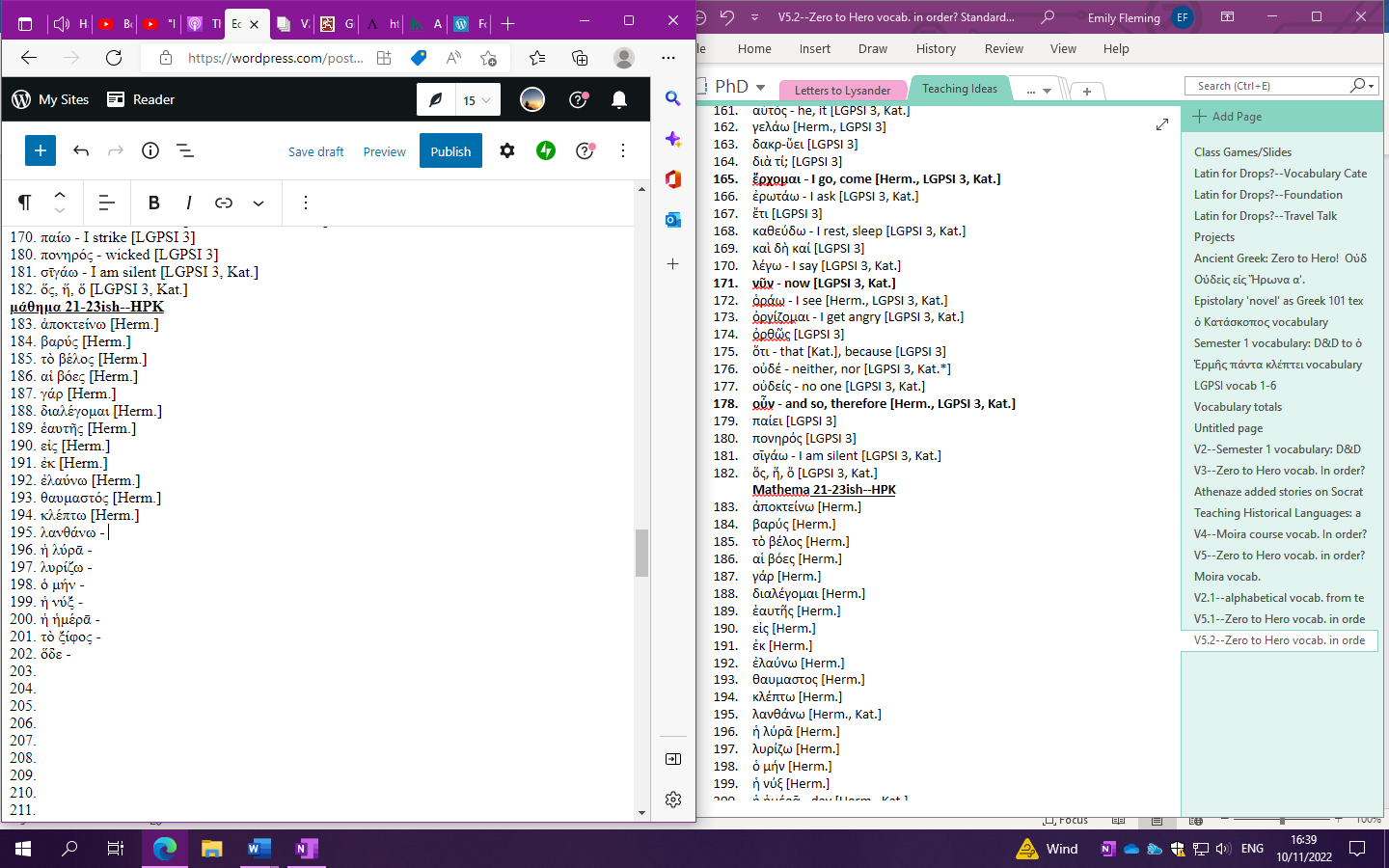
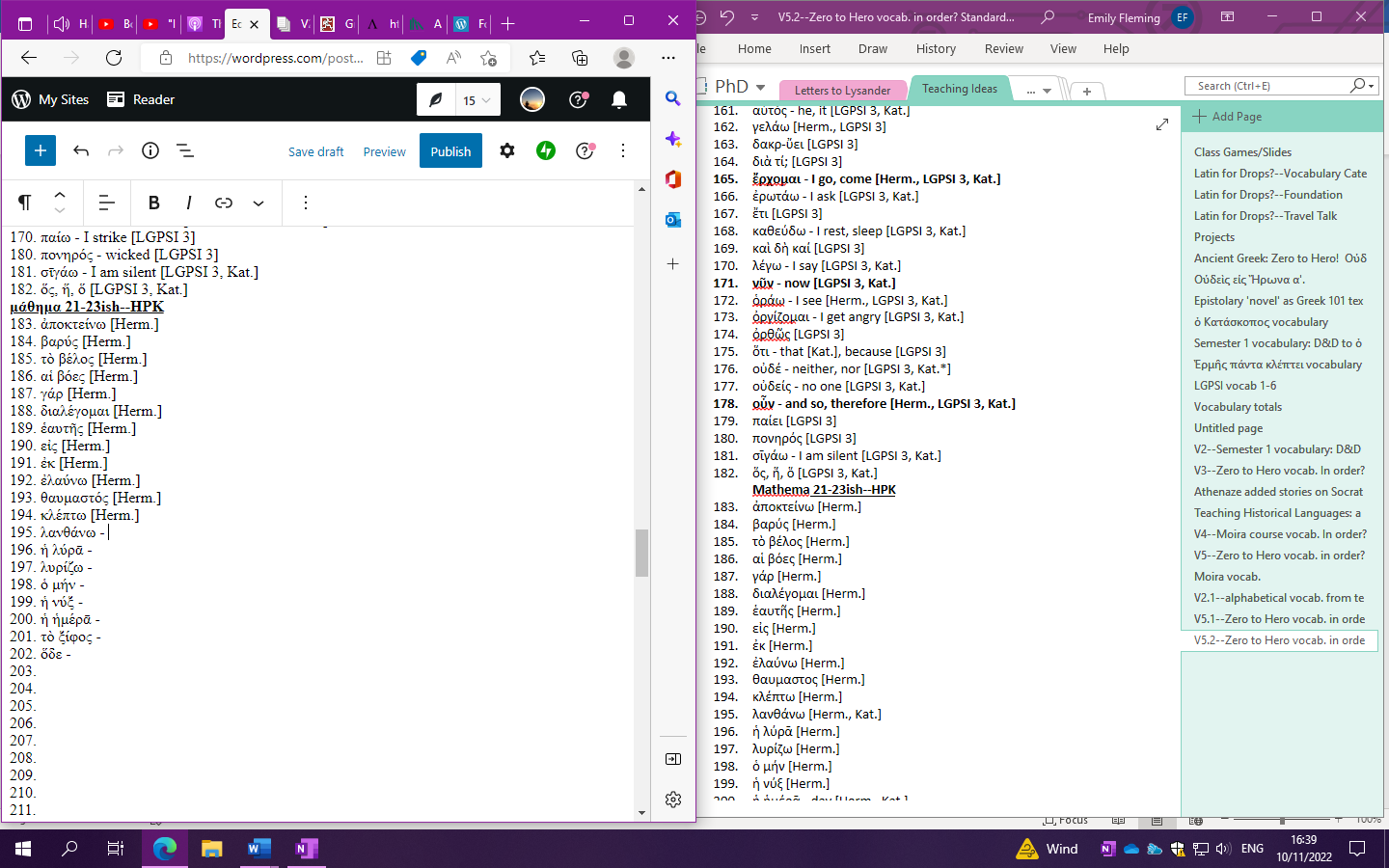
CI Curriculum for Ancient Greek: Zero to Hero!
Yes, I realize that 'Zero to Hero' is beyond the acceptable level of cheesiness in naming conventions for university courses. As this curriculum project is very much still in development, however, for now I am going to refer to it by whatever cheesy name I feel like. While 'Zero to Hero' is not exactly a sophisticated title, it communicates some key features of the way I aspire to teach Ancient Greek. First, by assuming that some students are starting from absolute scratch, with no previous Latin (or indeed, any other second language), and with no knowledge of the terminology of formal grammar. Second, by spending many hours of class time playing Μοῖρα, a D&D-like tabletop roleplaying game.
Well, I say 'D&D-like' because Dungeons and Dragons is the only TTRPG with which I expect the average person to be familiar. Μοῖρα is a slight simplification of the Fate Core system; if you know anything about Fate, you know that it's actually radically different from any edition of D&D. The main advantages for me of the Fate system are that it is more narratively driven and involves less number-crunching. Using less math might widen the appeal for the average university student; it certainly makes the rules a lot easier for me to translate and explain. More important to me is the storytelling focus, which gives me a relatively straightforward formula for a gamified version of TPRS. I love the idea of using TPRS in the classroom, but the scope for subject matter feels overwhelmingly broad (how am I supposed to come up with that many ideas for vocabulary-sheltered stories?) and high pressure. If the stories fail to engage students--if they're too repetitive, or not funny enough, or funny for twelve-year-olds but not for twenty-year-olds--then I've put in all that work for very little return.
And so I gravitate towards gamified storytelling. The structure of games is inherently somewhat repetitive, as a feature rather than a bug: the point of a game is to innovate within the rules, in order to create something satisfying or to entertain yourself (and your friends). I feel much more comfortable with my ability to create an interesting new environment (settings, NPCs, potential missions) for an existing game, than with my ability to create an interesting new story on my own. Part of the draw of the Fate system is meant to be the players' power to control aspects of the narration--which coincidentally means that the responsibility of telling a good story isn't all on the teacher or GM. Players in a Fate game have much more control over what happens in a session than do students in a Storyasking lesson. If students want to tell the kind of silly story that TPRS is known for, then they can absolutely get invested in the game to make that happen. If a room full of undergraduates wished to produce a different kind of story, whether serious or melodramatic, then they too could negotiate their preferred tone and dynamic in the exact same way.
In theory--famous last words!--it wouldn't be necessary for students to produce much speech in the target language. I reckon I'll have to hold myself consciously to reasonable expectations for student output, i.e., one to two words in the L2 towards the beginning of the semester, and perhaps as much as four or five words at a time after sixteen weeks. But I wouldn't be surprised if there's a hint of burnt rubber in the air, the first few times I take Μοῖρα out for a spin.
Sound interesting yet? I certainly hope so! I don't imagine that students can learn Ancient Greek purely from playing an RPG; rather, I think that playing RPGs would be a relatively easy and effective way to provide engaging input during class. I don't expect students to learn to speak anything beyond short phrases in Greek, nor do I particularly care what their spoken Greek sounds like. At the end of the day, the only one of the four language skills (listening, speaking, reading, writing) that we really need to engage with historical languages is reading. Speaking in Greek to a class is useful because allows me to provide input (necessary for acquisition) and students to negotiate meaning with me and with each other (certainly helpful for acquisition).
The only thing I particularly care about students doing outside of class meetings is reading. (Or listening to the same input, in the case of dyslexia or other significant learning differences.) At the time I'm writing this, October 2022, there are extraordinarily few Greek texts I'm aware of with sufficiently sheltered vocabulary for students to read (rather than decode) in their first semester. Over the past few months, I've compiled a list of about 350 Greek words from two CI-style novellas with heavily sheltered vocabulary and minimally sheltered grammar (Ἑρμῆς Πάντα Κλέπτει and ὁ Κατάσκοπος), as well as from the first six chapters of Seumas Macdonald's Ørberg-inspired Lingua Graeca Per Se Illustrata. I haven't checked recently how perfectly said list overlaps with Dickinson College Commentaries' Core 500 words, but it's certainly close--rather closer, I would guess, than the first 350 vocabulary items in any existing Greek textbook. In addition to this list (alphabetized, at the end of this blog post), I've come up with the couple of dozen words I think absolutely necessary to explain and play Μοῖρα, again preferring whatever vocabulary is high-frequency in the extant Greek corpus. Altogether, those three texts (plus the handful of supporting texts which have been written so far for LGPSI) will give your student access to a little less than 13,000 words of Ancient Greek written input for the first semester.
That sounds great. Some unscientific back-of-the-napkin estimation suggests that Athenaze I contains perhaps half that amount of Greek text, utilizing nearly four times as many different words (there are roughly 1300 in the Greek-English index at the back of the book). If we genuinely want our students to acquire by reading, and to learn to read well, 13,000 words of Greek text based on a 350-word vocabulary is moving in the right direction. Go us!
On the other hand...the rule of thumb for undergraduate courses is that you should expect to do roughly two hours' work outside of class for every contact hour, right? I think I'd spend the first two weeks teaching more dynamic vocabulary before handing them the first chapter of LGPSI, so we can divide those 13,000 words over the remaining fourteen weeks of a typical semester...and suddenly our 13,000 words don't look like nearly enough. There's no way that 900 words a week is enough input for university students to read, and no way they could spend six hours every week reading and re-reading those same 900 words without dying of boredom. (At least, I would have died of boredom.) Which means, we need an awful lot more Greek text for students to read, sticking pretty much to our core vocabulary list.
How many words do we need? There's not a ton of easily accessible data out there on the link between total words read and language acquisition--if you know of some, please comment! But a glance at Lance Piantaggini's blog suggests that high school students in their first year of a CI Latin program can comfortably read something like 45,000 words over the course of a school year. That, I think, is what we should be aiming for in the first semester of an undergraduate course that meets three times per week. If we expect students to acquire a language twice as fast in a university setting, then they deserve twice as much practice (and by practice, I mean input) as secondary students get. And that input should be as engaging and informative as we can make it.
This is obviously much too large a project for me to tackle alone, but I've made a small start. I've begun drafting a graded reader to fill in the gaps between Ἑρμῆς Πάντα Κλέπτει, ὁ Κατάσκοπος, and the first six chapters of LGPSI. (Why only the first six, you may ask? Purely because I'm not sure how well students could acquire more vocabulary.) Ordering the vocabulary and breaking it up roughly by class session is not a quick or easy task; I'd be thrilled to be done with that part of the project by Christmas. I do, however, have a draft of the vocabulary ordered for roughly the first six weeks, complete with incomplete lesson plans on PowerPoint. At some point I'll get around to posting those first fifteen slideshows, to illustrate how I imagine I might try to get students into the first session of Μοῖρα. Said presentations are of course riddled with errors and incomplete--I have not yet gone to the trouble of making the slides I would use for Picture Talks, for example.
You might notice that I have failed to standardize the presentation of the following list: only some of the nouns have articles listed, not all of the verbs are 1st person singular, macrons combined with other diacritics are represented by a hyphen following the vowel, etc. I've also left on the handful of low-frequency words that show up in Ἑρμῆς Πάντα Κλέπτει, even though I don't plan on requiring students to recall the words for, say, 'trident' or 'tongs'. Obviously I don't plan on targeting those words in the reader I'm writing; still, it seems preferable to know which words students would have seen before.
I reckon that's more than enough for one blog post; I'll share my PowerPoints introducing Μοῖρα another day. If you feel any of the work that I'm doing on Ancient Greek curriculum is useful, interesting, misguided, whatever--please get in touch! I would be particularly thrilled to collaborate with others on writing relevant Greek texts--my syntax and morphology are (I think) correct most of the time, if not error-free, but I'm well aware of how clunky my Greek is.
And here's the additional vocabulary I (currently) think necessary to explain and play Μοῖρα as a class:
Some Thoughts on Teaching Historical Languages
As I've been working on an Ancient Greek curriculum project, I've come up with the following list of principles I'm trying to follow. Some of them are a little contentious; I'll try and return to this post some time to add footnotes that indicate where my ideas come from. Questions? Comments? Concerns? If so, please comment!
*A note on vocabulary: I use the terminology of 'acquisition' rather than 'learning' consistently throughout, in order to imply that our goal is what Krashen et al. refer to as 'acquiring a language' rather than 'learning [about] a language'. I recognize that theirs is, at least originally, a peculiar distinction between the two words, and that the phrases 'learning a language' and 'acquiring a language' are entirely synonymous in most contexts.
'Objectivity and Impartiality: Epistemic Virtues in the Humanities', Lorraine Daston (2015)
A lifetime of unfinished projects has taught me one good thing: how to start enthusiastically. Four days after arriving in St Andrews for my master's degree, I sat down in the library with Classical Scholarship: A Biographical Encyclopedia and began making my way through its five hundred and thirty-four pages.* (This process was hindered by authors Briggs and Calder's alphabetical arrangement of their fifty subjects and my determination to read through the biographies in more or less chronological order; needless to say, the plans of Briggs and Calder were foiled by my compulsive tendencies.) An account of the lives and passions of fifty classicists was exactly what I needed to orient myself in the discipline, and the understanding I gained of the history of classics has proved highly useful since; I am thankful for the coincidence that I found that book on that day.
I wasn't looking for a history of how some of those very classicists shaped contemporary views of objectivity when I searched the Durham library website this morning for "Ancient Greek textual criticism", but I have once again found exactly what I was looking for by not looking for it. Daston and Galison's Objectivity was cited frequently in some of the early chapters of Values of Precision, enough that I thought I might want to get around to reading it someday; after running across Daston's chapter in the unenticingly named The Making of the Humanities, Volume III today, I am eager to track down a copy. More importantly, I am newly affirmed in the importance of my new discipline, which appears to be something called 'history of science'.
In St Andrews, my nearly-new discipline was Classics--Ancient Greek literature, specifically. I'd squeezed a classical lit major out of my final three semesters at UNC-Chapel Hill (not at all recommended, but pleasant times were nevertheless had). Classical Scholarship had helped me see what kind of research could be done in Classics and what kind of training you needed to do it. Similarly, Lorraine Gaston's chapter of The Making of the Humanities is exactly the kind of thing I want to read, and exactly the kind of thing I think--even after millennia of historical research--needs writing. I am surprised to find myself technically occupying the Ancient History side of the Durham department, rather than the Classics side; it is nice to be reassured that I am possibly in the right spot after all. That would mean that I need to learn how to become a historian, however, which sounds like a lot of work at the moment.
Key concepts that I need to keep tracing from Daston 2015:
The soundtrack for today's work has been 1940's instrumentals: if I can't let myself work on the fiction project, I can at least listen to the characters' music and pretend that I'm working in a coffee shop, rather than my sister's childhood bedroom.
*Thank goodness my 879,453-word journal has a search function. I finished Classical Scholarship four days later, in case you were wondering. In case you weren't--well, all I'll say is that future generations were grateful for Samuel Pepys.
**I systematically use braces {} to denote a word which has been transliterated. You should, too, because a) it reduces ambiguity; b) nobody is using braces for anything else; c) braces are a standard feature of keyboards, whereas italicizing can be a pain; d) it reduces the ugliness of transliterated words like {'istorih}; and e) I wouldn't have to keep writing this footnote.