
OK, but _why_ is the US a lawyerly society, and what does that mean?
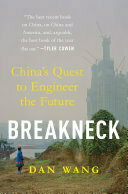
Finished reading: Breakneck by Dan Wang 📚
Slipped into the acknowledgements is the author’s own comment, “Breakneck is written from a perspective that makes most political scientists tart and many historians grumpy.” So at least Wang knows what is coming. I was not entirely grumpy while reading this book, drawn to it as I was by a mention of “process knowledge” in a review. I think that Wang’s descriptions of various aspects of the Chinese “engineering society”–some coverage of manufacturing in China, the one-child policy, zero-Covid–are clear, moving, and informative, and I’m glad to have read them. Wang’s argument about how an engineering outlook has dominated the decisions of the CCP is overall quite persuasive. I’m grateful for how this book (in serendipitous connection with some other recent reads, including Leo XIV’s Magnifica Humanitas and this particular response to it) has helped me to think about what a humane economy might look like, by studying one particular economy which is so frequently inhumane.
But given the book’s probable influence, I’m bothered by the inadequacy of Wang’s description of the US as a “lawyerly society”. First of all, even if I didn’t know anything about American history, I’d like to think that I’d still notice that Wang portrays the “lawyerliness” of the US as largely dependent on more-or-less progressive elements from the 1970’s onwards. (For this view he appears to depend largely on Paul Sabin’s 2021 Public Citizens: The Attack on Big Government and the Remaking of American Liberalism, a book which I haven’t read; I therefore can’t confirm how well Wang’s “lawyerly society” corresponds to Sabin’s arguments.) And yet it’s quite clear, not only from what I know of the US but from examples cited in the book, that America’s lawyerliness is nothing new; on the contrary, it’s part of how the country has always been. It’s perfectly sound, of course, to study that that legal culture has evolved in the last fifty or sixty years. What is not sound, historically or even logically, to totally ignore centuries of America’s legal culture, something that (as Wang notes) seemed noteworthy even to de Tocqueville. And as a result, we know that Wang’s causes (the regulatory responses to the efforts of individuals such as Ralph Nader, Rachel Carson, and those they inspired) simply cannot be the actual cause of the “lawyerly society” Wang describes.
I happen to think I can tell you what that cause is, as can anyone who’s familiar with either Frederick Jackson Turner’s The Frontier in American History or Daniel Immerwahr’s How to Hide an Empire. It’s pretty straightforward. America is in large part defined by its series of new frontiers, and by the series of new resources generated by that ever-recurring expansion. The frontier is fundamentally the meeting-place between a place with established laws and a place without them–and it is therefore a place where the laws are fundamentally up for a bit of debate, or negotiation. From the 15th century onwards, the New World has in one or more ways been continually the subject of legal grey areas: is this land Spain’s to exploit, or Portugal’s? (No need to worry about the people who already live there, of course.) Which company will the king charter to operate in the colony? Who is authorized for trade?
And the establishment of a new nation in North America is an example of this trend (let’s start a new country out of all these states! let’s have some continental congresses to decide how it runs, shall we?), not a counterexample. A new constitution is set up–but a constitution on the edge of what its people regard as a frontier. And so the treaties that the US signs with various native tribes nations are, of course, always provisional in a legal sense–always up for renegotiating or simply ignoring, when convenient. There are no real penalties for breaking agreements at the frontier.
The nation’s physical frontier admittedly closed a little later than Turner was able to realize, as can be attested to by residents of Hawai’i, Puerto Rico, for a long time the Philippines, et al. But by that time, the US was well on its way to capitalizing on technological frontiers. After all, agreements not to use nuclear weapons can’t be expected to precede the existence–or deployment–of actual nuclear weapons…can they? So in a similar fashion to nuclear technology, laws and agreements for governing the use of new technology has lagged behind the actual development and use of new technology, right up through the history of computers. Even today, we are still figuring out what laws make sense where various forms of artificial intelligence, including social media and LLM’s, are concerned.
And this, I submit, is not generally because human beings just aren’t smart enough to figure out the ways that existing laws would apply to new territories or new technologies. It is in fact because Americans are smart enough to see the opportunities for creative interpretation or amendment of existing legal frameworks, that we are able to set aside the legal norms we already have in favor of developing new ones specific to a new domain. The FDA was not established (in 1906! C’mon, Wang! where is the Progressive Era in your book?) because everyone in the stockyards suddenly forgot whether or not it was appropriate to sell diseased meat; they exist because the development of railroads & refrigeration enabled the meatpacking czars to profit from selling diseased meat at a hitherto undreamt-of scale. Similarly, when today’s chatbot founders have the opportunity to increase profits by providing mental health services, they’re only interested in doing so as long as the existing responsibilities of actual mental health clinicians don’t apply. I don’t think it’s a very challenging moral ambiguity as to whether one can train an LLM on someone else’s creative work without that person’s explicit permission. The protracted cover-ups of the missteps in the chemical revolution also violated pre-existing norms. What was lacking during the several decades 3M continued to manufacture PFAS after discovering that it was extremely harmful and steadily accumulating in human beings was not actually the EPA’s rather recent “4 ppt” guidelines for PFAS in drinking water. What was lacking was a conscience, and the willingness to apply existing rules about poison to new chemicals.
I’ll cut the diatribe off there, I suppose, because this book review is too long, and I want the reader to understand that my frustration is not mere historian’s pedantry. My grumpiness about Wang’s fundamental misunderstanding of the frontier’s role in America’s lawyerly society results from the fact that his book is a call to action. He presents a parallel problem with twin solutions: China could do with more lawyers (or with placing a higher value on the law, anyway), and the US could do with more engineers (or the same, valuing engineers more highly). It’s true that engineering is a kind of power to remake the world, and that those who are properly equipped can do something apparently similar with the law. But despite his stated sympathies with the ways that “lawyers are servants of the rich”, Wang doesn’t really have any idea how and why that is sometimes so much the case in the US.
If Breakneck were to live up to its promise, Wang would have needed to explore the gap between a lawyerly society and a law-abiding society. Because being a lawyerly society has obviously not transformed the US into a society that is particularly good at sticking to its laws, when a new physical or technological frontier appears on the horizon. In the last few decades of globalization, we have become experts at evading our own trade, labor, & environment laws by simply outsourcing that labor & manufacturing to countries where it’s easier to abuse one’s workforce or one’s environment. This is blatantly immoral. It is an astonishingly creative interpretation of US laws to simply pay Foxconn to treat their workers like animals or machines.
Ultimately, I agree with Wang, that the US should rely much less on Chinese manufacturing. But bringing manufacturing back to the US is going to be a brutal project. The American workforce is, I suspect, mostly not going to be willing to work under the same conditions as the average worker in Shenzhen–nor is it feasible to pay Americans at Shenzhen rates. Reimagining manufacturing as a safe and humane industry will require vast wisdom and insight, not just a new supply of the process knowledge that has rusted in America. It will require vast numbers of Americans to possess and exercise a conscience. It will also probably require vast sums of money. No one is going to make a really good fortune off of disentangling American supply chains from China under humane working conditions. And meanwhile, what are we going to do about Americans whose monthly budgets are counting on Wal-Mart and Dollar General prices, if Wal-Mart and Dollar General prices go away?
Someone could write a really good and useful book about what it would look like for American manufacturing industries (to say nothing of, say, American agriculture) to disentangle themselves from the Southeast Asian sweatshops, the Chinese factories, etc on which they rely, and to humanely increase the US’s manufacturing capabilities. That would be a wonderful call-to-action book to be able to read.
The book that Wang has actually written still offers an excellent look at the way the Chinese government turns its people into numbers, for the purposes of trying to engineer an ever-better society. It has serious limitations as a book for thinking about America’s future, however, because of its limited comprehension of America’s past. American laws proliferate because Americans have always left room for a few lucky folks to strike it rich by creatively ignoring the laws we already have. If Wang’s prescription is applied to US engineering without an accompanying change in the American conscience in respect to the frontier, we can confidently predict that such a libertarian impulse will simply facilitate the same kinds of exploitation to which we have grown accustomed.
How to fix the American conscience is an even more difficult project than how to revive American manufacturing. Absent a conscience, of course, the easiest route to reviving manufacturing is super easy, barely an inconvenience: you just create wartime conditions that a significant portion of the population is on board with. Indeed, since chatter about the antichrist flutters around the tech world these days, it is worth noting that war offers precisely the right theater for the contradictions of the one opposed to Christ. War exists in the place where social norms and laws–alliances, kinship groups, governments, justifications–crash like waves into the lawlessness of cruelty, destruction, and death. And while you may not hear much about it from billionaire libertarians (who have profited enormously from the aforementioned American attitude towards legality at the technological frontier, as it happens), the anti-Christ is not only the specter of an all-encompassing government that feigns to offer the unity of Christ’s church. In 2 Thessalonians, in fact, the source for the figure of the restrainer (τὸ κατέχον), Paul refers to the one opposed to Christ as a man of lawlessness. Which is a less useful picture of the Antichrist for a libertarian billionaire, perhaps, than the leader of a totalitarian one-world government, but quite useful for the person who wishes to understand the tenuous role of legality whenever Americans find a new frontier.
From the Christian perspective, the negative vision of the Antichrist–able to enact and manipulate laws, yet himself lawless–is of course not the only option. The Christian prescription is a positive one: the American conscience, particularly at geographic or technological frontiers, needs Jesus Christ. While that prescription is simple to name, of course, it is not so simple to accurately describe. To meditate on the nature of law in the Bible is as rewarding as the psalmist states, but it is not so simple to state in a few words the relationship between fickle, flourishing humanity and the graven tablets of the law. The positive vision of the law has its origin and its fulfillment in Jesus Christ, and to contemplate law in the eternity of Christ is to know what one needs to do. It is also to know what there is in the good that is not so precisely captured by the law.
That call to action is not very likely be received by Tyler Cowen quite as rapturously as was Breakneck (“The best recent book on China, on China and America, and, arguably, the best book of the year flat out.") It does, however, offer the hope that America’s future might be something other–something better–than America’s past and present. And I agree wholeheartedly with Wang that change is needed. May we find true wisdom as we consider what that change might look like.