
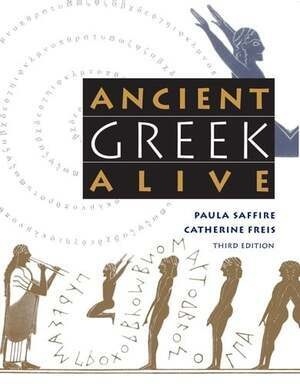
Finished reading: Ancient Greek Alive by Paula Saffire 📚
LibreOffice Writer estimates about 15,000 words of Greek text, counting the scripts at the beginning, the folk tales, the poetry, and the thesauros at the end of the book. The texts more or less all met my bar for “compelling input”, i.e., if I had encountered them in my native language, I would have found them acceptable to read. And as I mentioned in a previous post, I admire the authors' decision (borrowing a contemporary slogan) to “shelter vocabulary, not grammar”–or at least, not so severely that the results are unrecognizable as Greek. The Greek sections add up to a nice reader for students who are looking for more comprehensible input. Admittedly, it would be difficult to justify the purchase ($50 for a new paperback from UNC Press!) for a 15,000-word mix of a handful of culturally significant authentic snippets and some charming easy Greek folk tales. The best bet for the student working their way up to more fluent reading is to do what I did: check it out of the nearest university library.
Altogether, I consider the grammar/vocabulary sequence of Ancient Greek Alive as the best existing textbook for a Medulla-style curriculum in Ancient Greek. That said, the Greek text is (in my opinion) no more than a tenth of what a first-year student should be offered as reading material. If anyone is thinking of writing novice Greek texts, I would encourage them to take a look at AGA and consider trying to work with this textbook’s core vocabulary. It will probably suit you better for storytelling than any equivalently-sized textbook vocabulary list on the market.
I mentioned a few downsides in prior posts about the book. One that didn’t come up is the quality of the copy-editing in the third edition. My impression, from poking around online, is that the numerous errors in the book (mostly Greek accent typos, but with an eye-catching tangle in the English-language background section “The Personal Muse”, pp.152-3) are a feature limited to this latest edition. While I am dreaming of a world in which Ancient Greek is taught through acts of meaningful communication, I shall also express the hope that renewed interest in this textbook might result in UNC Press bringing out a more tightly edited fourth edition.