books
- Objectivity--or as Daston frames it in this chapter, objectivity versus impartiality. Does impartiality overlap exactly with the concept of 'disinterestedness', so important in the eighteenth century and vanishing in the next? Daston doesn't say; perhaps she and Galison discuss this in the longer book.
- 'Epistemic virtues'--these came up fairly often in Berrey's Hellenistic Science at Court, which I found fascinating; they seem highly relevant to my project. Need to read more about the history of this term and its significant uses.
- Thucydides I.22--I knew that {akribeia}** came up in Thucydides, I think (thanks TLG!), but I hadn't thought about that fact in quite a while. I'm still trying to figure out where exactly Ancient Greek historical writing fits into my dissertation outline--a section on 'rhetorical uses of accuracy & precision' keeps not quite fitting in where I want it to--but maybe there's a closer link than I had realized between Greek historiography and Alexandrian textual criticism (the latter of which is what I had intended to read up on this morning). Maybe {akribeia} in writing history & Homer is what I need; maybe this is finally the connection that will turn my pages and pages of notes into a coherent whole...
- 'Big Science', to use Daston's term--absolutely fascinating the way she traced the origins of highly collaborative and highly methodical research projects in, say, nuclear physics to 19th century historiographical projects like Mommsen's Corpus Inscriptionum Latinarum. I've been reading up on 20th century science megaprojects (the Manhattan Project, the Apollo missions, et al.) for an idea that I had last week for a novel. I absolutely have not started to write the novel (well, except for a few paragraphs), and of course my dissertation takes priority, so it doesn't even matter if I see connections between the novel and what I'm reading for my PhD--but the synergy is exhilarating. I may start a new Scrivener file, just so I can take notes for the novel as well....
- Networks--fascinating also the way she stresses the importance of apprenticeship-like research seminar groups in establishing historical methodologies. This features connects both with a number of chapters in Values of Precision, which emphasized how standards are negotiated by networks (cf. especially M. Norton Wise's 'traveling numbers' concept), and with the image of a mathematical network described in Netz's 2002 chapter (and elsewhere in Netz's writing, I think). I'm sure this broader topic has connections with Steven Johnstone's A History of Trust in Ancient Greece, but at the moment I can't think what they are.
- Daston's conclusion--a fascinatingly negative take on objectivity as a whole--not just in its potential for facilitating distortion of history, or the posing of wrong-headed questions, but for its social effects. I don't know exactly the extent to which I agree with that negativity, but I love so much being forced to reevaluate. What a marvelous idea, this 'history of science'. How relevant. How important. How interesting. Someone should write a novel about a science historian time-traveling to 1940....
- Last Song before Night, Ilana C. Meyer
- Carpe Jugulum, Terry Pratchett
- The Truth, Terry Pratchett
- The Spy Who Came In from the Cold, John le Carré
- The Promise, Chaim Potok
- This Is Awkward: How Life's Uncomfortable Moments Open the Door to Intimacy and Connection, Sammy Rhodes
- Searching for Bobby Fischer, Fred Waitzkin
- In a Sunburned Country, Bill Bryson
- Jinx, Sage Blackwood (re-read)
- Jinx's Magic, Sage Blackwood (re-read)
- Jinx's Fire, Sage Blackwood (re-read)
- Chance Fortune Out of Time, Shane Berryhill (re-read)
- The Unicorn Hunt, Dorothy Dunnett
- National Velvet, Enid Bagnold
- Civilization and Its Discontents, Sigmund Freud
- The Pigeon Tunnel: Stories from My Life, John Le Carre
- Odd and the Frost Giants, Neil Gaiman
- Crispin: The Cross of Lead, Avi
- On the Trail: the History of American Hiking, Silas Chamberlain
- Outliers, Malcolm Gladwell
- Sense and Sensibility, Jane Austen (re-read)
- Queens' Play, Dorothy Dunnett (re-read)
- The Disorderly Knights, Dorothy Dunnett
- Crispin: At the Edge of the World, Avi
- Pawn in Frankincense, Dorothy Dunnett
- The Ringed Castle, Dorothy Dunnett
- Checkmate, Dorothy Dunnett
- Crispin: The End of Time, Avi
- Excellent Women, Barbara Pym
- The Old Man and the Sea, Ernest Hemingway
- My Side of the Mountain, Jean Craighead George (re-read)
- Music Education in the Christian Home, Mary Ann Froehlich
- The Chronicles of Downton Abbey, Jessica Fellows & Matthew Sturgis
- The Power of Babel, John McWhorter
- Till We Have Faces, C. S. Lewis (re-read)
- The Screwtape Letters, C. S. Lewis (re-read)
- The Great Divorce, C. S. Lewis (re-read)
- Out of the Silent Planet, C. S. Lewis (re-read)
- The First Days of School, Harry K. & Rosemary T. Wong
- Margin: Restoring Emotional, Physical, Financial, and Time Reserves to Overloaded Lives, Richard A. Swenson
- Perelandra, C. S. Lewis (re-read)
- That Hideous Strength, C. S. Lewis (re-read)
- Hidden Figures, Margot Lee Shetterly
- One Thousand Gifts, Ann Voskamp
- Extravagant Grace, Barbara Duguid
- The Tolkien Reader, J. R. R. Tolkien
- The Thief, Megan Whalen Turner (re-read)
- The Queen of Attolia, Megan Whalen Turner (re-read)
- The King of Attolia, Megan Whalen Turner (re-read)
- A Conspiracy of Kings, Megan Whalen Turner (re-read)
- Thick as Thieves, Megan Whalen Turner
- Niccolo Rising, Dorothy Dunnett
- Spring of the Ram, Dorothy Dunnett
- Race of Scorpions, Dorothy Dunnett
- Scales of Gold, Dorothy Dunnett
- Lies Women Believe: And the Truth That Sets Them Free, Nancy Leigh DeMoss
- A Wrinkle in Time, Madeleine L'Engle (re-read)
- A Wind in the Door, Madeleine L'Engle (re-read)
- Iron Man: The Gauntlet, Eoin Colfer
- Many Waters, Madeleine L'Engle
- Holes, Louis Sacchar (re-read)
- The View from Saturday, E. L. Konigsberg (re-read)
- A Swiftly Tilting Planet, E.L. Konigsberg

Finished reading: Greek Reader by Mark Jeong 📚
ἀναγιγνώσκουσα σήμερον (4/2/26) ἐξετέλεσα τὸ βιβλίον A Greek Reader: A Companion to Biblical Greek, ὅν Μαρκ Ιεογγ συνέγραψεν. ὡς φαίνεται ἀπὸ τοῦ ὀνόματος αὐτοῦ, τὸ βιβλίον τοῦτο συνεγράφη ἵνα οἱ μανθάνοντες τῃν Κοινὴν γλῶσσαν τῆς τοῦ Κρῶι εἰσαγωγῆς οἱ μαθηταὶ ἀναγιγνώσκοιεν αὐτόν. χρσηιμώτατον οὖν ἐστι τῷ μαθητῇ τοῦ Κρῶι, χρήσιμον δὲ καὶ ἐμοί. οὐκ ἤρεσκέ μοι ὅτι τὸ νῦ ἐφελκυστικὸν καὶ ἡ ἔκθλιψις οὐκ ἔφαινον ἑν τοσούτοις κεφαλαίοις, ἀλλʽ ἴσως ὁ Κρῶι ἄνευ τούτων πολλὰ κεφάλαια συνέγραψεν.

Finished reading: Reading Greek with the Desert Fathers by Timothy Brady 📚
ἀνεγνώσθη τοῦτο βιβλίον. ἀγαθὸν βιβλίον ἐστίν. ταῦτα τὰ μικρὰ καὶ ὀλίγα τὸν συγγραφέα ἔλαθε·
-p.17 (story 7), “τᾶς” ἀντὶ “τὰς”
-p.32 (story 18), δεκαεπτά glossed as 15
-p. 35 (story 19), “τὸ Θεὸν” ἀντὶ “τὸν Θεὸν”
-p.39 (story 21), “ἐν ᾦ” ἀντὶ “ἐν ᾧ”
-p.40 (story 21), “ἀπέκδωκεν” ἀντὶ “ἀπέδωκεν”
-p.51 (story 29, FN 12), “ὄρασις” ἀντὶ “ὅρασις”
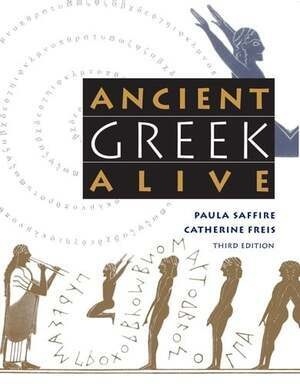
Finished reading: Ancient Greek Alive by Paula Saffire 📚
LibreOffice Writer estimates about 15,000 words of Greek text, counting the scripts at the beginning, the folk tales, the poetry, and the thesauros at the end of the book. The texts more or less all met my bar for “compelling input”, i.e., if I had encountered them in my native language, I would have found them acceptable to read. And as I mentioned in a previous post, I admire the authors' decision (borrowing a contemporary slogan) to “shelter vocabulary, not grammar”–or at least, not so severely that the results are unrecognizable as Greek. The Greek sections add up to a nice reader for students who are looking for more comprehensible input. Admittedly, it would be difficult to justify the purchase ($50 for a new paperback from UNC Press!) for a 15,000-word mix of a handful of culturally significant authentic snippets and some charming easy Greek folk tales. The best bet for the student working their way up to more fluent reading is to do what I did: check it out of the nearest university library.
Altogether, I consider the grammar/vocabulary sequence of Ancient Greek Alive as the best existing textbook for a Medulla-style curriculum in Ancient Greek. That said, the Greek text is (in my opinion) no more than a tenth of what a first-year student should be offered as reading material. If anyone is thinking of writing novice Greek texts, I would encourage them to take a look at AGA and consider trying to work with this textbook’s core vocabulary. It will probably suit you better for storytelling than any equivalently-sized textbook vocabulary list on the market.
I mentioned a few downsides in prior posts about the book. One that didn’t come up is the quality of the copy-editing in the third edition. My impression, from poking around online, is that the numerous errors in the book (mostly Greek accent typos, but with an eye-catching tangle in the English-language background section “The Personal Muse”, pp.152-3) are a feature limited to this latest edition. While I am dreaming of a world in which Ancient Greek is taught through acts of meaningful communication, I shall also express the hope that renewed interest in this textbook might result in UNC Press bringing out a more tightly edited fourth edition.
...Actually, I understand why so few teachers use Ancient Greek Alive
For all that the Greek readings in Saffire & Freis’s textbook possess real charm, spending more time with those texts has made me realize how tricky it would be to re-draft my little historical reader to align with its vocabulary progression. The trouble is that the stories are just so very short, often on the order of about 100-200 words long. And for all that I like very much the idea of the Thesaurus at the back, the amount of unfamiliar vocabulary in them is probably just too overwhelming for a beginner student. The NT selections are not so bad on this front as the ones from Heraclitus; at least, the NT verses selected tend to feature much more internal repetition of words. I acknowledge that the Thesaurus sections were chosen mainly for their foregrounding of certain grammatical structures, and that the authors of Ancient Greek Alive don’t (presumably) see vocabulary acquisition as a goal for that section. But that makes no sense. When you read, it matters whether or not you know what most of the words mean. When most of the words in a sentence have to be glossed for you–and the same is true of the next sentence, and the one after that–it is hard to see how a student will be able to internalize the grammatical structure with which they are being presented. This is just silly. The same, by the way, is true of the lines from Sappho which constitute the student’s second poem to be memorized–and this for a poem that’s already in Aeolic.
I still think this book would work okay for a student who loved to memorize and found it quite easy to do: you would simply have the student more-or-less memorize the folk tales as well as the Thesaurus selections. If a student was willing to memorize everything, then they’d eventually end up able to read Greek. However, this textbook offers nowhere near enough material–and too much of it, much too difficult–for a student to learn by reading. Even then, I still think that a student would learn better from reading exponentially more Greek.
The lists of “vocabulary to be learnt” are a little misleading in this regard: they don’t at all prepare you for the Thesaurus readings. They teach you most of the words that show up in the folk tales. I think that’s a shame, to decide that students have to struggle through texts they’re wildly under-prepared for, and then fail to even incorporate the rewards of those struggles into the rest of the text.
I think, if I were really committed to writing a reader to go with this textbook, what I’d need to do is to give up altogether on the idea of history per se and go back to the epistolary idea. You would want to write pretty much one letter for every single chapter of this book. I don’t know whether the fictional baby Greek letters I’ve written are sufficiently charming for students to enjoy reading one every day or not. It would require a lot of creativity, to figure out a new letter to write that fits well with every single day’s vocabulary. Also, the vocabulary is distributed with great unevenness across the days, but it’s not uncommon to encounter a day with twenty or even thirty new words, counting the vocabulary in the Thesaurus. And should one include the vocabulary in the Thesaurus, to begin with? If you don’t, what’s the point of the section to begin with?
Maybe it would be a good creative writing exercise for me to try and make the epistolary reader happen as a companion volume to AGA. But that removes the prime advantage of the historical reader, i.e., it was supposed to make it easy for teachers to find things to talk about in Greek, in the classroom, every day. If I go back to epistolary reader, it’s no longer the case that one could count on having the option of a safe, easy, informative discussion topic for every single class. And I liked the idea of learning Ancient Greek through History, darn it. It meets a real need, I think: students do tend to be woefully ignorant of the ancient world in which Greek speakers lived and wrote and traveled.
So I don’t know that I really will throw out the idea of an LGPSI historical companion reader after all. For all that I think Saffire’s little stories are so charming and re-readable, I think the vocabulary in the early chapters of this book is simply too difficult to adapt that way.
Have we all been sleeping on Ancient Greek Alive?
Simply turning up to the UNCA library on Tuesday to wander through the shelves for a couple of hours seems to have filled me with new life, academically speaking. I found two books that had been misshelved by a row or more (and only checked out one of them). I serendipitously encountered a book on my TBR list, George Steiner’s After Babel, and brought it home with me. I was reminded of the kind of research I want to be able to read (competently, critically), and the kind of research I want to be able to do.
And, not least, I checked out a book which may change the direction of my Ancient Greek introductory graded reader project: Paula Saffire and Catherine Freis’s Ancient Greek Alive. I checked it out for the novelty of the Greek reading material it contained; extremely simple folk tales are part of a healthy diet for language slackers like me. The next day, having read through the nine introductory scripts and the first ten lessons, it struck me: this is the easily the sanest vocabulary progression I’ve ever encountered in a textbook. Very restrained when it comes to nouns: e.g., one learns only μήτηρ & παῖς together in their first story, and the other family nouns you’d expect (πατήρ, ἀδελφός/ή, υἱός, θυγατήρ) are saved for other chapters. Same deal with parts of the body: you get ὀφθαλμός & χείρ quite early, δάκτυλος soon after, but there’s never a frantic attempt to cram in, say, οὖς, κεφαλή, πούς, πρόσωπον, as well. To me, this seems to be the most sensible decision, given how slowly vocabulary is really acquired, and how many other words you need to learn.
Verbs, for example. You need a lot of good verbs to tell any kind of a series of interesting stories, and many of the best verbs for writing beginner stories are irregular. By the end of Script #9, Saffire & Freis have gotten us off to quite a good start: ἀκούω, γιγνώσκω, ἀναγιγνώσκω, γράφω, δακρύω, ἐθέλω, ἐσθίω, ἔχω, κάμνω, λαμβάνω, λέγω, μανθάνω, μεθύω, πίνω, χαίρω, ἐρωτάω, ὁράω, γαμέω, καλέω, νοσέω, ποιέω, φιλέω, βούλομαι, ἔρχομαι, φοβέομαι, δείκνυμι, δίδωμι, εἰμί, εἶμι, κεῖμαι, ἀνίσταμαι, and οἶδα. That is a terrific set of verbs to be working with during the first few weeks of class. Do students know all of them equally well? No, they do not. But they have seen them before and will see them again, because that is a fantastic list from which to plan classroom activities or write extra reading material. I don’t know that you can be properly impressed by the vocabulary review list on p.25 until you’ve spent time with other Ancient Greek curricula. It’s just so–elegant. And sensible. I am a very firm believer in not sheltering students from common irregular verbs until they’ve been at the language for a semester or (worse) almost two: they simply don’t get enough practice time with -μι verbs if you don’t touch them until the year is almost over. No, give them a couple of -μι verbs right from the start, and lots of opportunities to use them.
And the authors haven’t been overly precious about avoiding any kind of verb form for which the students haven’t been given a complete paradigm & grammatical explanation. The 1st & 2nd person plural forms are, I note, exempt from student production for a while. Although this is painful, I can recognize that they are simply not as important for students in either classroom conversation or in storytelling, and sacrifices (temporarily) have to be made. But the teacher’s scripts contain not only all six personal endings and the imperatives a TPR partisan would expect, but also the 1st person plural present active subjunctive. There are also a handful of aorists scattered throughout these introductory scripts, mostly in the imperative & infinitive to contrast aspect, but a handful to indicate past tense (“ἔμαθον τὸ ποίημα”, e.g.). Again, I think all this is healthy for a student. They can (and will) learn to produce and analyze these forms later. But at the very beginning, to be exposed to them in a meaningful context is what they need.
It also hurts a little to have such a tiny set of prepositions (I see ἐπί, ἐκ, & δία listed, and I am fairly certain I remember a glossed ἐν from a later script), but I can recognize this also as a sensible temporary sacrifice. Getting comfortable with personal endings for verbs & case endings for nouns/pronouns should reasonably come first, and internalizing those deserves time. Thankfully, Saffire & Freis have also chosen the path of wisdom in allowing some of their two dozen starting nouns to come from the third declension. Again, students will internalize this if given sufficient space to do so, and it’s better to start them as you mean to go on.
I suspect one of the reasons this book isn’t more popular is the authors' approach to the content of the AG readings: “Being a purist I was unwilling to water down or otherwise distort Greek material. I admired the Greek texts for their beauty and vigor, and did not want to tamper in the least….I went to the children’s library…picking out any stories I thought were funny, intriguing, or both. These I translated into Ancient Greek” (p.xv). Thus AGA’s Ancient Greek readings are mainly “original” Ancient Greek content, which has little or nothing to do with the Ancient Greek world. I more or less share Saffire’s disinclination to simplify authentic texts drastically enough for a first-semester student to be able to read them, which is why I am working on writing my own. Not because I identify as a purist (I don’t); I just think that the texts become less intrinsically interesting after passing through that layer of translation and de-authentication. Once you’re reading an adaptation rather than the real thing, and the satisfaction of touching someone else’s words across the millennia is gone, the adaptation in question needs to be tremendously compelling on its own terms for me to feel any kind of intrinsic motivation to read it.
But AGA also contains a handful of authentic short poetic excerpts to be memorized (Sappho, Archilochus, Mimnermus, Homer, and a couple of Anacreontea), along with a Θησαυρός section at the back of the book, containing brief prose excerpts from the New Testament, Heraclitus, Xenophanes, epitaphs and related snippets (some from Greek tragedians, most from Lattimore’s 1962 Themes in Greek and Latin Epitaphs), Diogenes, and other famous sayings. This kind of encounter with authentic texts is, I think, far more compelling than an adapted version. I also think that memorizing sentences (in this case, authentic sentences with interesting content) is much more valuable from an SLA perspective than is memorizing vocabulary lists. I think a teacher could do much worse than to ask students to memorize some of the Θησαυρός selections–or perhaps to make artistic posters illustrating them with nice calligraphy. From what I’ve seen of the folk tales so far (through about chapter 10), they are also engaging enough that I would feel I was being reasonable if I asked students to create little illustrated picture books of the stories. This sounds like a small thing. But compare a random Nasrudin story with a random reading from another Greek textbook: do you honestly think that these stories land the same way? The folk tales (again, thus far) have sufficient charm that I would not find my time wasted if I were to read them in any language. The same simply cannot be said of other Greek textbooks.
Of course, there isn’t anything like enough enough Ancient Greek material for students to read in this book. I don’t have an estimate yet, but to put a wild round number on it…maybe ten thousand words total from these readings? Fifteen? I am not certain that it is as high a figure as twenty. And this, mind you, is for a book that’s meant to cover two semesters of Attic Greek. For all the joy of rereading and memorizing–which again, is vastly more plausible for Ancient Greek Alive than for any other AG textbook I’ve laid eyes on–that is still not the kind of input that any student trying to learn to read Greek fast needs. To try and get from zero to large quantities of authentic texts (even the “easy” ones) in a year is an ambitious goal. I don’t think this book alone is likely to get you there.
Nevertheless, the texts in the book are worthwhile (okay, maybe I’ll admit to ambivalence about the skit ὁ ἰατρὸς ἔρχεται), and the sequencing of vocabulary and grammar is almost shockingly sensible. And any teacher who picks up this book is going to have already accepted the major sticking points that I suspect many teachers will encounter with my Ancient Greek reader: namely, that the content doesn’t have enough to do with Ancient Greek, and that they’re just not sold on (or not sufficiently comfortable with) the idea of speaking Ancient Greek in the classroom. “Here’s tens of thousands of words of extra reading for your students to do, relying largely on the vocabulary & grammar that they’ve already learned; they could be doing this instead of (or in addition to) tedious translation exercises or memorizing vocabulary lists & verb paradigms” sounds like a pretty soft sell for the teacher who’s already decided on Ancient Greek Alive as a textbook.
No, the textbook isn’t free–and I suppose that is not quite my original vision. But it is eminently re-usable; you could get by with classroom copies, if you were on a tight budget. It isn’t Koine–which I still tend to think is the most sensible place to start with AG language instruction, since that’s the dialect most of the intermediate-friendly texts are written in. I don’t love the layout, visually, and I am not sure I’m sold on the whole idea of starting with uncontracted verb forms (though I am intrigued). I also prefer macrons in first-semester texts, although I think a competent teacher could get away with genuinely teaching vowel quantities through their pronunciation; that’s probably preferable to cluttering up the text with more diacritics, even if it makes me (not at all a competent speaker) nervous. Thus far I am not blown away by the historical context English readings–they’re okay, but I could name other textbooks whose historical sections I prefer.
But despite these quibbles and questions, I still think I’d do better to scrap my existing vocabulary list and take up with this one. That’ll be a little bit of a project, to organize the AGA vocabulary by chapter and then to start rewriting οἱ λιθικοὶ αἰῶνες. The end result, however, seems likely to be one which is more widely adopted by others, and which and fits more smoothly into the way I actually plan on teaching: in a classroom, face to face with human beings.
OK, but _why_ is the US a lawyerly society, and what does that mean?
Finished reading: Breakneck by Dan Wang 📚
Slipped into the acknowledgements is the author’s own comment, “Breakneck is written from a perspective that makes most political scientists tart and many historians grumpy.” So at least Wang knows what is coming. I was not entirely grumpy while reading this book, drawn to it as I was by a mention of “process knowledge” in a review. I think that Wang’s descriptions of various aspects of the Chinese “engineering society”–some coverage of manufacturing in China, the one-child policy, zero-Covid–are clear, moving, and informative, and I’m glad to have read them. Wang’s argument about how an engineering outlook has dominated the decisions of the CCP is overall quite persuasive. I’m grateful for how this book (in serendipitous connection with some other recent reads, including Leo XIV’s Magnifica Humanitas and this particular response to it) has helped me to think about what a humane economy might look like, by studying one particular economy which is so frequently inhumane.
But given the book’s probable influence, I’m bothered by the inadequacy of Wang’s description of the US as a “lawyerly society”. First of all, even if I didn’t know anything about American history, I’d like to think that I’d still notice that Wang portrays the “lawyerliness” of the US as largely dependent on more-or-less progressive elements from the 1970’s onwards. (For this view he appears to depend largely on Paul Sabin’s 2021 Public Citizens: The Attack on Big Government and the Remaking of American Liberalism, a book which I haven’t read; I therefore can’t confirm how well Wang’s “lawyerly society” corresponds to Sabin’s arguments.) And yet it’s quite clear, not only from what I know of the US but from examples cited in the book, that America’s lawyerliness is nothing new; on the contrary, it’s part of how the country has always been. It’s perfectly sound, of course, to study that that legal culture has evolved in the last fifty or sixty years. What is not sound, historically or even logically, to totally ignore centuries of America’s legal culture, something that (as Wang notes) seemed noteworthy even to de Tocqueville. And as a result, we know that Wang’s causes (the regulatory responses to the efforts of individuals such as Ralph Nader, Rachel Carson, and those they inspired) simply cannot be the actual cause of the “lawyerly society” Wang describes.
I happen to think I can tell you what that cause is, as can anyone who’s familiar with either Frederick Jackson Turner’s The Frontier in American History or Daniel Immerwahr’s How to Hide an Empire. It’s pretty straightforward. America is in large part defined by its series of new frontiers, and by the series of new resources generated by that ever-recurring expansion. The frontier is fundamentally the meeting-place between a place with established laws and a place without them–and it is therefore a place where the laws are fundamentally up for a bit of debate, or negotiation. From the 15th century onwards, the New World has in one or more ways been continually the subject of legal grey areas: is this land Spain’s to exploit, or Portugal’s? (No need to worry about the people who already live there, of course.) Which company will the king charter to operate in the colony? Who is authorized for trade?
And the establishment of a new nation in North America is an example of this trend (let’s start a new country out of all these states! let’s have some continental congresses to decide how it runs, shall we?), not a counterexample. A new constitution is set up–but a constitution on the edge of what its people regard as a frontier. And so the treaties that the US signs with various native tribes nations are, of course, always provisional in a legal sense–always up for renegotiating or simply ignoring, when convenient. There are no real penalties for breaking agreements at the frontier.
The nation’s physical frontier admittedly closed a little later than Turner was able to realize, as can be attested to by residents of Hawai’i, Puerto Rico, for a long time the Philippines, et al. But by that time, the US was well on its way to capitalizing on technological frontiers. After all, agreements not to use nuclear weapons can’t be expected to precede the existence–or deployment–of actual nuclear weapons…can they? So in a similar fashion to nuclear technology, laws and agreements for governing the use of new technology has lagged behind the actual development and use of new technology, right up through the history of computers. Even today, we are still figuring out what laws make sense where various forms of artificial intelligence, including social media and LLM’s, are concerned.
And this, I submit, is not generally because human beings just aren’t smart enough to figure out the ways that existing laws would apply to new territories or new technologies. It is in fact because Americans are smart enough to see the opportunities for creative interpretation or amendment of existing legal frameworks, that we are able to set aside the legal norms we already have in favor of developing new ones specific to a new domain. The FDA was not established (in 1906! C’mon, Wang! where is the Progressive Era in your book?) because everyone in the stockyards suddenly forgot whether or not it was appropriate to sell diseased meat; they exist because the development of railroads & refrigeration enabled the meatpacking czars to profit from selling diseased meat at a hitherto undreamt-of scale. Similarly, when today’s chatbot founders have the opportunity to increase profits by providing mental health services, they’re only interested in doing so as long as the existing responsibilities of actual mental health clinicians don’t apply. I don’t think it’s a very challenging moral ambiguity as to whether one can train an LLM on someone else’s creative work without that person’s explicit permission. The protracted cover-ups of the missteps in the chemical revolution also violated pre-existing norms. What was lacking during the several decades 3M continued to manufacture PFAS after discovering that it was extremely harmful and steadily accumulating in human beings was not actually the EPA’s rather recent “4 ppt” guidelines for PFAS in drinking water. What was lacking was a conscience, and the willingness to apply existing rules about poison to new chemicals.
I’ll cut the diatribe off there, I suppose, because this book review is too long, and I want the reader to understand that my frustration is not mere historian’s pedantry. My grumpiness about Wang’s fundamental misunderstanding of the frontier’s role in America’s lawyerly society results from the fact that his book is a call to action. He presents a parallel problem with twin solutions: China could do with more lawyers (or with placing a higher value on the law, anyway), and the US could do with more engineers (or the same, valuing engineers more highly). It’s true that engineering is a kind of power to remake the world, and that those who are properly equipped can do something apparently similar with the law. But despite his stated sympathies with the ways that “lawyers are servants of the rich”, Wang doesn’t really have any idea how and why that is sometimes so much the case in the US.
If Breakneck were to live up to its promise, Wang would have needed to explore the gap between a lawyerly society and a law-abiding society. Because being a lawyerly society has obviously not transformed the US into a society that is particularly good at sticking to its laws, when a new physical or technological frontier appears on the horizon. In the last few decades of globalization, we have become experts at evading our own trade, labor, & environment laws by simply outsourcing that labor & manufacturing to countries where it’s easier to abuse one’s workforce or one’s environment. This is blatantly immoral. It is an astonishingly creative interpretation of US laws to simply pay Foxconn to treat their workers like animals or machines.
Ultimately, I agree with Wang, that the US should rely much less on Chinese manufacturing. But bringing manufacturing back to the US is going to be a brutal project. The American workforce is, I suspect, mostly not going to be willing to work under the same conditions as the average worker in Shenzhen–nor is it feasible to pay Americans at Shenzhen rates. Reimagining manufacturing as a safe and humane industry will require vast wisdom and insight, not just a new supply of the process knowledge that has rusted in America. It will require vast numbers of Americans to possess and exercise a conscience. It will also probably require vast sums of money. No one is going to make a really good fortune off of disentangling American supply chains from China under humane working conditions. And meanwhile, what are we going to do about Americans whose monthly budgets are counting on Wal-Mart and Dollar General prices, if Wal-Mart and Dollar General prices go away?
Someone could write a really good and useful book about what it would look like for American manufacturing industries (to say nothing of, say, American agriculture) to disentangle themselves from the Southeast Asian sweatshops, the Chinese factories, etc on which they rely, and to humanely increase the US’s manufacturing capabilities. That would be a wonderful call-to-action book to be able to read.
The book that Wang has actually written still offers an excellent look at the way the Chinese government turns its people into numbers, for the purposes of trying to engineer an ever-better society. It has serious limitations as a book for thinking about America’s future, however, because of its limited comprehension of America’s past. American laws proliferate because Americans have always left room for a few lucky folks to strike it rich by creatively ignoring the laws we already have. If Wang’s prescription is applied to US engineering without an accompanying change in the American conscience in respect to the frontier, we can confidently predict that such a libertarian impulse will simply facilitate the same kinds of exploitation to which we have grown accustomed.
How to fix the American conscience is an even more difficult project than how to revive American manufacturing. Absent a conscience, of course, the easiest route to reviving manufacturing is super easy, barely an inconvenience: you just create wartime conditions that a significant portion of the population is on board with. Indeed, since chatter about the antichrist flutters around the tech world these days, it is worth noting that war offers precisely the right theater for the contradictions of the one opposed to Christ. War exists in the place where social norms and laws–alliances, kinship groups, governments, justifications–crash like waves into the lawlessness of cruelty, destruction, and death. And while you may not hear much about it from billionaire libertarians (who have profited enormously from the aforementioned American attitude towards legality at the technological frontier, as it happens), the anti-Christ is not only the specter of an all-encompassing government that feigns to offer the unity of Christ’s church. In 2 Thessalonians, in fact, the source for the figure of the restrainer (τὸ κατέχον), Paul refers to the one opposed to Christ as a man of lawlessness. Which is a less useful picture of the Antichrist for a libertarian billionaire, perhaps, than the leader of a totalitarian one-world government, but quite useful for the person who wishes to understand the tenuous role of legality whenever Americans find a new frontier.
From the Christian perspective, the negative vision of the Antichrist–able to enact and manipulate laws, yet himself lawless–is of course not the only option. The Christian prescription is a positive one: the American conscience, particularly at geographic or technological frontiers, needs Jesus Christ. While that prescription is simple to name, of course, it is not so simple to accurately describe. To meditate on the nature of law in the Bible is as rewarding as the psalmist states, but it is not so simple to state in a few words the relationship between fickle, flourishing humanity and the graven tablets of the law. The positive vision of the law has its origin and its fulfillment in Jesus Christ, and to contemplate law in the eternity of Christ is to know what one needs to do. It is also to know what there is in the good that is not so precisely captured by the law.
That call to action is not very likely be received by Tyler Cowen quite as rapturously as was Breakneck (“The best recent book on China, on China and America, and, arguably, the best book of the year flat out.") It does, however, offer the hope that America’s future might be something other–something better–than America’s past and present. And I agree wholeheartedly with Wang that change is needed. May we find true wisdom as we consider what that change might look like.
the existence & the naming of the infinite
Οἴονταί τινες, βασιλεῦ Γέλων, τοῦ ψάμμου τὸν ἀριθμὸν ἄπειρον εἶμεν τῷ πλήθει…. Ἐντί τινες δέ, οἳ αὐτὸν ἄπειρον μὲν εἶμεν οὐχ ὑπολαμβάνοντι, μηδένα μέντοι ταλικοῦτον κατωνομασμένον ὑπάρχειν ἀριθμόν, ὅστις ὑπερβάλλει τὸ πλῆθος αὐτοῦ–Archimedes' Arenarius, tr. Mendell: “Some people believe, King Gelon, that the number of sand is infinite in multitude….There are some who do not suppose that it is infinite, and yet that there is no number that has been named which is so large as to exceed its multitude.”
A nice chapter epigraph?
τὰ δʼ ὑπεναντίως εἰρημένα οὕτω σκοπεῖν ὥσπερ οἱ ἐν τοῖς λόγοις ἔλεγχοι εἰ τὸ αὐτὸ καὶ πρὸς τὸ αὐτὸ καὶ ὡσαύτως, ὥστε καὶ αὐτὸν ἢ πρὸς ἃ αὐτὸς λέγει ἢ ὃ ἂν φρόνιμος ὑποθῆται–Aristotle, Poetics 1461b16-18, tr. Butcher: “Things that sound contradictory should be examined by the same rules as in dialectical refutation whether the same thing is meant, in the same relation, and in the same sense. We should therefore solve the question by reference to what the poet says himself, or to what is tacitly assumed by a person of intelligence.”
Captain Elliott, of Persuasion
I have begun listening to Persuasion, the way that you might tear into whole-grain bread as soon as it has left the oven. A warm slice of bread is never quite going to count as health food, but it is not so very bad for you, either--and it is awfully nice. Re-reading Jane Austen is really not at all what I am meant to be doing with my life, but life at Upper Cross has proved comforting so far.
I wonder how much my impression of Anne Elliott this time around has been shaped by the current theme in my reading. I spent most of the journey back from the States re-reading parts of the Temeraire series by Naomi Novik. Last week I listened to sufficient samples of Patrick Tull and Simon Vance to put in a request for the latter's recording of Master and Commander (though I respect the conventional opinion that Tull's accents are more lively and more authentic). So captaincy and ships were very much at the back of my mind as I listened to Anne's management of Musgroves of all ages and stages. And indeed, there is a very particular kind of leadership in the way Anne handles the crew at Upper Cross. The bloody discipline of the Navy--very much present in what I recall of C.S. Forester's books, presumably a feature of O'Brian's which my imperfect memory of them has elided, and implicitly queried by Novik's characters--is of course an impossibility in Jane Austen's countryside. But the domestic version of good Naval order, or its absence, is near the fore of Austen's descriptions of a household's residents and their characters. And when other parties are slack, it is Anne who is relied upon: to smooth tempers, to stop her nieces and nephews from running wild, to hint at the correct or sensible action for her sister to take, to play umpire or diplomat between her sister and brother-in-law.
At least, Anne keeps the household shipshape when she is allowed to. She has little effect at Kellynch Hall, where her father and sister Elizabeth use her without even appreciating her good sense, as the Musgroves do. Here perhaps is a contrast with the captains of His Majesty's Navy and His Majesty's (fictitious) Aerial Corps: the captain of a household, who in Austen's world is a woman, gains her authority from diplomacy rather than orders. Where Anne is respected, however imperfectly, she uses her powers to keep things shipshape; where she is ignored, she is reduced to playing Cassandra. Does Captain Wentworth know anything like the struggles of a domestic captain? Does he understand the parallel between his role and Anne's? There has been no hint of it by Chapter Ten--and I suspect that the comparison may never really come into focus. But I am finding the contrast between the management of a ship and a household, however eisegetical, an interesting theme in this particular voyage through Persuasion.
Book Review: Dava Sobel's Galileo's Daughter
The title is misleading: this is not a review of Galileo’s Daughter. More precisely, it is a review of Alan Lightman’s review of Galileo’s Daughter. I have written up some thoughts about Lightman’s review in order to fulfill the remaining requirement for the Reader badge, as outlined in Volume One of the Rebel Badge Book. This is the first badge I’ve completed–may there be many more! And may one of them be the Writer badge, when I–Deo volente–finish the rough draft of my PhD dissertation this summer.
Alan Lightman’s review of Galileo’s Daughter is in some ways excellent. He eloquently summarizes the historical highlights of Galileo’s life, capturing the personality of the scientist well. That said, I worry he has missed the heart of the book. Lightman writes,
'The daughter's letters reveal little about the father's thoughts, yet they add texture to his world. Where we learn much more about the scientist is in the letters he wrote and received from friends, students, churchmen and other scientists.... Although ''Galileo's Daughter'' focuses on the daughter, its real center of gravity rests with the father and the gripping battle that enveloped him.'
With this appraisal, which comes in the first third of a review that stretches to nearly fifteen hundred words, Lightman dismisses what makes Galileo’s Daughter stand out from the many biographies of Galileo that already exist.
I do not think that I read Maria Celeste’s letters as texture–or if I did, perhaps I have a higher opinion of texture than Lightman does. The emphasis on Maria Celeste is interesting firstly because, at least in my opinion, Sobel does such a remarkable job of drawing out the character of the nun. In the letters, as in Sobel’s commentary on them, we see generosity and concern for others as a driving motivation for the young woman. In the details which Lightman calls ‘texture’, we see sacrifice, asceticism, piety, suffering, and the struggle of daily life. Maria Celeste’s life was difficult. I think one of the few weaknesses of the book was Sobel’s implicit lack of sympathy for Maria Celeste’s sister, Suor Arcangela. Reading between the lines, the chronically ill Arcangela was not cut out for the challenge of life under the Rule of St Clare–a challenge which was imposed upon her, rather than chosen. Did Arcangela resent the father who had hidden her away in a world of hunger, exhaustion, and illness? Sobel never asks. I could not help but reflect, though, that Arcangela might have had some justification for not desiring emotional closeness with the father who consigned her to a life of privation.
In light of Suor Arcangela’s notable silence towards her father, then, the fact that Maria Celeste was able to care so deeply for him is all the more remarkable. She seems to have brought out the best in Galileo the man, in addition to adoring Galileo the legend. Sobel’s note at one point that Maria Celeste bid fair to become the convent’s abbess is a melancholy one. What the ‘texture’ of her letters reveals is that in Maria Celeste the convent, as well as the father, lost someone of great importance too soon.
And it is the religious aspect that I think is secondarily so important about this biography, as opposed to others. In Maria Celeste’s letters we see authentic, persistent, and generous piety. The excerpted correspondence with churchmen, which Lightman suggests is more illuminating, is one which might well lead the reader to anger and frustration with the Roman Catholic Church. At least, it certainly did so for me. The texture of the letters exchanged with cardinals and ambassadors and popes is a texture of power and of nepotism. Between the cardinals and the Medici there is little to choose. Titles and estates are inherited or fought for, in the church just as in secular matters. What Sobel highlights more clearly, through her use of primary sources, than do many write-ups of Galileo, is the extent to which the scientist’s problems with the church were about the authority to interpret Scripture. The problem with the Copernican view was not that it contradicted Scripture per se but that it contradicted the official interpretation of Scripture. And as reading about this conflict reignited old anger in me, it was restorative to have so much ‘texture’ as counterpoint. Because if the Italian church of Galileo’s time had not had its Poor Clares along with its Barberinis, I would have wanted to see it burned to the ground, just as the Protestants did.
In Lightman’s view, then, it seems that reading the book without Maria Celeste’s letters would largely deprive the reader of local flavor. I think however that it is her love, her generosity, and her piety–echoed in Galileo’s affection for her and patronage of the convent–which redeems the story. The view of the Roman Catholic church would otherwise be too brutal, too arrogant, and too frustrating to deal with. As it is, Suor Maria Celeste helps me to understand why, even at the end of his life, Galileo would have been able to remain committed to the church of Rome.
'Objectivity and Impartiality: Epistemic Virtues in the Humanities', Lorraine Daston (2015)
A lifetime of unfinished projects has taught me one good thing: how to start enthusiastically. Four days after arriving in St Andrews for my master's degree, I sat down in the library with Classical Scholarship: A Biographical Encyclopedia and began making my way through its five hundred and thirty-four pages.* (This process was hindered by authors Briggs and Calder's alphabetical arrangement of their fifty subjects and my determination to read through the biographies in more or less chronological order; needless to say, the plans of Briggs and Calder were foiled by my compulsive tendencies.) An account of the lives and passions of fifty classicists was exactly what I needed to orient myself in the discipline, and the understanding I gained of the history of classics has proved highly useful since; I am thankful for the coincidence that I found that book on that day.
I wasn't looking for a history of how some of those very classicists shaped contemporary views of objectivity when I searched the Durham library website this morning for "Ancient Greek textual criticism", but I have once again found exactly what I was looking for by not looking for it. Daston and Galison's Objectivity was cited frequently in some of the early chapters of Values of Precision, enough that I thought I might want to get around to reading it someday; after running across Daston's chapter in the unenticingly named The Making of the Humanities, Volume III today, I am eager to track down a copy. More importantly, I am newly affirmed in the importance of my new discipline, which appears to be something called 'history of science'.
In St Andrews, my nearly-new discipline was Classics--Ancient Greek literature, specifically. I'd squeezed a classical lit major out of my final three semesters at UNC-Chapel Hill (not at all recommended, but pleasant times were nevertheless had). Classical Scholarship had helped me see what kind of research could be done in Classics and what kind of training you needed to do it. Similarly, Lorraine Gaston's chapter of The Making of the Humanities is exactly the kind of thing I want to read, and exactly the kind of thing I think--even after millennia of historical research--needs writing. I am surprised to find myself technically occupying the Ancient History side of the Durham department, rather than the Classics side; it is nice to be reassured that I am possibly in the right spot after all. That would mean that I need to learn how to become a historian, however, which sounds like a lot of work at the moment.
Key concepts that I need to keep tracing from Daston 2015:
The soundtrack for today's work has been 1940's instrumentals: if I can't let myself work on the fiction project, I can at least listen to the characters' music and pretend that I'm working in a coffee shop, rather than my sister's childhood bedroom.
*Thank goodness my 879,453-word journal has a search function. I finished Classical Scholarship four days later, in case you were wondering. In case you weren't--well, all I'll say is that future generations were grateful for Samuel Pepys.
**I systematically use braces {} to denote a word which has been transliterated. You should, too, because a) it reduces ambiguity; b) nobody is using braces for anything else; c) braces are a standard feature of keyboards, whereas italicizing can be a pain; d) it reduces the ugliness of transliterated words like {'istorih}; and e) I wouldn't have to keep writing this footnote.
Clearing the Shelves, Part II: January's Fiction
I felt justified in listing writing under “Skills” on my recently refurbished résumé. After all, I exercise my ability to put words on a page most mornings by churning out seven hundred and fifty words of uncensored thought, as prescribed by Julia Cameron in The Artist’s Way and facilitated by www.750words.com; I’ve written a few short stories and drafted a few (admittedly terrible) novels; occasionally I even write about what I read and post it on the Internet. I recently realized, however, that there exists a dire discrepancy between the time I spend writing and the time I spend editing. On this blog, for example, the total published posts are outnumbered by the rough drafts which will never see the light. (This is the third post to be labeled “Clearing the Shelves, Part II”, so perhaps sequential titling isn’t a good strategy for me.) As effective as my “morning pages” have been in combating writer’s block, I sometimes feel a little chagrin at the stylistic sloppiness such a habit has left unchecked.
In misfortune there is opportunity, no? After the beginning of the knee pain that followed two weeks of slightly overenthusiastic running (I’ll start with interval training next time, I promise), I began reading as though that was my best ticket out of life-transition-induced depression. Consequently, I got through about at least foot of books in January. In trying to keep this post to a manageable length, I’ve gotten even more practice in editing than I expected: first this review was of all of the books I finished in January, then of just the fiction, and then of all the fiction that didn’t raise deep questions about the nature and functions of fantasy as a genre. While it may take me some days to post it all, I’ve gotten even more editing practice than I expected. (Success. Sort of.) These five fiction books all came from my crate of unread books; all but one ended up in the canvas tote bag bound for Mr. K’s Used Books.
Ilana C. Meyer was too recent a writer for me to be able to predict the quality of her writing from her reputation; Terry Pratchett, on the other hand, is legendary as the Wodehouse of modern fantasy. I’m glad I finally got around to reading the two Pratchett novels a friend passed on to me a few summers ago, although working through my feelings about the vampire pastiche Carpe Jugulum proved surprisingly involved and long-winded; I’ll post those reflections on good and evil in fantasy as soon as I figure out just what I think about Granny Weatherwax.* I have less to say about The Truth, but perhaps the strongest recommendation I can give is that it’s the only one of the books I read in January that I plan to keep.
That’s not just because I enjoyed Pratchett’s endless news- and word-related puns on William de Worde, founder of Discworld’s first newspaper; nor is it just because I liked the humorous, Raymond Chandler-esque, magical gritty city better than Carpe Jugulum’s mountainous Kingdom of Lancre. Pratchett’s characterization in this book, of both heroes and villains, is excellent, nowhere more so than with William. At first he seems like a pretty generic version of Aimless Young Male Protagonist, Just Starting His Hero’s Journey. The Truth certainly is William’s hero’s journey, and he certainly grows up over the course of the novel. But the way Pratchett gradually reveals (mostly through the thoughts and dialogue of William’s friends) that William’s inexperience with the world extends beyond knowledge of how to run a newspaper, into both ignorance of injustice and insensitivity in handling it–all of this is very well executed. By the end of the novel, William has grown in courage and competence but still doesn’t know who he is. The reader does, and that’s part of what makes William an interesting character. I replaced The Truth on the shelf so that I can enjoy all the newspaper quips again sometime, and so that I can sit down and study just how Pratchett illustrates different characters so well.
I turned from Terry Pratchett to John le Carré with some trepidation. The first le Carré book I read was Tinker, Tailor, Soldier, Spy, a laborious read which involved at least three false starts and a great deal of confusion. The Spy Who Came In from the Cold is, despite also being a story about Cold War espionage, quite a different book. Where Tinker, Tailor felt like an impossible maze of characters, identified more often by physical characteristics than by name, the narration in Spy Who Came In sticks closely to just two characters. The game those characters are playing is also more straightforward than Smiley’s dilemma in Tinker, Tailor; consequently, the reader can spend less time unraveling the plot and more time paying attention to Alec and Liz. Le Carré’s writing is lean and understated rather than flowery, and highly effective in capturing the grim atmosphere of East Germany and in giving the reader an occasionally ironic distance from his characters' opinions. (In his memoire, he credits the clarity of his style to a supervisor from his early days as a spy–not a profession that came up when my high school English teacher extolled the practical applications of good writing.) It’s not a happy or romanticized story of the Cold War, but it is a gripping one. A quick read and an unforgettable conclusion; highly recommended.
Although Chaim Potok’s The Promise was written within a few years of Spy Who Came In, it is a world away from the thrills of espionage. The Promise is primarily a story about being Jewish in twentieth-century America, and much of its tension involves textual criticism and interpretation of ancient religious writings. As a Christian who has lately been spending some quality time with the Greek New Testament, I thoroughly enjoyed the book’s scholars getting into heated debates about the validity of textual emendations to the Torah. What makes The Promise an interesting book even for those indifferent to stemmatics and manuscript traditions, however, is the way that Potok interweaves an apparently abstract, impersonal question (“how ought we to wrestle with the difficult aspects of our sacred texts?") with the book’s very personal family dramas. As in The Chosen, an earlier book with the same protagonists, Potok is rather more enamored of Freud than later psychologists are (or than I am, for that matter); the reliance on Freud is occasionally irritating, given that one of the subplots involves a psychologically troubled teenager. Nevertheless it’s a fascinating story of sons and scholars that comes together in the last few chapters in an emotionally satisfying conclusion. To paraphrase one of the characters in The Promise: you can “hear the Song of Songs”, the author’s love of the Torah, in the way he writes. Whatever your religion, it’s a beautiful and somewhat unusual theme to encounter in a novel.
*Hypothesis: If a story is not to be a tragedy, then the fate of its characters who embrace evil must be either defeat or redemption. All the stories I can think of in which the villains/monsters don’t meet one of these fates (or potentially some weird combination thereof?) are tragedies–if you can come up with an exception to this rule, please share it in the comments! Otherwise I’m going to forge ahead with the somewhat bizarre argument that Carpe Jugulum is actually a tragedy in disguise….
Beach Reading
Prior to this summer, I can’t remember spending a week at the beach in July. I arrived on the South Carolina coast during the second week of July expecting sweltering misery and sunburns. I was disappointed on both counts: I had a wonderful time lounging on the beach and returned melanoma-free. I brought a small library of things I’d been meaning to read, however, and I finished four books with my feet in the sand.
The most fun book from my giveaway pile was definitely P.G. Wodehouse’s The Brinksmanship of Galahad Threepwood. I enjoy Wodehouse very much (and the Blandings books in particular), but I still plan to let this one find a new home at Mr. K’s or the next Skyland library book sale. Wodehouse novels generally contain the same elements as a Shakespearean comedy: mistaken identity, mayhem, mixing of classes, and at least two or three weddings at the conclusion. Brinksmanship was entertaining, well-written, and immaculately choreographed in plot (Wodehouse supposedly wrote detailed plot outlines for all his novels before writing the first word.) There are some familiar faces here, with slight variations and new names: a few feckless young men who quite innocently end up on the wrong side of the law, a competent and unassumingly pretty young woman, a writer forced to pay rent by banging out pulp fiction or children’s books, and an Responsible Agent of Order (in this case Beach and a policeman ally rather than the Efficient Baxter). Gally was a new character to me, and a pleasant variation on the theme of Bertie Wooster; in the end, however, most of the members of this book’s cast were a little less charming and a little more frustrating that those of, say, Leave it to Psmith. Recommended if you find yourself holding this book and needing a good laugh–but not recommended as heartily as what I consider the perfect Blandings book, Something Fresh.
The shortest book I read at the beach was easily Zitkála-Šá’s American Indian Stories, less than a hundred pages long. What fascinated me about this collection of loosely connected essays, anecdotes, and stories was its melding of styles. The author’s prose tends towards the Edwardian: long sentences, ornate diction, poetic descriptions of natural beauty. The stories, however, are something else. The author starts off by describing her childhood and transition to a Quaker boarding school in Indiana, then some of her career as a teacher and writer. This impressionistic autobiography comprises maybe two thirds of the book. The rest of it is what you might call fiction, both traditional stories and original ones, but is presented with no announced transitions and no familiar signposts that the author is leaving the story of her life and turning to someone else’s. Occasionally I would realize, a page or two into a new section, that the narrator was no longer Zitkála-Šá but the nameless protagonist of a new story. I can’t say I have a deep familiarity with Sioux storytelling conventions after finishing this book, but I enjoyed its different perspectives on narrative, history, and tradition. I won’t be holding on to it for a re-read, but I recommend it for anyone who wants to learn more about Native American stories and experiences.
There’s an old inside joke in my family: What is the capital of Yugoslavia? That’s it. That’s the whole joke. It’s not much funnier when you know the backstory, which relies on one party being repeatedly annoyed by other parties in the same way for eleven or twelve years. I picked up The Fall of Yugoslavia: The Third Balkan War as a sort of trump card for one of the annoyers; unfortunately, they didn’t want it at the time and I couldn’t get rid of it without reading it. (Have I mentioned that I have trouble letting go of knowledge?) I finally got through all two hundred and ninety-eight pages of Serbian names I can’t pronounce and political intrigue and endless acronyms for paramilitary organizations, and I’m glad I did. The Balkan conflicts of the 90’s are a little too old for me to remember, a little too recent for history books, and a little too localized for the rest of the world to understand, or to care much anymore. Journalist Misha Glenny’s narrative is fascinating: he starts the story with the debate over whether Knin properly belonged to the new people of Croatia or Serbia, and continues through the dissolution of Yugoslavia and the various attempts by external and internal parties to stop the bloodshed in the region. In addition to tracing the ethnic conflict back to its various historical roots–Serbian prominence under communism, atrocities committed by Croatians during World War II, the conversion of Bosnians to Islam under the Ottoman Empire, and more–Glenny points out the two major failings of the international response to the Balkan wars.
First, interest–Glenny highlights Slovenia’s entirely peaceful secession from Yugoslavia as the trigger of the conflict, not because of any ethnic tension there, but because it forced the other republics to dissolve their political ties sooner, and with less forethought and negotiation than they required. Also, Germany had a historic economic interest in Croatia, and German diplomats therefore pushed other countries to recognize Croatian independence. Which seems like a good idea, but there was still active conflict in Croatia at the time between the army and its large Serbian minority, who were concerned about the discrimination they were beginning to face under the new regime. . .and Macedonia wanted independence too and was politically stable, but Greece has long been concerned about Macedonia as a political and cultural threat, and Greece had pull with Germany, so Germany more or less badgered what would soon become the EU into recognizing Croatia and Slovenia but not Macedonia. . .but of course Macedonia has a small Albanian minority with some opinions of their own, and so on and so on.
The second major issue–ignorance. I accepted Glenny’s arguments because he knows the region extremely well, speaks the languages, won various journalism awards, and had substantial friends and connections in various parts of Yugoslavia, not to mention some excellent contacts in the US State Department. Twenty-five years ago, I might have read about the latest slaughter of innocent Bosnians and been outraged. Yet atrocities were committed often and everywhere throughout Croatia, Serbia, and Bosnia-Herzegovina; after reading about atrocity after retributive atrocity committed by various paramilitary groups, you start to realize that no people were unaffected by destruction, and that not many people were innocent. Some of them were just much savvier in manipulating the visiting camera crews.
The Fall of Yugoslavia was rather depressing but well written, insightful, and shows the futility and tragedy of trying to establish ethnically “pure” states in the Balkans or anywhere else. I still planned on letting it find a new home, but I spent enough time talking about Croatia during World War II that at least two more Flemings will have finished it within a couple of months. Recommended for anyone interested in the Balkans, geography, political science, or twentieth-century history.
I started reading Schaeffer’s The God Who Is There in high school but only made it halfway. When I pulled it off my shelf this summer and turned to my bookmark, I was utterly lost. So I started back at the beginning and pulled out a notebook for thinking, copying, and generally slowing myself down. My reading style is usually fast and careless, but I have never been particularly successful in speed-reading philosophy.
And that’s what The God Who Is There is: Christian philosophy. Meant as a discourse on apologetics in the postmodern era, the book delves into big questions of art and culture, epistemology, ontology, semantics, faith, and existentialism. Schaeffer launches early in the book into Hegelian dialectic, of which I remember the textbook summary and little else. Schaeffer isn’t very keen on Hegel’s thesis/antithesis/synthesis model: to him, it interferes with man’s ability to establish truth and non-truth, Aristotle-style. The further I read, the less sure I was that I really understood Hegel’s philosophy. (Do innovative ideas, wrong or right, perhaps take more than a sentence to summarize?) I think I’ll need to read some Hegelian philosophy to understand why Schaeffer was so opposed to dialectical thinking.
Once I got through that part of the book, however, I could only appreciate Schaeffer’s insight. Fifty years ago, he wrote about the perceived chasm–the “line of despair,” in his words–between the things we can know can know (e.g. that the earth is round, or that public parking here in downtown Charlotte is overpriced) and the “philosophic other” we can believe in (that God exists, or that someone loves you). Schaeffer’s primary argument is that, while our knowledge of the universe is limited and some things are easier to recognize than others, the leap of faith in God is “over a brook rather than into a chasm”: He is sufficiently (though not exhaustively) evident in our world and in our lives. Schaeffer traces the development of that chasm as it traveled from philosophy to art to music to general culture, and finally theology.
That main thesis took me some serious time and mental energy to work through; my grandmother cheered me up by telling me that she used to read Schaeffer with encyclopedias and dictionaries open on the table. The latter part of the book was easier to read and full of insights. I was especially interested when he got started on words and their meanings. He cites a number of instances of writers and artists (Dali, for instance) using the connotations of Christian symbols (a cross, a church, an image of Jesus) in their art, without intending meaningful correlation to what they represent. Schaeffer is right: religious symbols are part of the wider culture, whether or not you believe in them, and are therefore free game in a way for any artist, regardless of their beliefs. I can like, accept, or be interested in Dali’s art as art or his art for what it communicates–but I shouldn’t stop thinking about what art or music means just because Jesus is in it. The same goes for art produced by confessing Christians, too.
In a book about creativity I’ve been working through (The Artist’s Way, by Julia Cameron), the author encourages the reader to keep an open mind–not necessarily so that they will change their beliefs, but so that they will examine them. I greatly appreciate the ways that Schaeffer encouraged me to examine my beliefs in The God Who Is There, and recommend the book for anyone else who wants to think through their answers to life’s big questions.
Editor’s note: an earlier version of this post incorrectly identified Lithuania as part of Yugoslavia. Thanks to my grandfather for pointing it out–don’t write posts late at night, folks.
Clearing the Shelves, Part I
I introduced this blog with a post on last year’s books, and–until I find a topic of interest that forces me to explain the title of my blog–I suppose I might as well keep the monthly reading going. If you see something on the list and either like it or decide to read it, let me know!
I could list dozens more examples (with even more exclamation points!), but you should understand that the enthusiasm is sincere: I really like books, and I really will read pretty much anything. Unfortunately, my good intentions don’t always last long after my return from the library book sale, and I end up with shelves full of books I haven’t read yet, and will likely never need to read. Major categories of unread books I own include books about foreign languages, books in foreign languages (Harry Potter and the Sorcerer’s Stone in five languages, for example), classic literature I’ve been a little lazy about, and general nonfiction.
One of my missions upon returning home from college was to start clearing out some of these books–at least the ones that I didn’t really need. As titles such as Pandemonium and Parade: Japanese Monsters and the Culture of Yōkai and Crime Science: Methods of Forensic Detection migrated from the shelf to the discard pile and back to the shelf, I was forced to think about why it is hard for me to get rid of books I haven’t read. Why do I collect so many books in the first place?
One of the reasons homeschooling was such a pleasure for me is that I deeply love both knowledge and stories. There’s no such thing as useless information! was my creed for a few years. Someday I might find myself writing a murder mystery, and need to know more about crime science. I might visit Japan and want to know more about Japanese folklore. Giving away Introductory Analysis: The Theory of Calculus feels like giving up on my dreams of learning more about math. I find it hard to give up knowledge, and owning a book is a marvelous vehicle for gaining more knowledge. I also still nourish the dream of expanding and revising ideas for stories, to which end nearly all stories are useful. I can hardly become a better writer without reading, right?
I should be able to accept that I can just check these books out from the public library when they’re more relevant to my life. That worked, for a few books. I don’t know Spanish and I’m working on German and Greek right now: El mago de Oz can go. With books like The Fall of Yugoslavia, though, I know I’ll never seek it out (unless of course I am moving to a former Yugoslav republic–unlikely to occur). My best chance at reading most of these books is now, and some part of me will be disappointed if I don’t read them.
The compromise I reached was therefore that I would get rid of these books I didn’t love, but I would read them first. I haven’t read that many of the books earmarked for the Mr. K’s pile, however, because it can be hard to make myself read something I don’t care much about instead of something I do. That being said, I started cracking down on these semi-wanted books last month, and I have knocked out four. Only a few dozen to go. . . .
Now that the introduction’s out of the way, on to the books!
I picked up In a Sunburned Country a few years ago because I didn’t know anything much about Australia. I know a little more, thanks to Bill Bryson’s tour. Bryson’s gift as an author is anecdotes. Little stories about the people he met at Uluru, about the punishing adventures of explorers in the Outback, about the nice Australian lady he corresponded with for decades, about stopping by various big things along the roadside because there’s nothing but rabbits for two hundred miles. (It would be fascinating to see the Big Prawn…also hard to imagine one wouldn’t be a bit disappointed.) I was more interested in, say, Bryson’s visit to a radio school than his account of getting drunk in a middle-of-nowhere pub and setting up a timeshare in Thailand. His accounts of the flora and fauna are delightful: did you know that Australia is home to twenty-foot worms? Or that kangaroos are sort of pests? The history of European settlement was interesting, but often not as much fun. I knew going into the book that white Australia’s treatment of its Aboriginal people was shameful, but it was still horrifying to read stories of native people occasionally being hunted more or less for sport a few centuries ago. I suppose most countries have ugliness in their past, however nice and sensible the people generally are. Recommended if, like me, you’ll probably never see Australia but wish you could. Still passing the book on to a new home.
Searching for Bobby Fischer was a lot of fun as a former chess club member, even though I couldn’t tell you the King’s Indian Gambit if my life depended on it. Since Fred Waitzkin was a journalist, I expected the writing to be clear and effective, and it was. What I didn’t realize is that being a journalist afforded him certain interesting experiences when he took his young son, Josh, to watch a tournament in Russia. The movie of the same name focuses on Josh, naturally, and streamlines Waitzkin’s account of national championships, victory and defeat, tangents on famous chess players. There’s a lot more about Fischer himself in the book, as well as other chess greats. I knew some of them (Susan Polgar is only more famous now than she was in the late eighties), but there were lots of wonderful stories about other prodigies on the rise, the characters in Washington Square Park, and the casualties of Russian politics in the chess world. Recommended for anyone curious about the strange world of chess. Still not keeping it.
I nearly gave up on National Velvet. Horse books aren’t really my thing, and I have no special nostalgia for the Elizabeth Taylor film. What kept me going was a) the book’s shortness; b) the insight into working-class England of the 1930’s; and c) the strange interactions of the Brown family. The main plot is a sort of wish fulfillment for both readers and characters (look what happens when you pray, “Oh God, give me horses!"), but the family interactions are surprisingly unromanticized. Both Velvet and her mother are singled out as unattractive, and not in a YA, “I feel like I’m so ordinary but this hunk can’t take his eyes off me” way. Just ordinary plainness, with extraordinary passion underneath. Donald, the baby brother, is another fascinating minor character: is he a psychopath, or just a weird kid? It doesn’t really matter, but the story is a little richer (and weirder) because of his beautiful face and fascination with death. The pacing is a little weird, and the writing style is not one I would ever desire to emulate, but I don’t regret finishing the story, which has its moments of fun. Not really recommended except for horse lovers and people with nothing much to do. Not keeping it.
I was going to give away Civilization and Its Discontents without opening it–I know I read at least parts of it for a Comparative Literature course–but I couldn’t remember what it was about. Also a short read. Freud lays out across eight chapters the what and why of modern man’s general, chronic unhappiness. He theorizes (at least, I think he does) that it comes down to our guilt (largely sublimated) at experiencing desires perfectly able to be satisfied in an amoral primitive world but incongruous with civilization’s continued existence. I don’t fully buy into all of his theory; also, if he set forth a remedy for this guilt, I missed it. So are we supposed to just tell ourselves not to feel guilty for wanting to have four different women as wives? Not exactly a life-changing book to have read, but interesting for the way it lays out problems. It is true that we accept compromises to our desires, knowingly or not, in choosing to follow laws and show up for work on time and live like other people do. I’ve been thinking through my particular discontent with civilization more often in the past couple of months, as I was until recently planning a thru-hike of the Appalachian Trail. I think, though, that I’ll look elsewhere than Freud for my solutions. Recommended only if you like philosophy and have about two hours to kill on a Wednesday night. Not keeping it; sorry, UNC.
This Is Awkward does not belong to me in the first place, and I therefore do not have to decide whether to keep it. I think I would, if I had that choice. It’s a highly relevant take on awkwardness and other life problems, written by an RUF pastor whom I was privileged to hear speak at Fall Conference during college. Be warned: Rhodes is truly honest about the awkward aspects of his life, from insecurity about writing a book to struggles with depression, from his parents' divorce to his own problems with physical intimacy. His honesty and his humor are what make This Is Awkward a worthwhile read. It’s encouraging, to read it and realize that God’s grace extends even to bad Christians, even to those of us who keep screwing up in the same ways again and again. It’s also a great call for authenticity: stories like his, which require some true humility in the telling, are the ones that make an impact, and allow other people to be real, too. Something for us all to try. Recommended.
As I mentioned last post, I’m a chronic re-reader, and no, that hasn’t changed in the last few weeks. I picked up my Kindle while sort-of cleaning my bedroom, and went through a few of the books I own only in a virtual form. No need to worry about shelf space with these–huzzah! Sage Blackwood’s Jinx trilogy, which I think I owe to an Amazon sale and an aunt’s recommendation, is quirky: there are some serious fantasy stereotypes (orphan with mysterious powers, trio of adventurous children, various quests through a magical forest), but there’s also some original charm. Blackwood succeeds in not only in building some quirks into her Brothers Grimm-type forest, the Urwald, but also in connecting it with a distant university and a totally different type of magic. Interesting thematic questions arise, especially in the second and third books: how do you persuade individuals to band together? What should you do when there’s serious disagreement over natural resources? When should access to knowledge be limited? The depth of characterization varies, but I appreciated that the title character has some unusual limitations. Sure, he has great power, like every other middle-grade fantasy protagonist, but he comes to realize that he’s actually not a born leader. Not on his own, anyway–he has to rely on other people’s gifts as well as his own. Isn’t that true to life? Recommended for other secret lovers of middle-grade fantasy.
When I first read Chance Fortune Out of Time, I was a little disappointed. It’s an interesting setup: Chance Fortune, together with various friends and enemies, is cast through time and space trying to fix something that went badly awry while the Outlaws were busy in the Shadow Zone (see Chance Fortune #2). Certain characters are forced to get along, or at least work together, and this should create some great tension. Somehow, though, the tension doesn’t run very deep for either of the two groups wandering through the space-time continuum. Chance and his companion work through their history real quick, it seems, and all we really get out of it are some not-so-subtle allusions to other superheroes. I guess Berryhill must be a DC fan, and a fan of Doctor Who, judging by some more references, and he clearly enjoys tales of the Old West, which is all great–I just wish he would go back to telling his own stories. The first two Chance Fortune and the Outlaws books are just as packed with allusions to the world of comics and pulp fiction (well, really any fiction in the case of Chance Fortune and the Shadow Zone) but they work because the characters and story have real heart. This book doesn’t match the emotional depth of its predecessors. On the other hand, there are two great twists, which I will not spoil (more out of principle than because I expect readers of this blog to flock to the CF series). Well played, Berryhill: the Boogeyman’s backstory was awesome. The real reason to read (or re-read) this book is the ending: totally out of left field for me, but in a way that resonates with what these books are about. “God makes us strong so that we may protect the weak.” Recommended for those who have enjoyed the previous Chance Fortune books.
And that just leaves Dorothy Dunnett, whose books I felt compelled to return to after being accepted to a master’s program the University of St Andrews in Scotland. I would feel utterly unprepared to spend a year in Scotland without a decent understanding of the court of James III, so back to the machinations of Nicholas van der Poele I go.
Last Year's Books
For the first time in my life, I’ve kept a reasonably complete list of the books I’ve read. This has been a goal for years–it’s quite common to open an old, partly-filled notebook and find a page or two listing some of the books I read over the course of a day, or a week, or a month. (See, for example, my primary high school notebook: Tarzan of the Apes, finished 2/10/10; The Return of Tarzan, finished 2/10/10; and An Education for Our Time, finished 7/19/10.) From May 2017 to March 2018, however, I managed to keep this list going in the back of my planner.* I can’t imagine a better introduction to this blog than a long list of books.
First, who is Dorothy Dunnett, the most featured author on the list? Dunnett was a Scottish painter and author, mostly of historical fiction set during the Renaissance and Reformation (though the Reformation doesn’t play much of a role in the books). Her books are probably the most dense fiction I’ve read: dense with imagery, detail, names, untranslated period poetry, chess metaphors, and plot. So much plotting in those books. The first series, the Lymond Chronicles, provided marvelous distraction during a period of time when I was desperate for an escape; I highly recommend the first book, The Game of Kings, to anyone who enjoys historical fiction. The main character of the second series, House of Niccolo, is harder for me to like…and likability matters in a series much longer and denser than A Song of Ice and Fire.
Second, even a casual peruser can see that I am a chronic re-reader. Sometimes age brings out new aspects of a book. Sense and Sensibility is different from when I left it at nineteen: I have more sympathy for Edward Ferrars this time, and Elinor’s trials are even more painful. Same story with Lewis’s Space Trilogy and Till We Have Faces. As a teenager I didn’t understand everything happening with Jane and Mark or with Orual, and I knew it. I’d planned on coming back to these stories for a long time, and the journey back was beautiful. The Tree, the river, and the mask speak to me more clearly than they did in seventh grade, and I’m glad to have returned to Lewis’s greatest work.
Sometimes I re-read to remember. Upon finding out that the fifth book in Megan Whalen Turner’s Queen’s Thief series had been released under my radar, I began pulling her books off the shelves right away and dropping heavy hints about Christmas gift ideas to my mother. I read the series freshman year of college, during my inaugural Book Binge week (an unhelpful coping mechanism for the stress of the last week before exams), and a refresher seemed in order. The Thief remains an excellent book for children, well-written enough for an adult to enjoy, and superbly put together in its surprise ending. As the characters mature in the later books, Turner maintains the depth of her world and its characters. (Highly recommended series for teenagers…and anyone else, really.)
If I’m honest, though, the main reason I read and re-read is for comfort, just as I did before my freshman year exams. Life is stressful and discouraging, and a good story reminds us of what is good and what is true and what is beautiful. Whether that tale is the familiar, well-crafted story of Holes during the long third quarter or the fresh joy of “Farmer Giles of Ham” during an exhausting night at Heathrow, a good story is a source of hope in the dark.
*I have some consistency issues (as should already be clear from this first post) and therefore have resorted to using an undated planner wherein I fill in the months I’m using it and feel no guilt about missing say, February, October, and November. My planning year is therefore somewhat offset from the norm. Also, I’m pretty sure I didn’t finish any books in the entire month of April this year. Mono is hard.